Showing posts with label iPod. Show all posts

August 19, 2013

The Twitter Google Netflix iPad Dotcom YouTube Facebook Era

As technology has weaved its way into practically every aspect of our lives, it has become something of a challenge for historians, journalists and others to try and encapsulate this new era of near-pervasive Internet, dramatically reduced barriers to publishing, and obsessive gadget accumulation.

I grew up in a world where a whole generation of people could be summarized easily, defined by population bumps like the Baby Boomers, a shared experience in battle, as Tom Brokaw frequently cites in The Greatest Generation, or quite simply, by the assigned letter given to those born in a ten to fifteen year period, like Generations X and Y. Now, newsmakers and analysts alike are trying to explain just what this new era should be called. Is there one device or one company or one shared experience that defines us?

With some quick research, it's clear there are many players vying for the elite status of owning our tech-savvy era. I tapped into Google (disclosure: I work there) for a few examples. Let them play out and see if you favor one over another or have a better option. All screenshots current as of Friday, August 16th, 2013.


The iPod Era: 69,100 Google results
Represents: The iPod at peak was more than half of Apple's revenue, outpacing Mac and all software sales. The iPod was a cultural phenomenon representing fashionable portability of digital media and personalization of music listening.
Is it over? Yes. According to AppleInsider, the iPod Era ended in 2010.


The iPad Era: 132,000 Google results
Represents: The first successful tablet computer disrupted the old way of doing many things, and picked up where Apple's iPod and iPhone had left off.
Is it over? Probably not. The iPad Era launched in 2010. Debate from AdAge questions if it's done.


The Google Era: 259,000 Google results
Represents: Near-instant retrieval of information, and a reduced need to memorize. Ability to scale.
Is it over? Nope, unless you think Business Insider is onto something.


The Twitter Era: 401,100 Google results
Represents: Near-instant ability to communicate and a real-time medium.
Is it over? No.
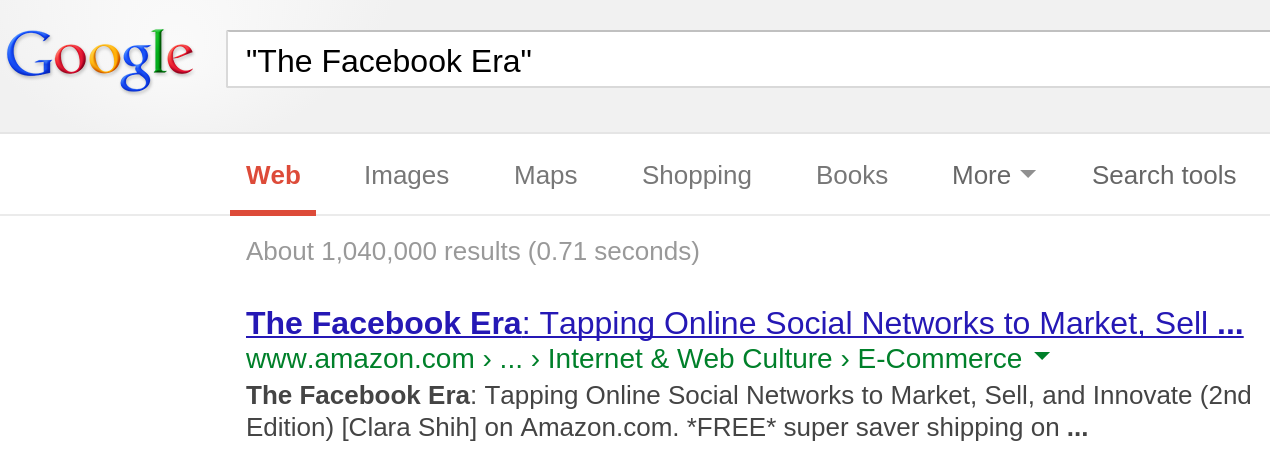

The Facebook Era: 1,040,000 Google results
Hey look! A book: The Facebook Era
Represents: Increased connections with social ties, and ease of discovering personal information.


The myspace Era: 59,500 Google results
Represents: Like Facebook, only earlier, more personal information online, simple creative sharing.
Is it over? Yes. Absolutely. This dude missed the whole thing.


The Blogging Era: 150,000 Google results
Represents: Ability for anyone to publish, in long form, at no cost.
Is it over? Getting there. In 2004, this guy claimed 2014 would finish it up.


The Android Era: 297,000 Google results
Represents: The entry and rapid adoption of Android as a smartphone OS. 
Is it over? No.


The YouTube Era: 210,000 Google results
Represents: The ability of anyone to publish video and have it be seen around the world. Also represents casual video consumption relative to professional 
Is it over? No.


The Dotcom Era: 1,490,000 Google results
Represents: Referred to as much as a bubble as an era these days, the first rush online by traditional services and businesses. Many did exceptionally well. Many more disappeared. 
Is it over? Yes. At least the first round.


The Microsoft Era: 423,000 Google results
Represents: The last few decades of a world where personal computing was dominated by Windows PCs and Microsoft software.
Is it over? Many people think so. In fact, a "Post-Microsoft Era" has been discussed.


The Steve Jobs Era: 67,900 Google results
Represents: Steve's personal impact on the world of technology, design, marketing and one of the most successful companies in Valley and tech history.
Is it over? Unfortunately, yes, as Steve passed away, but his impact lives on.


The Netflix Era: 41,600 Google results
Represents: On demand instant access to a wide variety of films and TV shows, and the business impact for those in more traditional markets. A disruption of Hollywood.
Is it over? No.

So what era are we in? If you went by total numbers, the Dotcom Era had the most Google results, but that's historical by nature. The Facebook Era is in second place, with Google properties, including YouTube and Android having nearly as many when combined. The iPad era is still strong, with Twitter putting on a good rising show, and Microsoft being high in the rankings, given its market penetration.

Other good options I either didn't run or tested but cut so this post isn't a mile long... "The Yahoo! Era", "The Amazon Era", "The Google Glass Era", and more... it's all fun. Can you think of others? What's the winner in your view?  

October 05, 2011

Steve Jobs: An Irreplaceable Icon

The world's outpouring of affection for Apple cofounder Steve Jobs is remarkable. In a time when scandal and tawdriness make headlines, and the foolish are revered, Steve represented something else - an intelligent, perfectionist approach to creativity, aimed at the greater good to constantly refine and bring value, through technology - and somehow won the hearts of the people. Amidst a world of awkward poor dressing techies, Steve exuded class and presented himself as being above the fray. His presentations were a masterpiece. His products were art. He took a world consumed with cutting margins and making it up in volume and made it emotional - a status symbol. He helped define a generation of computing and electronics in hardware and software, and became the man on a pedestal by whom all other CEOs and innovative tech leaders are measured - a tall task for the current crop and those to follow.

The last 4 or 5 years of uncertainty around Steve's health (and I feel like I know him so well that he should simply be referred to as Steve) were the unspeakable story - the deep hope that he could surprise us all - again - with "One more thing" and show that he had somehow beaten cancer and proven his immortality. All while fighting unspeakable challenges at home and in hospitals, he and his extended team churned out more and more products, hit after hit that built Apple into the highest-valued company in the world. Each keynote worried us that it would be his last. His very figure was dissected by cheap online tabloids trying to score a few million page views, and we rejected the opportunity to have this new shrunken image burned into our pupils, because we knew that despite his newfound frailties, Steve inside remained the lion we all knew.

For 15 or so years, Apple and Steve Jobs have once again been whole - practically synonymous. College students everywhere can't remember a time when Steve was not leading the company. But for those of us who suffered during the dark days of Apple, when the word "beleaguered" followed the company everywhere, and showing up with a Mac in a world that was going Windows was a conversation starter, knowing you were different.

It's not just that Steve did his job better than anybody else when he was on top. It was that he took a company in the middle of a very public suicide and turned it around, using the perfect mixture of humility when it was needed, and arrogance when it too was needed.

During the summer before my junior year in college, I remember my roommate, almost with a cat call, announcing that Gil Amelio, then CEO of Apple for a mere 500 days, had resigned. Yet another obvious example that Apple was doomed, and we would have to settle for something less than great for the rest of our computing days. Even I had almost given up. But this presumed bad news was the turning point that brought the original visionary who made the Mac what it was to the company that could make history again. Almost nobody saw it coming. Not even the geeky among us who said we would give up our Mac when you pried it from our cold dead fingers knew what was coming. Not even those of us who held our AAPL shares in the single digits and cheered when the company market cap passed $4 billion had any idea of what the next decade would bring. If we had, we would have put our life savings on it.

Why is the world reacting to the passing of Steve in the way that it has? Why has the President of the United States taken the time to remark on his passing just hours after Steve left us for what's next? Why did the leaders of practically every tech company on the planet express their heartfelt loss and appreciation for the man's accomplishments? Because Steve stood for something. He personalized the fight for the user so absent in a world of drab number-pushers unwilling to take chances. He personally stood for making change for humans that made products desirable. He was, to many, a hero - even to those who found themselves going against Apple in the market.

In the last few years, as we've all started to think about the inevitability of Steve's passing, as cancer doesn't give anybody any slack, writers have all had the chance to write their premature obituaries, to share their favorite stories of Steve - to tell their first experiences of the Mac or the iPhone or the iPad or anything else that made Apple have an impact on them. I now have three children who will grow up in a world without Steve Jobs, who will be forced to hear from me stories that make him sound like Thomas Edison and Henry Ford wrapped up into one. I have but the one blip of a memory of when I saw him at an early Apple Store in Palo Alto, when being his perfectionist self, he answered a support question I had. I am glad I saw a keynote of his at MacWorld in person a full decade ago. Even as some of my preferences changed in terms of my own computing and mobile choices, I never lost faith in Steve and his fight.

The world lost a vibrant 56 year old man. In a world where people regularly crest over 100 years old, and CEOs melt into their chairs into their 80s, Steve could not beat cancer. There were no karma points for being the best in the world for what he did and being an inspiration to all who saw him, knew of him, came into contact with him, and understood him. And this is just wrong. It is a major reason why underneath all the praise and wistfullness and sorrow, there is also anger, and frustration that a man who had already given so much, who had so much more to give, was taken from us too soon. This is unacceptable.

Tim Cook and the rest of the Apple team have an impossible task, to satisfy the millions of Apple fans and the tech world who has grown used to expecting the impossible from the company and seeing it exceeded. I have no doubts that Steve has trained his successor and management team well, that they know the right way to build products and make things beautiful and magical. But in a world of copycats, Steve remained without equal for decades, a cut above the rest. There will be no replacing Steve. Just an end to an era, and the start of a new landscape, where he moves into the history books instead of current events.

I do have a heavy heart tonight. I say it without melodrama, without a need for others to feel shared sorrow, but for reality. The whole world lost somebody special today, and we will never get him back.

August 25, 2011

The Time I Asked Steve Jobs an iPod Support Question

What would you do if you unexpectedly came face to face with Apple's world-famous CEO, Steve Jobs, who had been credited with launching or assisting with most of the major transformational events in personal computing over the last thirty years? Shake his hand? Tell him how much you love Macs? Ask to take a picture? If you're me, you try to play coy and ask if he could help you with a support question - because that's exactly what I did in my first run-in with the revered, yet reportedly mercurial Apple exec, who as you know, announced he was resigning his post as Apple CEO yesterday, moving up to the chairman of the board role.

Back in 2002, Apple was just getting started with the company's retail store initiative, and among the first stores to debut was the venue in Palo Alto on University Avenue. Living in Belmont, not too far north of the shop, I thought I would lazily take a Saturday afternoon and check out the newest Mac laptops. Like any good Mac fan, even if I wasn't exactly in the market to upgrade, I felt it my civic duty to check them out and get familiar. But when I entered the store and glanced past the display of white laptops, I spotted something much more interesting - as Steve Jobs himself was in the store, having a conversation with the store manager. From what I gathered, the pair were talking about contingency plans of what to do if the weather went bad - and how the worst thing you could do was have to shut down the store. The world has heard how Steve got involved in the little nuances of many of the company's products, so it's no surprise the retail store launch was much different.

As you can imagine, trying out new trackpads and screen resolutions on Macbooks immediately seemed less important. So I positioned myself with my back to Steve and fussed around with the closest computer's dock, clicking aimlessly while I wondered if I would get a chance to talk to Steve myself. After a few minutes, the manager parted, to the back of the store, and I turned around to talk to Steve. Not wanting to be a complete fanboy and putting him at unease, I coyly asked if he was a "Certified iPod genius"... a play on the store's Mac geniuses. Looking at me somewhat amused, knowing that I knew who he was, no doubt, he said, "As a matter of fact, I am."

I then told him how I had been one of the first to purchased the company's initial white 5 GB iPod MP3 players, and that no matter how much charging I did of the device, battery life was atrocious and had gotten to the point I was considering taking it back or getting it repaired. I asked what I should do. He said that the issue was a "known bug" and that a fix was going to be rolled out shortly. Having recently seen an iPod update that was recently recalled, I asked him if that was the one he meant, which had been "rolled back". He said yes. In the meantime, he told me that I should leave my iPod unplugged overnight until it ran down to zero, and then charge it up, and all would be well.

By this time, the store's manager had returned, and was standing nervously next to Steve. It seemed he was concerned Steve had been exposed to the common visitor and clearly couldn't wait to step in and continue their conversation. So I told Steve thanks, adding, "thanks for all you do", a knowing nod to his history without gushing about it, and I left the store. After meeting Steve, no laptop or box software could have been more fulfilling.

Steve Jobs' news yesterday is being read as the latest bad news in a series of bad news stemming from his much-discussed health issues over the last few years. His job change is by no means an obituary, but many are seeing it as the end of an era - the PC industry's elder statesman and one of the world's top visionaries and creative minds stepping further into the shadows. I once wrote that I wished Steve Jobs were immortal and that I would teach my children about Steve Jobs as they grew up. For what we have seen as users is a hero and a real legend in our lifetime who changed the world, something we can all hope to do in a very much smaller way. But the man is still with us and I hope this isn't the last we see of Steve Jobs, the legend who was humble enough to expose a smile and answer some 24 year old's iPod support question on a rainy day in Palo Alto.

Good luck, Apple, and thanks, Steve.

April 23, 2011

With iApps Surging, Apple Seemingly Abandons Web Apps

Considering the dramatic success of Apple's App Store for iPhone, iPod Touch and iPad, it seems remarkable that at the 2007 introduction of iPhone, the device was not set up for third party native applications, with Steve Jobs and crew suggesting standards-based Web apps were the way for developers to design for the device. A June 2007 press release gushed over secure and reliable apps designed on Web 2.0 Internet standards, but by July of 2008, the App Store launched as part of iTunes, and hundreds of thousands of apps have found their way to iDevices. Meanwhile, the Web Apps directory on the Apple Web site has atrophied, not having updated in nearly five months - while competitors such as Google push for Web app development inside Chrome.

The Web Apps directory on Apple.com looks much like the iTunes App store, Mac App Store or other application directory, including the Android Market, with "Most Recent", "Most Popular", "Alphabetical" and "Staff Picks" across many different categories, including "Games", "News", "Social Networking" and others. But if you look at the most recent content, you don't see anything new since December 3rd 2010, and Puck Billiards, posted on November 30th, has enjoyed the exclusive Staff Picks position for the entirety of the duration.

Puck Billiards Has Been Featured Since 11/30/10.

Prior to the directory's freeze, staff picks for Web apps were issued every few days. The staff picks page shows other highlighted apps posted November 18th, 29th, 30th, December 2nd and 3rd and then nothing. No mention of a change in status for the directory, or future plans. If you are a developer looking to submit a Web App, you can still do so, or provide feedback to the directory, but it's not completely clear anybody's listening.

Apple's Web Apps Page from a Previous Era Is Still Live

In contrast to the hundreds of thousands of apps on the App Store, Apple's Web Apps splash page mentions "over 1700 web apps to flick and scroll through", but this page too is clearly in the dustbin of history. The 1,700 number was live as of January 2009 (according to Archive.org), made even more antiquated with no mention of the iPad, referring only to iPhone and iPod touch.

iOS has been an incredible platform, an extremely lucrative one for Apple and its developer community. But the silence on Web apps makes it look as if they just walked away. The right thing to do would be to close submissions, shut down the page, and put up a note saying the directory won't be updated.

February 21, 2011

Yobongo: The Open Chat Room In Your Pocket (Preview)

In the four months since Yobongo first gained attention, CEO and co-founder Caleb Elston has been working to prepare his product for the visibility and scale potentially demanded by what's potentially the world's biggest tech event, SXSW, an environment which can catapult new sites into the stratosphere, or should they fall flat, have them forced to regroup. The service, currently in private beta on the iOS platform, has seen increasing activity at practically all hours, the equivalent of an open bar for discussion with members of the local community, which never closes.

In the last few weeks, I've finally found a reason to keep my iPod Touch nearby, in a home full of Android devices. The magnet-like pull is from Yobongo, whose goal is to bring people, potentially perfect strangers, who share a geographic location, together to talk about anything. The application's real-time nature, enabling true conversations between friends and others, goes beyond the world of serve and volley status updates or Q&A, putting the focus back onto the world of conversation instead of performance and counting of replies, retweets and likes. In fact, there are no points of feedback for updates - just a constant flow.


Yobongo in Action. Note notifiers for private messages, number of people chatting.


The concept hasn't changed since October, with the idea being people in shared spaces may discover they have common interests and can engage in intriguing discussions. For the many of us who routinely bump into the same faces and avatars on every network, this could be refreshing. Yes, just like any other social situation, it's easier to talk to those you know than those you don't, but Yobongo eases that process by mixing everyone in a single space.

So each morning, after turning off the iPod's alarm, I peek at Yobongo to find Caleb talking with users in the private beta. Some folks I know, and others I don't, but I am getting to know. And it's incredibly easy to jump into the stream of consciousness. For one, your avatar displays when you open the app, so they can welcome you. Second, the app doesn't start with a blank screen, but shows all the text flowing through the river - with the newest updates below. Should you want to, you can scroll up and see how the conversation evolved, see updates from people whom you may have missed, and get caught up.

Posting to the site couldn't be easier. There are no groups to join, as with other apps, some I like a lot (including Beluga and TextPlus). There are no demands to friend folks, as you're already connected to everyone live. And once you start typing, everybody knows because the system lightly says "... is typing." If more than one person is typing, the system updates there too. So you immediately, even in a small space like the iPod Touch, get an idea for all the participants, the ongoing messages, you can get updated on private conversations and see the thread as it evolves. Not bad.


An active Yobongo chat and a separate private message.


Caleb, previously highlighted on this site for his work with Toluu, Kallow and Kickpost, started the project with fellow Justin.TV ex-colleague David Kasper, who is responsible for engineering while Caleb handles product, the "yin and yang" of the operation as it stands now, he told me. While the company has been mentioned in the same breath as big group chat monoliths like GroupMe and others who have raised millions, Yobongo has not yet taken any funding. Lucky for them, they do have free residence at Dogpatch Labs, courtesy of Mike Hirschland and Ryan Spoon of Polaris Ventures, who would probably have the first in to a round A if Yobongo wanted to be YoFunded.

Like Quora, Facebook and other sites, Yobongo holds a few rules to help avoid abuse of the system. It's preferred that guests use real photos and use their real names. The app's short community guidelines ask to "be friendly", "be respectful" and "be authentic".

Does the world need yet another place to chat beyond the big social networks, and new places like Convore or the host of group messaging participants, including Beluga, GroupMe, MessageParty and TextPlus? It seems to me there is room for a lightweight system that doesn't feel like work, that is open to all who arrive, and leverages proximity. Whether Yobongo is the solution to an event like SXSW or not, only reaching those on iOS, remains to be seen, but I can see clear value to talking with both the friends you know, and the friends you don't yet know.

You can get in on Yobongo's private beta list by heading to http://www.yobongo.com. The service's first official intro video is below.

November 25, 2010

iPad Tablet Competition Reacting Fast, Expanding Market


When Apple introduced the iPod, there were already a number of hard disk MP3 players out there. It wasn't clear to everyone that the move into this market was a good one for the company, and its initial sales didn't hint at the juggernaut it would later become. This was due in part to its Mac-only start, as well as its need for Firewire, but also due to needing to publicly define a market, improving upon the established competition and convincing the public that this product was a must have. Over time, the public got it in a big way, and the iPod became a cultural icon, selling nearly 300 million units. Later competition to the iPod from Dell, Microsoft and others was clunky, and sales were comparatively pathetic.

iPod Sales Growth by Year (Wikipedia)

When Apple introduced the iPad earlier this year, they were not the first tablet PC provider, but they set the standard again - helping to transition the market from a geeky niche to a consumer product millions are lusting over, just as they had done with the iPod. This time, however, it seems the competition is faster to respond, and with better quality peers - backed by able competitors, starting with the expanding variety of Android tablets including the Samsung Galaxy Tab and MotoPad, to BlackBerry's PlayBook, which are taking the iPad's queues in terms of appearance and functionality, and getting out there not years after the iPad, but only a few quarters.
The BlackBerry PlayBook

Regardless of your personal preference for Android or the iOS, it seems apparent that Apple will have a battle on its hands that is better coordinated, and on more fronts, than it did with the iPod. They don't have two years to slowly define the market and get the product right.

On Monday, it was announced that Samsung's Galaxy Tab had sold 600,000 units globally in the first month it was available. This contrasted with the iPad selling more than a million units in the same time period. Knee-jerk horse race focused reactions, like this one from VentureBeat said things like "So just a month in, the first model in a new series of Android-based tablet computers is already losing to Apple’s market-defining iPad."

It's a good thing markets aren't made in thirty days and that brands know better to ignore bloggers when it makes sense. If markets were made in thirty days, Apple should have walked away from the first generation iPod. And it's also a good thing this isn't a zero-sum game. There are going to be a lot of people who have room for Android tablets who didn't have room for iPads, and there are going to be others, like my house, no doubt, that will have both.

Apple CEO Steve Jobs roundly mocked the first Android tablet entrants to the market, saying their 7 inch screens would do them in, contrasted with the iPad's nearly 10 inches. But his comments smack more of preemptive market protection, as Apple no doubt plans to offer a family of iPads, as they have laptops and iPods for the last decade. As someone who has the Barnes and Noble NOOKColor, which has an Android foundation and one of those smaller screens, it's clear to me there is room for both. The NOOKColor review is for a later time, but there is absolutely a space for a tablet that can be held one-handed, and with the variety of Android manufacturers that are out there, there will no doubt be a variety of designs consumers can choose from - not a one size fits all strategy.

Apple is on quite a roll. There is no debate, really, with the stock at all-time highs and the company expanding its corporate offices in Cupertino, purchasing land from HP, and their product line is fantastic. But they cannot rest easy. The market is being defined, and a single month's sales are just that - a single month's worth of data.

November 04, 2010

Sonos' Wireless Dock for iDevices: Simple and Sweet

The last year has forever changed the way I consume and enjoy music. The addition of Spotify to my life (and soon the rest of you in the US) made iTunes a vestigal program good only for synching iPad apps. The addition of Sonos leveraged the power of the Web to tap untold number of electronic music streams from around the world, wirelessly throughout the house. That's why I followed my initial test unit with the purchase of two more, and why my YouTube account is full of videos of my kids rocking out to great sound. Today, a small companion piece, a wireless dock for both iPod and iPhone, arrived in my home, and it makes getting music trapped on all those iDevices incredibly simple to get onto my Sonos. It's simple, small, and sounds great.

Thanks to an address mixup, my review wireless dock unit reached me today, a week or so after the true gadget blogs got their hands on the device. But that didn't make the experience any worse for the wear. After opening the envelope marked "Urgent", the device was streaming music from my iPod Touch to my Sonos players in five minutes or less.

The Sonos S5 systems I have in my home are notable for two primary things - there is no digital display, making the device appear as one big speaker, and also, no way to push physical media. No CD slot. No tape deck. No iPod Dock. The Wireless Dock for iPhone and iPod fills that gap, for the many Apple geeks who want to get music from their iTunes to the best speakers in the house.

Adding the Wireless Dock to Sonos, With AutoPlay in the Office

Setting up the device was truly simple. I plugged it in, added the component to my network using Sonos' desktop software, and it saw my iPod as a music source. Now, I can stream the content from this device (or any friends' devices they bring with them) just by plugging it in and selecting it from Sonos. There's still something magical about clicking pause or play on the computer and having it stop a device wirelessly, but Sonos gets it done. I can even control my iPod Touch with my Android phone using the Andronos software on the Android Market.


My Docked iPod Can Stream to My Sonos Speakers

The retail price for the wireless dock is $119, so it's not the cheapest peripheral ever, but it's a solid add-on for existing Sonos equipment owners, and the device is polished enough to have been made by Apple itself. To be honest, Sonos' hardware is some of the best designed gadgetry in the business, beautiful enough to sit in every major room in my house. That they also have access to all my best sound makes music to my ears.

Disclosure: I received the wireless dock from Sonos for free. I received my initial Sonos S5 unit free of cost as well, and have since purchased multiple devices. In theory, I should tell you I also have free access to Spotify Pro as well, but I'd pay for that too if given the chance. :)

October 01, 2010

New Apple TV Extends Fragmentation, Cupertino Style

For all the noise around fragmentation in the world of Android, one would think the state of affairs on the other side of the technology aisle would be perfectly unified - with one operating system, one user environment, and one experience where all things play nice. But while it's not as often discussed, my plethora of Apple devices is increasingly fragmented. The newest culprit? The brand new Apple TV, which has an incredible form factor, and some surprises in terms of what's simply not there - making me have to remember what media plays on what devices, and what devices are capable of doing what.

Despite my switch to Android on the phone, I still have plenty of Apple products in my house - from my wife and my laptops, our iPads (shared with the twins), a first generation Apple TV and second generation Apple TV and the newest iPod Touch.

After getting the new Apple TV, and attaching an entirely too expensive HDMI cable (not included) from Radio Shack, I set up the device and browsed to available TV shows to rent or buy.

The first search I made was for "Dexter", the Showtime drama I've become addicted to in the last month or so. Having already pulled down seasons one through three on my Mac, I wanted to pull down season four on the Apple TV. No dice. No results found.

Browsing the available TV networks quickly displayed why this was the case. Apple TV only offers selections from Fox, ABC, BBC and Disney. With Fox being the lowest in the alphabet, I thought it was a bug, but it wasn't that I missed Showtime outright, it just flat-out doesn't exist. CNET highlights how only 3 of the top 25 shows are available, but there's just something odd about knowing content is in the iTunes store (like Dexter) but my new Apple TV can't get to it, while the old first gen one (downstairs) can.

The capability gap between different devices from Apple is already clearly felt within iTunes. The iPad has started a cottage industry of high quality application development for the larger screened devices, which is great, but the backwards compatibility is practically invisible. In fact, if you have iPhone and iPad, you might find yourself buying an application twice, on the same account, for each device, with no discount. With the promise of applications being developed for the new Apple TV, you can see the potential for yet another purchase looming on the horizon.

While Android is clearly struggling with the challenge of bringing 2.2 support to all the latest handsets (and making progress), we see Apple TV running a variant of iOS (mixed with the traditional Apple TV OS), different than that of the iPhone/iPod Touch, with iPads still not having iOS 4, and yes, Macs still being Macs. I don't think it's too crazy, for a company focused on the Open Web (courtesy Daring Fireball) to find a way to tap into the Internet in a very real way and unify access to media and applications.

For now, until this is solved, it seems we need to expect the new Apple TV to have a different set of titles from iTunes than its older cousin, and the iPod Touch or iPhone to have a different set of applications than the iPad or Mac OS. This is real fragmentation, and it's a drag.

March 29, 2009

iPhones Can Protect Your Warcraft Account, and Someday Much More

By Daniel J. Pritchett of Sharing at Work (FriendFeed/Twitter)

Two recent iPhone stories highlight some interesting potential for Apple's iPhone and iPod family.  First up is WoW Insider's announcement of a free iPhone Authenticator available in the app store for securing World of Warcraft accounts.  A Battle.net user is typically a World of Warcraft player but the accounts can be tied to any Blizzard game you might own, including their future releases.

As shown in the screen shot on the left, the Authenticator program generates a new string of numbers once every minute or so.  Once a player links the authenticator to an account, these numbers must be supplied along with a user name and password at each login — a two-factor authentication challenge.  This iPhone app is an alternative to the existing solution where gamers can pay Blizzard $7 for a key fob that generates a similar passkey every time its button is pushed.

World of Warcraft characters and items are regularly hijacked via targeted trojans and keyloggers.  They can be stripped bare in a matter of minutes, their contents flipped quickly for tens or even hundreds of dollars on WoW's thriving grey market.  Given the time and effort involved in securing an account rollback from Blizzard customer service, many players will opt for the peace of mind granted them by this new application.

The next iPhone may read fingerprints and retinas

The second tidbit comes from Apple Insider (via Engadget): An Apple patent filling hints at fingerprint and retina scanning potential in future iPhones. Apple is researching the potential for embedding biometric scanning devices (cameras, etc.) behind the touch screen of an iPhone.  Such enhanced iPhones would allow for secure identification in order to unlock the phone itself.  These enhancements would also allow the iPhone to serve as an easily obtainable high-powered authenticator for other systems such as Blizzard's Battle.net.  While we might only imagine such tools as being necessary for sensitive operations like banking or remote logins to corporate intranets, the Blizzard app demonstrates that it can be cost effective to secure our less critical digital holdings.

The Blizzard authenticator is a great example of high-powered security applications that the iPhone family can provide right now, and the recent patent filing by Apple gives us insight into other uses for tomorrow's iPhone.  We'll certainly have the mobile available as an ever-more-secure authentication tool, but we'll also be able to use it as a remote sensor for home and office medical purposes such as the recently promised glucose monitor or a biometrically secured retail barcode scanner.  There are undoubtedly more possibilities than I can come up with on my own, and I look forward to seeing some of them becoming reality in the near future.  If you've got a great example of alternate uses for mobile phones, please share it in a comment!

Read more by Daniel J. Pritchett at Sharing at Work

January 05, 2009

DRM = Doesn't Really Matter

If one of the biggest items to be delivered at tomorrow's MacWorld Expo is the elimination of DRM from songs on the iTunes store, as is rumored, then we are on the brink of the biggest snoozefests in technology event history. Forget that Mr. Steve Jobs potentially is suffering hot flashes, and is instead being replaced by Cupertino's wild-haired Pillsbury Doughboy, Phil Schiller. This Macworld has got to be the lowest-anticipated in terms of new product debuts that I can ever remember. And when it comes down to it, despite all the online horror and tongue-lashings, I'd venture a bet that the supposed evils of DRM that Apple has wrought on its users haven't really effected but a small percentage. I don't love DRM, but I live with DRM, and it doesn't really matter.

When Apple introduced iTunes and marketed it with the "Rip. Mix. Burn." campaign several years ago, music labels were furious, thinking the Mac-maker was embracing piracy, a second back to back blow to the maligned monopolists following Napster's runaway success. When Apple introduced the iPod in 2001, and later the iTunes Store in 2003, it had to bend over backwards to gain the cooperation of the labels, restricting who could play what songs when on what computers or iPods, and how many times they could burn playlists to CDs, all in the name of preserving profits.

Over time, some of the DRM rules were relaxed, and the advent of iTunes Plus meant you could some songs from iTunes without rights management, for an additional fee of 30 cents a song. The additional 30 cents, in theory, meant you could do whatever you wanted with the file, just like you can with any hard copy you own, be it cassettes, CDs, etc.

Although I've been an iPod user practically since the first day they were announced, and followed the Apple upgrade path through to my current 16 GB iPhone, and I now own almost 6,000 songs on iTunes, a significant percentage of which were purchased from the iTunes Store, I almost never encounter any issues with DRM. I've upgraded my laptop a few times, moving my data from one computer to the next and authorizing the new machine. I've synchronized new iPods and the iPhone and always been able to play them. My music plays on my Apple TV, and can be streamed from my wife's computer on our same network.

That my music is slathered over with Apple's proprietary DRM is not a big deal, period. I would practically have to go out of my way to find a way that having "suffered" through DRM for the better part of eight years with Apple has negatively affected my music experience. I do know that I certainly am better off than those who chose subscriptions with music companies that have disappeared and gone out of business. I'm better off with my digital music here than in stacks of CDs around the house. In fact, I gave all my CDs away to a co-worker when the babies were born as part of cleaning house!

For eight years, I've wondered if the fact I didn't care about DRM was because I am a hopeless Apple fanboy. Maybe I've fallen under the spell of believing Apple should make the rules for how I use what is ostensibly my music and media. But seriously, the drama of DRM and its limits has been so overhyped I don't even know where to start. If you want to buy your music somewhere else, go for it. There are alternatives. But there's a reason iTunes, iPod and iPhone have been such a success. It's because of what they let you do, not what they don't let you do. It's the best combo on the market, and I don't care one bit about the DRM wars which just might be coming to an end as we know it tomorrow. I never have.

October 07, 2008

i.TV Application Added to Apple's iTunes Store

Three weeks ago, we showed you images from an early access build of i.TV, a new application for the iPhone and iPod Touch that lets you get the latest TV and movie schedules from your area, rate shows, and leave reviews. The application, which is free, was added to the Apple iTunes application store late last night, and is available to the public immediately.

At launch, i.TV bills itself as the "ultimate" movies and TV guide for Apple's portable devices, offering more than 144,000 TV and movie listings, data from 5,000 local theaters, and nearly 6,000 TV previews or movie trailers. It currently works in the United States and Canada, so those outside North America will need to wait.


i.TV Pulled Down My Channel Data in Seconds to the iPhone

As has been said by many, no application is complete without some social element these days, and i.TV, as you recall, is no different. You can engage with other viewers of shows you like by sharing reviews, and you can recommend shows to friends by e-mail. In fact, some of the elements of this app shadow the recommendations I gave TiVo in June. (See: TiVo Is a Zero On the Social Web. It's Time They Fast Forward.)


You Can Get Show Data and Theater Info on i.TV

I downloaded the new application from the iTunes Store tonight, and the speed is remarkably faster than the first alpha I tried last month. It automatically recognized my location, and based on that zip code, I was pulling down channel listings in seconds. Given its price (free), there's really no reason not to have this app if you already have an iPhone or an iPod Touch. You can find it here: Apple iTunes Store: i.TV.

September 10, 2008

The Real Genius in iTunes 8? Apple Will Make More Money.

At times, it seems like the mainstream press hasn't yet figured out how to preview Apple events. That Apple periodically updates its iPods or iPhones or computers and software is really no surprise. The home runs are typically saved for MacWorld San Francisco, with big announcements sprinkled in at the company's WorldWide Developers' Conference (WWDC) and the occasional one-off event. But even when the company makes largely expected announcements, some go into severe hype in advance, and severe lows following. And like the illegal drug users who share the same spike and eventual crash, they're usually left looking for more. But behind the acid trip rainbow iPod Nanos and and upgraded iPod Touch, there was an element of real genius - as iTunes was upgraded with a new tool making it even easier to spend even more money on the popular online music store.


An iTunes Genius playlist, based on ATB's "Do You Love Me"


One of the major new features of iTunes 8 is called "Genius", which will leverage your own iTunes listening history, as well as that of other iTunes users, and try to create a playlist of songs similar to that which you are listening to. Like "Party Shuffle", it will get some mixes right, and some wrong, but it's following along the path of Pandora and Last.fm to use a crowd's information to provide recommendations and guess what other songs or artists you would like.

(See also: ReadWriteWeb: iTunes 8: The Genius in the Box and Mark Evans: Is Apple’s Genius Good or Evil?)

The breakthrough for Genius isn't so much that you can rediscover old music that you've neglected, although for some that is no doubt true. The real value is in the Genius sidebar, which is plastered with "Buy" buttons linking to the iTunes Music Store. In a time when so many Web services are hoping ad clicks will provide them with a way to the promised land, the simplicity of how Apple rolls out new services that enable a larger revenue stream is impressive.

For me, Apple iTunes long ago became my default source for new music. Even if I found a song on the radio or through Last.fm or another source, the first step is to head to iTunes to get it and download it. If iTunes doesn't have the song or album, it might as well no longer exist. I won't be heading to another service to find the song, but I may buy something else instead. That Apple has now made a mainline to my credit card every single time I fire up iTunes is a great way for me to continue making regular donations to my favorite for-profit Cupertino-based charity.

Of course, given I already have 4,342 songs totaling 18.3 days worth of music which hasn't been listened to in the last six months, according to my "Neglected" playlist, maybe I should be satisfied with what I have. Now that would be true genius.

i.TV Launching iPhone App for Local Movie, TV Listings

Apple Computer's Steve Jobs famously said, in 2004, that he felt "you watch television to turn your brain off" and use the computer "to turn your brain on". In the ensuing years, however, Apple has marched directly into your living room, with the Apple TV, and the company's digital devices are making the partnership between your computing side and your television-watching side better and stronger. A new iPhone application from i.TV debuts today, letting iPhone and iPod Touch users tap into the Web, and pull down local movie and TV listings, search by name, and see user-submitted reviews.

And interestingly, the application, though in its infancy, teases with options about scheduling shows for recording on your DVR, or even renting and buying selected media.


Click Images for Larger Size


Once you have downloaded the i.TV application to your iPhone or iPod Touch, its first query is to ask you your zipcode. Entering your zipcode references available TV service options for your area. When you've selected a TV service, such as Comcast, i.TV will take a few minutes to pull down your full channel listings and TV schedule.

From this point, you can browse channels by time, starting with the current time, and go forward and backward in time. Using Apple's touchscreen technology, you can select any TV show to see more detail, rate it from one to five stars, give a thumbs up, or see user reviews.


Click Images for Larger Size


You can also use i.TV's database to search TV listings. As you can see in the screenshots, I did quick searches for "Conan", looking for Conan O'Brien, and the term "Law &", to see how many Law & Order derivatives I could find. Obviously, quite a few.


Click Images for Larger Size


i.TV, which has offices in both Palo Alto and Park City, Utah, also offers the same level of detail for theater listings. Using the same zip code information I previously entered, I could browse local movie theaters, see which films were playing, and get a quick synopsis of the movie.


Click Images for Larger Size


But gathering data from i.TV is not a one-way passive operation. i.TV's developers promise the ability to send alerts to friends, write reviews and respond to reviews by other i.TV users, making a microcommunity around television and theater entertainment consumers who own iPhones or the iPod Touch. The i.TV application, added to the Apple iTunes Store today, can be found on their App Store, here: http://www.apple.com/iphone/appstore. The company's Web site is here: www.i.tv.