Showing posts with label Spotify. Show all posts

June 29, 2014

50 Top Startups from 2010: Acquired, Pivoted or Still Going?

Editor's Note:

This is one of the longest posts I've made - in length and duration. It's said that one year in the life of a startup is the equivalent of dog years when compared to more established companies. So looking back to a post I made just over four years ago is the equivalent of a generation of startups, and a quick glance at each shows what you'd expect from a generation of change - with some names graduating to the big time, others running in place, and yet a good chunk who've disappeared altogether.
My goal with this June 2010 post was not to highlight the top private companies, as I withheld inclusion of many of the bigger companies, like Facebook and Twitter and Tesla. Instead, it was to show 50 I was following that had promise, leveraging a tool from Symbaloo. I highlighted 50 top startups on the Web. I was reminded of this effort when, at the conclusion of my kids' kindergarten year, many teachers featured computers with Symbaloo organizing their Web.

So let's go back to the list of fifty, and see what's happened. How many are on the verge of hitting the big time, how many are out of business, and how many got acquired?
Walking Down Fifty Top Startups of 2010

#1: Foursquare Status: Independent
At the time of the post, there was no buzzier company than Foursquare. It was the undisputed leader of the checkin. It beat back competition from Facebook Places, and its places database became the backend of even more third party apps. But its Swarm app has seemed to fall flat among users, and nobody's quite sure where the company's headed.

#2: Spotify Status: Independent
At the time of my post, Spotify hadn't even made it to the US. Now it has 1,000+ employees and is the clear market leader in streaming music, with Apple's Beats and others chasing. The company is looking to finish the music business revolution started by Napster more than a decade ago, and remains one of my favorites.

#3: Automattic Status: Independent
Automattic, the company behind WordPress, isn't going anywhere. They've got about 250 employees, and have been acquiring small services like Intense Debate, instead of getting gobbled themselves. They haven't had a big exit like Tumblr, or become a small part of a big company, like Blogger at Google, but they're a lead option for publishing, from blogs to full-featured sites.

#4: Posterous Status: Acquired by Twitter
Posterous was acquired by Twitter in 2012, and while they initially promised their Spaces service for private blogging would remain live, it was quickly killed, becoming yet another acquihire. They'd raised $10 million overall.

#5: Blippy Status: Pivoted beyond recognition
The Blippy I liked didn't turn out how I had hoped. Its initial privacy bump with credit cards being revealed online came at an inconvenient time, right as they raised funding and were poised to come out of the gate strong. That, combined, with an audience skeptical of their focus on oversharing, meant they had to do the dreaded pivot. Phil Kaplan, cofounder of Blippy, left with momentum flagging. Now they're an app for animated GIFs.

#6: SlideShare Status: Acquired by LinkedIn
In 2012, Slideshare was acquired by LinkedIn for a rumored $119 million. That'd probably be around $300 million in today's inflated market.

#7: Tumblr Status: Acquired by Yahoo.
Following incredible traffic growth, Tumblr became the biggest acquisition made by Yahoo CEO Marissa Meyer, who has a tough task to transform a Web pioneer. The $1.1 billion deal in May of 2013 was huge in many ways.

#8 TweetDeck Status: Acquired by Twitter.
The social networking client (which debuted here in 2008) was won by Twitter in a bid above $40 million, after a rumored buy from Ubermedia. TweetDeck founder Iain Dodsworth has since left Twitter, and is working in stealth on Gathers.

#9: Square Status: Independent
The company, headed by Jack Dorsey, cofounder of Twitter, made a stake for itself in an incredibly challenging market, and you can see their payment readers in small businesses or cabs. You could argue they got too big too fast, or margins are tight, but they've neither crashed nor graduated since the first report.

#10: Quora Status: Independent
Quora is an odd duck. They were a Web darling at the end of 2010, founded by early Facebookers, and attracting engagement from a who's who of Silicon Valley. With one founder jetissoned, and the company now being a fifth wheel at Y Combinator, it's not sure whether they're the next Wikipedia or Yahoo! Answers. Nobody really questions the quality of the discussions, but everything else is questioned.

#11: CinchCast Status: Pivoted beyond recognition
The audio Web publishing service I really liked, and used regularly, is vaporized, as was my published content. The shadows of that plan show a site focused on cloud-based conference calls and Web seminars. Meh.

#12: Sports Blog Nation Status: Independent
If you don't remember the name Sports Blog Nation, I'll bet you've seen their content. This one time sports publishing empire expanded to what's now Vox Media, taking on smart writing for tech and much more. I've been lucky enough to see this happen in front of us over the last decade, and consider the founder of SB Nation, Tyler Bleszinski, a fellow A's fan, a good friend. If there are any questions about Vox Media, it's whether the content business can be valued in a world where it's so easy to make it for free.

#13: Bit.ly Status: Independent.
Once Twitter switched to its own t.co URL shortener, bit.ly's perceived value for short link and analytics dropped dramatically. The company refocused on performance tracking and engagement, and is still plugging away, even if you don't hear about them daily, as you used to.

#14: my6sense Status: Independent.
Months after my initial post, I expanded my time helping my6sense from consulting to something closer to full time as VP of Marketing. We launched a lot of cool tools, but there wasn't a big enough market (or funding) to make that dream a reality. So I left to Google, and the team refocused on mobile advertising. Founder Barak Hachamov is now working on Samba.me, a reactive video messaging play.

#15: Thing Labs Status: Acquired by AOL.
Thing Labs, and the Brizzly team, were acquired by AOL after getting an offer in July of 2010, which I had incorrectly hypothesized was from Foursquare. Soon after, Brizzly was shut down, and the team splintered inside of AOL, to take up roost at Avocado, Dropbox and other places.

#16: Plancast Status: Pivoted beyond recognition
Plancast was given a funeral and the post-mortem was written in early 2012. The social events sharing company just didn't take off. The site still exists, focused on planning and event management.

#17: Seesmic Status: Acquired by Hootsuite.
After a bazillion pivots, and clear buddying up with Salesforce and Microsoft, the remnants of Seesmic were sold to Hootsuite in 2012. Founder Loic LeMeur seems to have retrenched into his annual conference, LeWeb.

#18: Lunch.com Status: Independent.
Lunch.com, a community around relevant news and opinion, has been very quiet - but seems to have its diehard users, as many of these sites get. I'd bet it doesn't cost much to run, so there's no urgency to shut it down, but it's hard to predict a rebound.

#19: Gowalla Status: Acquired by Facebook.
After years of chasing Foursquare's fumes, Gowalla's team waved the white flag, and was acquired by Facebook in December 2011.

#20: DropBox Status: Independent.
DropBox is a consumer cloud giant, and has managed a significant position, even when faced with industry competition from practically all the big names: Google, Microsoft, Apple, Salesforce to name a few. The world awaits what will happen once DropBox goes public.

#21: Lazyfeed Status: Dead
The lead developer made many intesting apps, including a Twitter and RSS mashup LazyScope, and Joint.im, but users haven't always followed. So Lazyfeed is gone.

#22: Hunch Status: Acquired by eBay.
The consumer-focused personalization company pivoted to providing services for businesses, and looks like a good fit for the online auction giant.

#23: Ecademy Status: Acquired by Sunzu
Ecademy was acquired by Sunzu in July of 2012, and the open business networking community's content was later vaporized. Most the original Ecademy team is now working on social media tactics with Scredible.

#24: Xobni Status: Acquired by Yahoo!
Initially rumored to join Microsoft in 2008, the address book apps and plugins group was acquired by Yahoo! as part of Marissa Mayer's buying binge in the summer of 2013.

#25: Tweetmeme Status: Dead.
Nik Halstead's smart consumer facing link site that pulled content from Twitter was sunset in 2012 in favor of analytics and more professional work, a move that made sense when Twitter reduced opportunities for consumer-facing developers.

#26: Feedly Status: Independent.
Even if Google Reader is dead (a moment of silence, please), RSS isn't. Feedly was among the most obvious to benefit from the feed reader giant's closure. Nobody really asks how Feedly makes money or what its future plans are… just that it keep working and doing well. It does. As they debuted here, I'm always happy to hear good news from team Feedly.

#27: Klout Status: Acquired by Lithium Technologies
I despise the idea of Klout. Independent arbiters giving you a score is distasteful. But that didn't stop the company from being famous (or infamous) and at least one other company deciding that their stockpile of data and faux reputation was worth paying for. So that happened. Congrats to the team.

#28: Justin.tv Status: Independent
Justin.TV is still around, while most of the team(including Justin himself) now is working on Twitch.tv, a games streaming platform. Justin.TV recently told customers that videos will no longer be archived, since nobody was watching anyway. I have to assume most people at this point are watching YouTube.

#29: Amplify Status: Dead
The Amplify we once knew, which encouraged you to build and share something between a tweet and a blog post, is gone - shutting down in February of 2012. Ironically, they pointed users to web clipping service Clipboard, which itself was shut down after being acquired by Salesforce.com a year or so later.

#30: OneRiot Status: Acquired by Walmart Labs
After pivoting from the unfriendly world of real time search to the world of ad networks, OneRiot was picked up by the active, if not lofty, palace of Walmart Labs in September 2011.

#31: Lijit Status: Acquired by Federated Media
Lijit has had its share of bumps over the last four years. The company was picked up by Federated Media in October 2011, and in early 2014, spun out when Federated Media sold off its content business in the beginning of this year. Now, Lijit claims they're back, under a new name. Lost? Me too.

#32: Echo Status: Independent
Echo may first have been known as a comments competitor to Disqus and others, and was among the first to capture reactions from the real-time stream. They successfully moved to aid enterprise companies with adding social platforms and engagement with their platform. They're quietly executing - even if an endgame isn't obvious.

#33: MyLikes Status: Independent
MyLikes bills itself as the largest content and advertising platform in the world and has a top-notch board. The social advertising platform raised just under $6 million in 2010, and isn't noisy about trumpeting its success. Side note: Robert Scoble and I were introduced as advisors in early 2010 when they raised seed funding, but things are quiet on that front.

#34: Outbrain Status: Independent
Outbrain, like it or hate it, is most well know for its “more like this” or “you might also like this” type of content ads spread across the web. Their goal is more engagement on content, and they do a great job at it. They've raised nearly $100 million, with the last round being in 2013.

#35: DailyBooth Status: Acquired by AirBnB
In a “you didn't see that coming” deal, the photo sharing site team behind DailyBooth ended up as an acquihire for dodgy rental service AirBnB in the summer of 2012. Meanwhile, DailyBooth is dead.

#36: Gist Status: Acquired by Blackberry (RIM)
Gist, the one-time contacts manager, was acquired by Blackberry in early 2011. A little more than a year later, news came that Blackberry would shut down the original site. Oh well.

#37: Soluto Status: Acquired by Asurion
The cloud service for remotely managing devices was acquired for more than $100 million by insurer Asurion in late 2013. Maybe not an exciting ending, but the checks still clear the bank - a good turn for $18 million funding by VCs.

#38: Tungle.me Status: Acquired by Blackberry (RIM)
As with Gist, social calendaring app Tungle was acquired in early 2011 by Blackberry to improve their software suite.

#39: Qwotebook Status: Dead
A fun idea for a quote repository and database, started by my good friend Drew Olanoff (and listing me as an advisor) didn't really get off the ground. Next time.

#40: Regator Status: Independent
Blog and content directory Regator is still tracking blog trends and aggregating news from the Web. But I haven't heard a word from them in some time, and they're not talking.

#41: Untitled Startup Status: Independent (with a new name)
Damon Cortesi's untitled startup ended up being Simply Measured. The social media analytics company now sports 159 employees and says it's used by more than ⅓ of the top 100 global brands. Hats off to you, Damon. I knew this was one to watch.

#42: Twazzup Status: Independent (but mostly dead)
Twitter's battles with developers over web clients and search made some promising ventures less so over time. Founder Cyril Moutran lists his time at Twazzup as ending in 2011 on his LinkedIn profile, spending more time on his role with Feedly.

#43: The Cadmus Status: Dead
The Cadmus is no longer being maintained, but the team behind the Twitter analysis tool is working on a host of new products under the name Anomaly Innovations in San Francisco.

#44: Branchr Status: Dead
The one time text and image-based pay per click advertising company, who once claimed hundreds of millions of ads on tens of thousands of sites, seemingly vaporized. Web site? Gone. Twitter account? Dead. Huh.

#45: Graphic.ly Status: Acquired by Blurb
Graphic.ly, the comic book enthusiasts platform, was integrated into Blurb earlier this year, having raised about $10 million in funding.

#46: BlockChalk Status: Acquired by Klout
BlockChalk, a Twitter-centric community bulletin board, renamed itself BlockBoard, and was later turned into an acquihire by Klout (see above) in February 2012.

#47: FitBit Status: Independent
FitBit, in my view, lit the fire of the wearable gadget revolution. They're the default fitness tracker, competing with Nike, Jawbone and others, and I've been a devout user for the better part of two years - even if I wasn't at time of this post in 2010. So far, they've managed to keep independent. I'd see them being picked up by a big company before seeing them go public, but if they did, I'd invest.

#48: RockMelt Status: Acquired by Yahoo!
Yahoo acquired Rockmelt in 2013 and the products were shut down shortly afterward, despite rock star visibility at launch, and the support of Marc Andreesen.

#49: Live Intent Status: Independent
LiveIntent is focused on email advertising and engagement. They've been at it since 2009. And they're hiring. But if I had to do this list again, they're probably not top of mind.

#50: Fabulis Status: Pivoted beyond recognition
I loved Jason Goldberg's Socialmedian, and launched it here. Fabulis was his next attempt, a social network for gay men. I liked the idea, but wasn't the target market. When Fabulis pivoted into Fab.com, and had a meteoric rise for flash sales and other online commerce, I was again cheering on Jason from the sidelines, and root him on through the subsequent downturn. We'll see what happens with Fab, but Fabulis is most certainly dead.


Summary

I never claimed I was ranking these fifty startups as the most likely to succeed, or ranking them in order, although it's easy to see the first ten named were stronger than the last ten in my list. But when the list was posted and people questioned the longevity of these companies, I knew it would take time to bear it out. With four-plus year hindsight, we have those results.

Of the fifty companies named, 21 are independent, 19 were acquired, four pivoted, and six are dead. I expected more to be dead, outright, but it shows me many companies in search of an out found a willing corporate partner - be it another startup, or a large company, be it Blackberry, LinkedIn, Yahoo! or eBay. Tumblr sold for more than a billion, and Spotify is valued at much more. Others, no doubt, went for nothing except a handshake. Interestingly, none of these 50 were acquired by Google.

If I were to do this again, with hindsight, there'd be less focus on Twitter tools, but in 2010, one thought Twitter's platform was not just an interesting testbed, but potentially a big business. And I didn't even mention Uber.

Meanwhile, Symbaloo, who hosted my original list of fifty… they're still around - and found a niche.

May 02, 2014

Staying Ahead of the Curve on Tech Trends Isn't Trivial

When it comes to picking choices in tech, making the wrong decision on formats, manufacturer, or version can set you back in terms of dollars, leave you with rapidly obsoleted hardware, or find you investing time in something that provides you with non-optimal returns.

As an early adopter, you have a higher tolerance for risk and you take bets on product direction before the rest of the population may agree with you, and your choice to move one direction can act as the initial spark in a good situation, or as the canary in the coal mine, in a negative one. This thought crossed my mind as we saw the news yesterday to Sony's recent struggles, largely tied to their ongoing challenges hawking Blu-ray.

As Sony was quoted in the Verge, "demand for physical media" was "contracting faster than anticipated," and they were left holding the bag. But this really shouldn't have come as a surprise. More than three years ago, I said I was through with physical media, and I haven't looked back. Between streaming video and audio services like Netflix, Spotify and Google Music, or eBooks from Google Play and Amazon, the Web has taken over where physical media couldn't compete.

And let's be honest for you Netflix users? How many of you still get the DVDs? Netflix is a perfect example of a company that saw the transition coming and pivoted to where the trend was going. Now they're overwhelmingly known for their streaming services instead the traditional red envelopes.

The last five years have seen pronounced trends that in hindsight are impossible to ignore, from the rise of smartphones and debut of functional, popular, tablets, and the integration of social networking in all aspects of society. You can debate the ebbs and flows of financials for some of the larger social networking sites, but you can't deny their immediate impact.

On the tablet and smartphone side, there were two obvious trends that people could recognize right away if they kept an open mind. The first was that the iPad was going to be a hit. The second was that Android, due to its partner-friendly approach and rapid iteration, was the horse to bet on.

Without pulling an +MG Siegler and calling this post "I was right. Let me tell you why...", I'll highlight a few bits from both topics.

Let's Talk iPad

Immediately reacting to the iPad's introduction in January 2010, I didn't go over the moon and claim the new consumer tablet would solve world hunger and eliminate illnesses in our lifetime. But I did see it for exactly what it was, concluding, "They are going to sell a ton of these machines, and you'll see them in places you never expected. Casual computing and content consumption are going to drive it." That's exactly what happened, with the hindsight of four-plus years.

The iPad may actually have sold too quickly and been too successful a product to keep Apple beating expectations, but it found a niche between the smartphone and the laptop, and set the stage for the tablet being the first computing experience for my young kids.

Companies that bet against the iPad (or tablets in general) have found themselves swimming upstream, defending an antiquated platform and in some cases, extracting revenue from fatigued customers, whose numbers are decreasing.

Let's Talk Android

While Apple was pushing the iPad and doing tremendously well, iOS wasn't the smartphone OS I ended up enjoying, for a whole bunch of reasons. Six months into the iPad's lifespan, I turned in my iPhone and turned to Android, saying at the time, "a bet on Android is a bet on the future. I am betting on an ecosystem and an application environment that encourages best of breed developers to move their product to a growing population of smartphones, and I expect to reap the benefits. "

There's no question in my mind now that was the right move - and you have to keep in mind that was more than a year before I entertained the opportunity of joining Google myself. I saw the trendlines that pointed to Android being the quantity leader, with greater partnerships and a fast-growing developer ecosystem that brought top apps to the hundreds of millions of users, and that's exactly what happened.

Let's Talk Smaller Tablets


Soon enough, the first generation iPads I bought aged, and another trend emerged - of the small form factor tablet, starting with the Samsung Galaxy Tab, which I preferred, and later the Nexus 7. This 6-7 inch form factor was a perfect fit for customers, as you could see with the rise of the Galaxy Note, ever larger standard smartphone sizes and the rise of the Kindle Fire and Nexus 7 line. Even Apple capitulated eventually with their own iPad Mini, although they're not usually the ones to admit they were late to an idea.

So what am I getting at? I'm not here to tell you I have a crystal ball that tells the future. But you can see, with your own eyes and experiences, what the trends are going to be, and being stubborn because something has always worked one way doesn't mean it's a good idea. You have to evolve as a user, as a developer, as a businessperson, or as a company, to make sure you're impacting that change and choosing wisely. Or you'll end up with a home full of VHS tapes. Don't forget to Rewind.

Usual Disclosures: I work at Google which is behind the Android operating system and is a partner or competitor with many of the companies in this post, like Samsung, Apple, Amazon, Netflix, Spotify and more.

January 07, 2014

Books Step Behind the Curtain of Tech's Leading Companies


Nearly three years ago, I made myself a public promise to stop buying books, CDs, DVDs, or basically any form of media that took up any space. (See: Physical Media Has To Go. I'm Digital Only From Here.) With media stores on practically every platform, whether you prefer Apple's, Google's or Amazon's, and streaming entertainment available from Spotify, Netflix and the aforementioned three, you can get just about anything you want straight to your computer, phone or tablet. So my all digital diet hasn't slowed me down a bit.

The end of 2013 brought us an unusual array of tales on technology going behind the public faces of some of technology's biggest names, including Apple, Google, Amazon and the newest $30 billion kid on the block, Twitter. So I spent a good amount of the holiday break taking in stories, with their own various embellishments, covering the challenges of building a mobile operating system at Google and Apple, the executive tug of war and pivot of Twitter, the focus on design in Jony Ive's laboratory, and how Amazon has craftily executed on its plan to become the single store for everything under the sun.

Taking in the tales of Silicon Valley companies is something I'll likely never get bored of, even if I'm covering the news as a blogger, living the news as an employee, or enjoying the benefits as an end user. So to get all four of these books at about the same time is an embarrassment of riches.

As I've read each of the books on Google Play, I've tried to be a good Web citizen and provide a rating and a short review. If we're connected on Google+ and you look at the book on Play, you'll probably see my take. If you aren't, or we haven't synched yet, here's a quick run through of what I thought on each title. Each title links to Google Play, where you can pick it up too.

Hatching Twitter (Author: Nick Bilton)

Review: "Many characters needed to make a mere 140. Politics over tech, and very public... similar to many startups that aren't quite under the microscope."

Expanding: As someone who's covered Twitter as a blogger for some time and used the service extensively for five years, I had hoped for more insight into how the Twitter team took on technology scaling challenges, worked through product decisions and managed the fast-growing community. Bilton focused primarily on the office drama at the highest levels, and the day to day challenges seem to happen practically invisibly. Also, as noted in my review, as a veteran of some challenging political environments in startups, the executive turnover is not unique to Twitter, but it's unusual for it to become so public, or for the company to survive even with the infighting.

Jony Ive: The Genius Behind Apple's Greatest Products (Author: Leander Kahney)

Review: "Good story. Very one sided. Jony is an exceptional mind working on high quality and highly desired products. The author recaps the highlights and approaches the subject as if Apple is infallible and perfect, which get tiresome. Jony is made out to be a deity. The truth is already incredible. The fable is not needed."

Expanding: Jony Ive and Apple make incredible products. The iPod and iPhone and iMac are great examples of that. I liked Jony's origin story and how he was forged in the UK before making his way to Cupertino. What I liked less was the over the top, breathless deification of Jony that went well beyond what I felt ws necessary. It was so sugary, one had to put the book down every few minutes until you could get enough strength to start again. That's no slight to Jony or Apple, of course.

The Everything Store: Jeff Bezos and the Age of Amazon (Author: Brad Stone)

Review: "The best book on tech in 2013 An intriguing dissection and chronicling of a truly modern company's rise to market dominance."

Expanding: The story of Amazon was by far my favorite of this group. What's striking is the drive behind Jeff Bezos and team to take on incredible challenges, and just get it done. Amazon, through perseverance and ingenuity, skated through the hardest times in the Web 1.0 crash, and came out a world leader, starting new businesses and categories at a pace and scale hard to fathom. If you had to read just one of these four, I'd pick this one.

Dogfight: How Apple and Google Went to War and Started a Revolution (Author: Fred Vogelstein)

Review: "Good stories and current! Only a few obvious inaccuracies, but well intended."

Expanding: This was a fun one, as someone who prefers Android to iOS, but has been a heavy user of both. As someone who knows some more color to much of the stories, I found some of the author's summaries and shortcuts to simply be wrong. I was mostly willing to forgive that, considering the book was entertaining and insightful. I only hope the parts that I liked were true. As a Googler, it actually gave me more knowledge about individuals on the team and their own efforts that I didn't have before, so I appreciated that.

If you're like me, and you live and breathe technology and the Silicon Valley, these four books are a great way to go beyond the day to day headlines and clickbait you see on the "news of the minute" sites. If you are an entrepreneur or even just an office drone like the rest of us, you could learn something, be it the why, or the how, but you can't say any of these books left you more lacking for knowledge at the end than when you started. So check 'em out - digitally.

Disclosures: Yes, I work at Google. Google makes Android and Google Play, and could be a partner or competitor to Amazon, Apple, Twitter, Spotify or Netflix, depending on which product or feature you're thinking about.

November 05, 2013

Enthusiasts & Evangelists: Pushing Product, Begging for Features

There's a fine line separating an enthusiastic user from that of an evangelist, even if the two terms are often thrown out there as equals. For as excited as a user may be about consuming your product or your ideas, it takes an extra level of effort - working as a partner, testing early versions of products, and seeing where a product is headed to be truly considered an evangelist. An enthusiast is typically on the receiving end, a consumer of the benefits, while the evangelist not only takes in the benefit of your work, but can help accelerate it.

Evangelists are often early adopters of your product, who have been converted to your story and ideas, and are willing to advocate on your behalf. Some of the top consumer-facing companies have turned to evangelists in house, and their fingerprints are all over the successful growth of their customer base, and regularity by which their products are seen in the press, while others rely on end-user evanglists to bring the story to new communities.

Enthusiasts, while excited about your product, are likely to be found breathlessly awaiting morsels of information, be they rumor or news. They may have their fingers on the buy button and refresh your product pages as they get ready to buy, and make cash available. They debate your benefits and beg for feature enhancements, but if their demands aren't met, they'll just as soon as wait for the next one, debate amongst their peers where you went wrong, and suggest why it just might be high time to switch to a competitor. Enthusiasts are never employees of the company, though they may be close to the teams, be courted in user groups and given early access to items to provide beta stage feedback.

Some of the Best Evangelists I Know

The most well known evangelist in Silicon Valley lore is very likely +Guy Kawasaki, who while at Apple in the early Mac days, fought to bring the Macintosh story to developers, schools and customers everywhere. Guy's moved on to promote other products, including +Motorola Mobility, but his Apple legacy remains intact. More recently, the work done by Shak Khan for Spotify and +Thomas Meyer of Sonos put both those products on the map for me. In both cases, Shak and Thomas delivered a 1:1 relationship with me as an early adopter, providing access to products, trading feedback on improvements, and finding ways to get their services in the hands of new users.

The ideal scenario is one telling many who tell more.

The best evangelists can help to convert enthusiasts into evangelists. As discussed in depth as the first stage of early adopter behavior, the enthusiast can graduate from being a consumer of your work, and instead works as an unpaid advocate for your story and your ideas - accelerating the network effect. As the 1:1 relationship at the initial touchpoint cannot scale past several dozen or even hundreds of top-tier influencers, one must hope that they evangelize on your behalf why your product is better, why you can be trusted to keep coming up with exciting new innovations, or, if you're behind in a certain area, why you can be counted on to bridge those gaps.

Seeing Potential Instead of Problems

An evangelist can believe strongly in a direction for a product and buy in early - in the same way as an investor can see potential a company and buy its stock. In 2010, my move to Android from iPhone was done at a time when the case could pretty easily be made that iOS' user experience was better and the list of applications available was longer. The debate as to which installed base was larger was also up for question. But I could see the trajectory, and, as I was later proven correct, the applications caught up, the user growth accelerated, and in the minds of many, the user experience is equal, or at least arguable. Even from a point of perceived weakness, I believed strongly that their choices as a platform were right.

The same could be said for Spotify's early trial back in 2009. While iTunes was the big fish in the pond, Spotify changed the game for me almost overnight - and every online music service has followed their model, even if the product hadn't yet officially shipped in the US, and there were occ

Crossing the chasm from enthusiast to evangelist is a lot like moving from a hobby to a religion. It's one thing to dabble, and quite another to commit. It's no surprise then, that evangelists are most commonly associated with religious institutions and converting people to the one true way.

Like a good religious person, one publicly glosses over the challenging parts, promising only purity and bliss. For example, in a 2007 post I wrote for +GigaOM, I highlighted "five lesser-known tips for being an Apple fanboy". The number one rule? "Never admit fault with Apple around non-Mac people." Giving the perceived opposition a weapon to use against you was never a good idea. It was better to suffer in silence, or quietly find a peer to help you with your issue than to growse publicly. The same goes for the converted evangelist. It is better to report product issues back to the company or their rep, or a fellow user than to complain publicly. Obviously enthusiasts have no such shackles - as they're all too eager to break apart your product and tell the world where you've done wrong.

My father raised me to believe that bad news travels much more quickly than good news. A person with a bad experience will tell seven people, and a person with a good experience will tell three. That requires a higher percentage of positive interactions, and to make this success repeatable. But while an enthusiast will share the good news and the bad news at equal volume, an evangelist will simply amplify the good news, and constantly work in the background to solve the bad stories. It's not blindness, but discretion.

Especially in the fickle world of consumer marketing and outreach, you need to find evangelists, who will find you enthusiasts. If your product can't convert people to share your story, your story probably isn't that good. Your service has to be that much better that an early adopter or evangelist will take that bet and invest their time and effort to tell your story - like I did with FriendFeed and Google Reader years ago, later Spotify and Sonos, and now with great stories like ChromeOS - which I strongly believe presents the platform of the future. People like Shak and Guy and Thomas are rarities, but they can be the accelerant that moves your flame to an inferno.

Usual Disclosures: I work at Google. Google is the proud owner of Android and ChromeOS, of course. We also make Google Play Music All Access, an assumed competitor to Spotify. Any bias is my own and I'm not speaking on behalf of Google at the moment.

August 17, 2011

Spotify Playlist Sharing Can Make You DJ for the World

On Friday, I mentioned Spotify's recent update that brought artist radio to the on demand music service, aiding for music discovery through similar bands and genres. But one of the main ways to discover music on Spotify is through your friends, thanks to the ability to design dynamic playlists and subscribe to any you find interesting. The social element, should you choose to leverage it, means you aren't just making playlists for yourself, but for anyone who wants to listen, making finding a new song even more exciting, as you can pass it on to your listening circle.

Having built my Spotify playlists largely for myself over the last two years, I haven't done an amazing job of curating them, and honestly, it's probable that the first one (Louis' Spotify) has gotten a bit stale. Even I don't listen to it as much as I used to. But I was jolted into paying attention when Facebooker Tudor Bosman, formerly of FriendFeed and Google, pushed me to keep updating the playlist. Apparently it is good background music to code to, and I wasn't doing my job well.

Tudor Asks Me to Keep My Spotify Playlist Flowing

With him now firmly in mind as my target audience, I know am even more interested in finding new music worthy of being added to the playlists. I even went back and cut many of my early adds, knowing I wanted to get the set right. Even if Tudor is my only listener, a good DJ just wants to be happy by making people dance. (Little known fact - I was the station manager of our campus cable radio station in high school and logged hundreds of on air hours) So now when I bump into a great song on Spotify, I add it to the playlist and imagine Tudor seeing the new song fall into his queue.

My Spotify Playlist Needs Some Updating for Listeners

Of course, Spotify's not the only service that has allowed for shared mixes. Apple's iTunes launched iMixes years ago, and I even wrote about my first one more than five years ago. But since the launch of iMix, Facebook blew up and Twitter debuted. This, in addition to other networks, has set the foundation for increased sharing one to one and one to many. Spotify posts have made up a good amount of my Twitter stream, and I've found new bands in my in box on the service, some good and some less so. 

Unlike Apple's iMixes, which if I remember correctly were to be published once and never edited, Spotify's playlists are dynamic. As I add or drop songs, the subscribers get new content and new arrangements. No good DJ plays the same set twice, and the same is true here, even if the subscribers are virtual.

August 12, 2011

Spotify's Artist Radio is Music Discovery, Pandora Style

While I've been head over heels for Spotify going back two years now thanks to its increasingly deep music library on demand to my laptop and mobile devices, integrated social sharing with friends and high quality sound with practically no buffering, I have seen some pushback from people who, seeing it for the first time, found it great for playing music you found, but not great for finding new music, in the same way that Pandora and Last.fm are known.

But there is a solution. It's called Artist Radio, and the company quietly pushed it out at the end of July without much fanfare. The combination means you can get the musical serendipity you like about Pandora and Last.fm, the social recommendations from friends, and yes, all the music you can eat on your own.

Here's how it works:

1. Search for any artist in Spotify (Examples: Underworld, The Cars, Blink 182)

Searching for Underworld Gives me a Track List

2. Click the artist name in search results.

The Underworld Artist page shows hits, albums... and see that at the top?

This brings you to the dedicated artist page, complete with their Top Hits, Albums, and even lower, compilations where their music appeared. Almost all artists have a short bio, as well as a list of "Related Artists", one fast way to find similar music. But there's more.

Underworld Artist Radio Plays More than Just Underworld...

3. At the top is a tab called "Artist Radio". Artist Radio performs the same way as an artist's channel plays out in Last.fm or Pandora. If you select Underworld as your artist, Spotify will play songs not just by Underworld, but by bands including Orbital, Fluke, DJ Shadow and more. Dr. Dre sets up Snoop Dog, Eminem and N.W.A. Tori Amos plays music from Kate Bush, Bjork, Suzanne Vega and others. You get the idea. Without having to go find more music yourself, Artist Radio streams a set of new tracks to you until you hit the stop button.

As longtime Pandora and Last.fm fans will attest, finding new music from artists that are similar to music you already like is a great way to find new bands, new albums, and keep your music library fresh. Spotify hasn't talked a lot about this for its new US audience, but the combination of related artists, artist radio, and social recommendations probably puts the service ahead of all the others in terms of total offerings. So for me, someone who hasn't paid any money to iTunes music for years (aside from upgrading to iTunes Plus for Google Music) and who just disconnected Sirius XM Radio to save a few bucks, I enjoy letting Spotify play DJ. So if you tried Spotify at first and missed this feature, come back and check it out.

July 22, 2011

Sonos Shrinks Wireless Sound Systems With Play:3


Sonos' mission is to deliver the highest quality music from any source to any part of your home, wirelessly. The company's beautiful Apple-like speakers have played a major role in my home's decor for the better part of 18 months, ever since I got my first S5, later added on two more units, and even a wireless dock to play songs from the iPod Touch. As new services like Rdio and Spotify have debuted, Sonos has been lightning-fast to support them, to get users fast access to their music. If there have been any complaints I've ever heard about the company's products, they've been price related. Something about premium quality and premium prices going hand in hand... but this week the company took a step down in the market with the introduction of the Play:3 line, which has a smaller form factor, fewer speakers, and a new profile which looks great if posed either vertically or horizontally. The new pricepoint is only $299, which should make the units even more attractive to consumers and audiophiles.

As someone who has long ranted in favor of Spotify for the better part of two years, I'm equally as effusive about my Sonos equipment - which plays a visible part in social gatherings, and entertains the kids who need to get their wiggles out by dancing to techno from all sorts of sources, including not just the aforementioned Spotify and Rdio, but also Sirius XM, local radio and topical content from the Web's deep library. Managing the now four devices (3 of the 5's and one of the 3) is simple with the intuitive software for both desktop and mobile, and it still amazes me to have the near instant response from an action I take on the app impacting the wireless speakers anywhere in the house.

How small is the Play:3? My 10-month old can straddle it.

With the introduction of the Play:3, Sonos is rebranding its equipment in a much simpler way than in the past. Gone is the letter and number pairing of the S5, replaced by the Play line of players and the Connect line, including the ZoneBridge and ZonePlayers that turn existing speakers into wireless systems, or connect your routers to your Sonos equipment.

When the Play:3 arrived at our door this afternoon, the twins opened it up and said "Dancing!" when they first saw the unit. So yes, they know what it's for. In about 3 minutes, the device was connected to power, added to my desktop software and streaming music. It's simply not fair how easy it is and how good it is to get such high quality sound from such a small device. It's a smart extension of the product line I've invested in after first getting introduced to Sonos early last year. Huge win.

Disclosure: The Play:3 was provided free of charge via Sonos. I've previously purchased multiple Play:5 machines.

July 14, 2011

Spotify's US Launch Goes Well as Listeners Flock for Invites

My experience with early access to Spotify in the US has been nothing short of game-changing in terms of what I expect from my music, and after my having said so for about two years, I know a good number of folks got fatigued of the promise, and just wanted the company to ship already. Today, as was much-anticipated and well reported, Spotify did open its doors in the US, bringing the massive on-demand music library for desktop and mobile devices to the world's biggest music market. The service was open via invitation only, as many found themselves refreshing their email boxes, waiting for the invites to arrive. Luckily, thanks to my ongoing relationship with the company, especially their Head of Special Projects Shak Khan, I snagged a dedicated URL with invites and passed them around on Google+, Twitter and Facebook before I had to zip off to something resembling a real job this morning. The link is here: http://www.spotify.com/us/louisgray/

In case it wasn't obvious, go get it ... now. I'll wait.

After much waiting and an equal amount of hyperbole, the arrival of the music app took on a life of its own, overshadowing the actual delivery of a new challenger that could change the way many of us consume and share music - as much as Napster and iTunes did in their own times.

Quickly stated, Spotify is a streaming music application that offers the deepest legal library of music available for multiple platforms. Unlike the lock-in faced from the iTunes/iOS side of the world, I can get to my Spotify library from any Mac, Windows or Linux computer, and any Android or iOS device. In addition to having incredible instant access to music with almost zero buffering, even if I have never listened to a track before, I can link Spotify to my Facebook social graph, share tracks and playlists with friends, and browse their own listening preferences to discover new music.

Spotify Highlights My Artists, Tracks, Friends, Starred Songs and Much More

In the last two years, when I heard of a new band or a new album, invariably I checked Spotify to see if the music was available there first, and in almost every case it has been - often weeks or months ahead of iTunes, Amazon and others. I often put Spotify to the "name an artist or song" challenge to friends who tried to find some lesser-known band to stump the service unsuccessfully, and then would skip to a later part in the song without any hiccups.

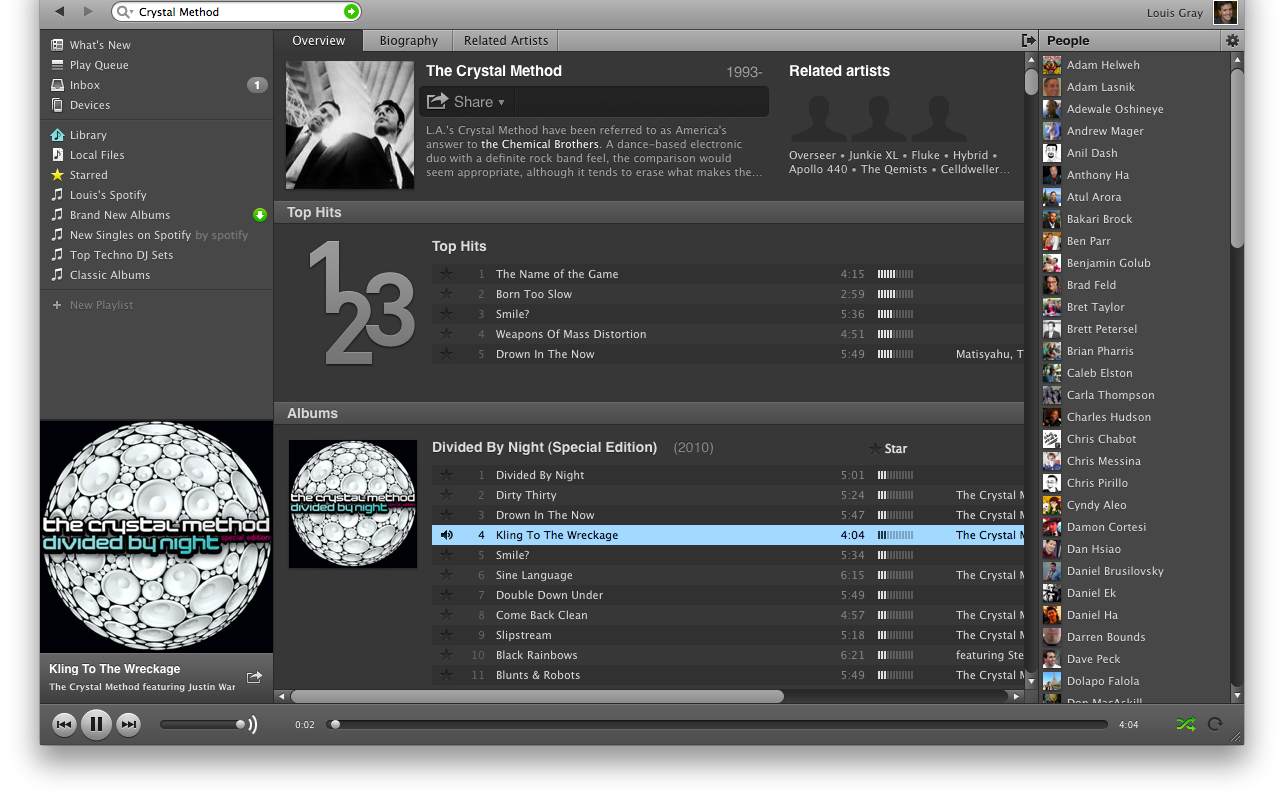
The Crystal Method playing on Spotify. Note the Scrollbar's Size for So Many Tracks!

Through the wait for Spotify's arrival, much attention was placed on the service's plan to continue with a free option for listeners, which scared the heck out of music labels. After much finagling, they landed a way to offer a free, entry price and premium price for the service. Considering premium is only $9.99 a month, it's a steal, period, and I'd expect serious conversions to the higher models. Spotify has also reportedly provided upwards of $60 million in music royalties to artists just in Europe alone in the previous year, putting them second highest behind iTunes. Add the USA to the mix and obvious virality thanks to social networking, and that number is bound to jump.

Pro Tip: Subscribe to the New Singles Playlist to Get New Stuff Immediately

As many skeptics have stated, Spotify does not enter greenfield territory, being flanked by Rdio, MOG and other streaming services, including the grandfather of the bunch, Rhapsody. The company's app is serviceable, but not beautiful, and music discovery could see some improvement. But that hasn't stopped practically everybody I know (myself included) from getting addicted to the service and using it with practical exception of all else. The flexible combination of downloads, streaming, playlists, sharing, and pure high quality sound sets Spotify apart from the rest, and you could see A-list artists as excited about the debut as we have been.

My Friend Charles Hudson's Profile on Spotify

As my invite URL link bounced around the social networks, emails started getting delivered late in the evening, and everybody who has been graced with a Spotify invite almost immediately sees the value and knows this changes their game. I am glad I haven't lost my purchased music converted from iTunes to Google Music, and love that GMusic is in the cloud, for Chromebooks' sake, but Spotify's got me in every other place. Sometimes, even after all the hype, things are better than expected or stated. With Spotify, this is one of those times. You owe it to yourself to try, if you've been locked out before. I am so glad I no longer look elitist with my early access. Go get it.

http://www.spotify.com/us/louisgray/

July 07, 2011

Spotify In the US: Of Course It'll be Great and Affordable

Spotify's long drawn-out arrival in the United States has been rumored and rerumored over the last two years, drawing fatigue from those both eager to get their hands on the service and those covering the space, some of whom have compared the nascent cloud-based music service to the much-delayed Duke Nukem Forever. In the meantime, US-based services like Rdio have emerged as real competition, alongside music lockers from Amazon and Google, and Apple's iCloud, which dropped last month with a feature set that was somewhat underwhelming to those who had epxected Spotify-like features from Cupertino.

In recent months, more news has trickled out from Spotify in terms of their expanding their US office in New York, and capturing deals with the dinosaur US labels, who haven't shown their innovation or eagerness to adopt their sales strategies in recent years, both cozying up to Apple and then cowering in response to their every move. Yesterday, Spotify in a fairly understated way said yes, their launch in the US was imminent, though no date was given, and now you see people speculating on pricing.

After initially having free access to Spotify starting in late 2009, I converted to a true paid for premium plan early this year, at $9.99 a month, bringing Spotify's huge music library to my desktop and all my mobile devices - made even better with solid integration to my Sonos S5 wireless speakers throughout the house. I do not expect that when Spotify officially launches that I'm going to see any kind of price hike, and I am adamant that this is the best deal going. Theoretically speaking, although I prefer lower prices of course, I would probably pay upwards of $30 a month to get Spotify access, just for the feature set they have today.

Due to the delays around Spotify and much ongoing hype, some from here, those who have been on the outside looking in might be tired of the promise and continue their skepticism until they can download the app and gain access to the service - but what was once a pipe dream looks like its coming very soon and at a great price. So if you're tired of hearing about it, you don't look like you have to wait much longer. It's the #1 reason I almost completely stopped using iTunes.

June 07, 2011

The Split Definition of Cloud Suits Those Speaking

Like any good Mac user and tech fan, I absorbed yesterday's announcements with Apple with great interest - knowing the OS updates will be hitting my laptop in a few months' time, and the iOS feature bumps will reach our array of iPod Touch and iPads at home - eventually seeing the best of these new features trickle out to non-Apple systems (including our Androids) thanks to the continued leapfrogging we see in this closely followed industry. But where Apple struck was where one would expect them to - in a manner that suited their interests. It's not necessarily always best for the future, but what's best for them. All money-driven companies would love to shape the future to meet their needs.

The most heavily anticipated updates from Steve Jobs and crew yesterday pertained to their introduction of iCloud, the next generation of MobileMe and iTunes. With Google and Amazon having announced music lockers, and streaming services like Spotify, MOG and Rdio in the mix, Apple's big move into the cloud was much-discussed, as news items followed each label, signature by signature, and watched the tea leaves to try and anticipate what Apple would deliver.

Apple used the term iCloud to represent the near-synchronization of digital media between a host of devices, from music to movies, books and photos. Buy once and play anywhere was the idea. No more moving of data back and forth. That's good stuff - and much was made of the $25 a year iTunes Match, which would push all your music, purchased on iTunes or not, to your other devices. Very clean, but oddly misrepresented, I believe. Apple says that iCloud stores your music, and its description page strictly states "your music is stored in iCloud", while the music automatically appears on your registered devices. But it's not streaming, and it's not as if when you are playing your music that you are doing so from their cloud. You're still doing it from your local device.

In contrast, we have seen two major business models from more acceptably-labeled cloud music services. The first, like Google Music, has you upload all your tracks (which can take a while) and then you can play them in a Web browser, any Web browser with your Google credentials, and play any time you like. The music is hosted in the cloud and streamed to you. The second, like Spotify and others, lets you tap into their available tracks, including playlists you've made from that library, and stream it to you.

Apple did not announce either of those approaches yesterday. They kept with their device-centric model which is making them billions of dollars and quite honestly, simplifying the Web and applications for millions of people. As I joked with one ardent Apple fan yesterday, Apple makes other people's inventions beautiful. They do quite a bit of innovation on their own, of course, but they sure do know how to take other people's ideas and make them look fantastic. But they didn't turn their back on their devices, despite talk of making them second-class citizens.

Google's approach on being truly Web-centric, and not tied down to specific devices, supports their business model, of course. They are making money from Web services (and associated advertising) while commoditizing hardware, which we will see with a big kickoff in a few weeks with the launch of the first ChromeBooks. The ChromeBooks, including the CR-48 which I've been using since December, bring you the Web and nothing but the Web. Sign in with your ID and get your content. Sign in with somebody else's ID and get their content. It's a fantastic idea and one that clearly supports their own business strategy. Their cloud interpretation supports what makes sense for them.

The divergence between these two players' strategies was in clear display yesterday. As a Mac user who has multiple Apple devices and a host of iTunes files, having them everywhere is cool. But I did also make the move to put them in the cloud (Google's version) and love the fact I can get to them from anywhere. Having used the CR-48 a ton lately, it's eye-opening to think of how the hardware is practically disposable. Assume you're logged out and it gets stolen. So what? Go buy a new one. For the price of a high-end iPod, you get everything back. No lost data or preferences. Google's interpretation of the cloud, which matches their interests, has some kind of real value to the user, and so does that with Apple.

If I was looking for a big announcement from Apple yesterday to keep me on iTunes instead of Spotify, it didn't come yesterday. I didn't see a major reason to stick with MobileMe/iCloud instead of Gmail and Google Docs either. But I absolutely see real value in their introductions, and anytime you see major companies slugging it out on quality for their users, everybody wins. But don't expect them to tell you what the future holds, unless you know that their projections are directly in line with what they can sell you today.

May 28, 2011

Youtify Turns YouTube Into Your Music Video Jukebox

YouTube is much more than a repository for amateur videos and bloopers. The video giant is the second largest search engine for the Web, a practically endless treasure trove for TV clips of all types, and unsurprisingly, heaven for music video promoters and fans. A cool site called Youtify (YouTube + Spotify, get it?) launched this month to tap this resource, letting you build your own playlists, search for your own music, and pretty much make the Web your jukebox. Even if you don't want to watch the videos, the music alone is great.

Available both as a stand-alone Web app (at www.youtify.com) as well as a Chrome browser app, Youtify transforms your Web browser into something looking much like the iTunes music player, prepopulated with two playlists: "Top 100", showing the usual popular fare from artists like Beyoncé, Katy Perry and Lady Gaga, and "Best of YouTube", which highlights fan-submitted music (like Super Mario beatbox and ukulele the beatles - obladi oblada).

Searching Youtify for Underworld Turns Up Scads of Videos

Every link plays the music video in the bottom left corner of your browser (like iTunes does in its music player) and has the option to expand to your full screen. You can also right-click and go to the YouTube video directly.

The Top 100 Youtify Videos Are Names You Would Recognize

While that's fun, what's even better is when you search for your favorite music. Even a techno geek like me could pick up hundreds of tracks (well, music videos) from bands like Chemical Brothers, Underworld and Daft Punk. If a band has ever made a music video worth playing, it's on YouTube. You can create and save playlists, and search playlists across the network. The great part of that is instead of recreating the playlists for each artist, it's possible they already exist somewhere. Searching an artist name can turn up dozens of playlists, each with dozens of videos already there.

Building and Playing a Youtify Playlist

With MTV getting way the heck away from its initial mission, YouTube has taken over as the premiere venue for music videos on the Web, and possibly, all media. Youtify makes finding those videos and the music behind them fun. While it's not going to replace your music library app (be it Spotify, iTunes, Google Music or something else), you'll definitely want to check this out. Just don't plan on being extremely efficient at the office while doing so. Find it at http://www.youtify.com.

May 27, 2011

How to Scrobble Your Google Music Plays to Last.fm

Google Music is very much a beta product, but one that is going to get a lot of attention as it becomes more widely available, competing in the online music world with Apple's forthcoming cloud music player, Amazon's cloud player, and Spotify, which thus far has focused on desktop or mobile applications to play on-demand tunes.

After taking a few days to upload my music to the cloud, I'm enjoying getting access to my tunes on any computer I want, from practically anywhere. But the service doesn't do a few things that are practically a must for me - first, update Last.fm with my listening history, and second, play to my Sonos S5 setup at home, leaving me to listen through my laptop or phone's speakers.

Last.fm integrated into my Google Music Player

After politely venting about these product holes on Twitter this morning, the first of these two holes was solved. Daniel Slaughter, a Web Developer at Grand Valley State University in Michigan alerted me to a project of his that brings Last.fm scrobbling to Google Music, letting the OCD side of me enjoy the music again, while keeping my statistics up to date.

Google Music Player updating Last.fm

His project, simply titled Google Music With Last.fm, is a script that runs on FireFox 3 or 4 with Greasemonkey installed, or of course, Google Chrome. To get it running, I downloaded and ran the script, and a new Last.fm section showed up in my Google Music. Once I had authenticated the application to update my personal Last.fm account, the song plays and history started to rack up.

If you're one of the early folks to gain access to Google Music Beta, and you miss the Last.fm integration that practically every other music player (including Spotify and iTunes) offers, you'll want to get this script going. Very easy to add and very clear to see the benefit. Nice work, Daniel.