Showing posts with label Media. Show all posts

February 19, 2019

The Future of Web Q&A Panels Should be Cake

Last week, Recode's veteran tech reporter Kara Swisher visibly held an aggressive interview with Twitter and Square CEO Jack Dorsey, who has been on something of a meandering press tour over the last few months, which has led to more questions than it's seemingly answered, as he has avoided specifics, and not taken full responsibility for many of the negative impacts the platform he created has spawned.

Despite Kara's noble attempts, this round didn't fare much better, largely due to Twitter's failing as a medium for such a debate. The #KaraJack hashtag, expected to be the core space for her serves and his returns, with a fair share of unforced errors, was difficult to follow in real time, with Twitter's poor design getting as much visibility as the discussion itself. Taylor Lorenz of the Atlantic called it impossible.

Twitter was not designed for this, and barring dramatic redesign or new product spinoffs, it won't be.

The most impactful press interviews are typically done live, be it for radio or TV, while other forums, like Reddit, have made Ask Me Anything (AMA) events a free for all with viewers getting as much access to the subject as anyone else. But #KaraJack wasn't supposed to be a free for all, with every tweet seeing replies from the masses, or requiring dedicated TweetDeck columns and search queries. It was supposed to be on a stage of sorts, with bright lights seeing yet another tech CEO sweat and try to avoid withering under Kara's query onslaught - the type of event you would see at an All Things D or TechCrunch Disrupt, or if you insist... at SXSW.


That's not to say panels can't be done on the web - for they can be, and done well, with a moderator having the option to interview a subject (or multiple subjects), with progressive question and answers, and audience reactions, but not interruptions. I know this, because I've seen it done. A quietly intriguing web service called Cake, created by Chris MacAskill of Smugmug and General Magic fame, has been working on a topics-focused, troll-free, community that offers a unique approach to panels.

Cake, when not doing panels, focuses on topics of interest.

If you're unfamiliar with Cake, the site's content is much like if Medium met Flickr - not a surprise from a site with roots in photography, like Smugmug, which coincidentally bought Flickr from Yahoo! last year. You can use Cake for long form posts, as I did last year after seeing my dad purchase a gun, making me rethink the safety of family visits, or you can just share a photo. Each post allows for Slack-like reactions, but also, comments, from any user - with a focus on finding similar interests, be it on Photography, Tech, Travel or anything else - not uncommon on the social web.

Cake posts showcase total reactions, which reactions, and related topics.

A site for sharing on the web is not new, nor is the idea of one focused on topics. Their manual approach to curation and high quality discussion is noble, but becomes challenging at scale, should they get there. But what is working is their approach to panels, which would have been a great home for #KaraJack, instead of Twitter.

Cake panels work because they remove the noise from the discussion and keep it in one place. Like Reddit AMAs, they can be scheduled and announced in advance. But unlike AMAs, a moderator can invite an individual or group of people to a panel, and when the panel begins, they are the only ones who can make posts or replies. The audience, for once, is silent. No shouting @replies, like on Twitter. No hashtag spam. Just the questions and the answers. And if you want audience engagement, you can create a parallel post on Cake to solicit questions or have discussion as the panel is ongoing.

Imagine a #KaraJack where only Kara or Jack could post.

Trying to design a conversational medium that is all things to all people is a mess. Twitter has struggled with experiments with tweetstorms, moments, live video, doubling character counts, trending topics, short form video and more. Twitter is great at real time news and short updates. Their search, after years of struggles, is actually very good. But it's not a good place for a smart panel like #KaraJack.

A Cake panel showcases who is on stage, what it's about, and engagement.

In the last few months, there have been panels with venture capitalists, the founder of GrubTubs, the man behind 20 years of Steve Jobs keynotes, and former General Magic employees, as well as dozens of others. Each of these panels has a clear formula, with a topic, an introduction, and then the back and forth of discussion that brings a feeling of a shared space, even if geographically distributed.

Do I expect future conversations with Twitter's CEO to happen on Cake? No. Of course Dorsey would want to use his own product. But #KaraJack didn't do Twitter any benefits, showcasing one of the service's many holes. There is a better alternative to Q&A like this out there, and I hope we can see more innovative panels coming.

The social web is long overdue for some real innovation, beyond photo filters and disappearing content. We need smarter conversations and less noise. Panels are a solid start.

October 20, 2018

Comments as a Platform, Or Silencing the Trolls


Web content has typically divided into three camps - those who create, those who react, and those who just watch. The lurkers, if you will. From the very earliest days of blogging, those first posts awaited the inevitable comments, and, given a clear revenue stream, you would see early participants like Fred Wilson say that "comments are how bloggers get paid."

[Source: https://vanelsas.wordpress.com/2008/06/02/the-real-value-of-social-media-interaction/#comment-2531]

The earliest engagements we had with people who read our site gave us incredible discussions, and spawned more posts and even, in rare cases, changed minds. Sites like Digg, Reddit, Slashdot and others became known for their diverse threads, and those in the comments are why you showed up.

But we've also seen the pendulum swing the other way. Everybody knows to "never read the comments" on popular news sites, as the most aggressive vitriol and ignorance floats to the top. YouTube comments have long been notorious for their lack of quality (though I feel this has improved of late). And Twitter, for many who should be able to use the platform, their every move can attract trolls who have a vendetta to take them down - but somehow don't get banned.

As social media sites eclipsed the momentum of blogs, conversations moved. We adapted by integrating social discussions from FriendFeed, Facebook and Twitter and appended them to our blogs. We would all share our posts on social, and then engage where the content landed. The best bloggers would find their readers wherever they were. But others simply turned comments off. Maybe it is because they were full of spam (they were) or the quality wasn't there (often true), but also, because the total quantity declined.

Let's go back to talking about Twitter. Twitter drives me nuts because it's fantastic and so poor at so many things. They seriously have real-time on lockdown. There is no better place to see what is happening right now. If there's a calamity, search Twitter. A breaking news event? Search Twitter. A sporting event? Twitter.

But Twitter has this awful habit of giving all users an equal voice. Now hear me out what I mean.

If you tweet publicly, anybody who you haven't blocked can reply, and their content is appended to your tweet. It follows you around. If a Republican politician posts, left-leaning posters race to take down their message, while the MAGA crowds prop it up and try to gain eyeballs. If the Kardashians say something, the crowds pounce on the valuable real estate quickly to show their adoration or pimp whatever link they've got going.

And down the publicity food chain, if you're a woman, especially a visible one, you get awful men saying foolish things. I guarantee it. They may call you names or question your ability. You block one and ten more pop up. If you're black, or Jewish, the racists will find you. They all know how to tweet.

So what I recommend above all other Twitter changes is the ability for people to reclaim their space. Hillary and Trump should both be able to post information without the crowd's replies being appended. Just like blogs and YouTube stars can turn comments off, Twitter users should be able to as well. The thing about social networks (and most products, to be honest) is that you should give the users control. But they haven't done it, and I think it delivers a great disservice to the platform, which has become a hotbed of harassment and hate - as Reddit and others have too.

If you can trust your commenters enough to give them a voice, by all means, amplify their voices. But when they have shown you time and again that they cannot be trusted, turn it off.

September 10, 2014

If Content is Portable, Where You Consume It Doesn't Matter

My good friend and colleague +Adam Singer lit a thought bubble with his latest rant against the dumb pipe of television, saying the formulaic, reality show centric content there is no longer palatable to generations growing up with many more choices - dominated by the on demand, everything's available alternative of the Internet. The summary, he says... is that who actually watches TV is "the old", backed by data from the Washington Post echoing the same.

The argument that the Internet is supplanting TV is one that can't be denied outright, but I believe it's the wrong discussion. What's happening is that the consumers wield incredible power in terms of deciding what they want to watch, when they want to watch it, and where they want to consume it - thanks to dramatic developments in on demand libraries like Netflix, YouTube and others, content destinations, including the smartphone, tablet, and PC, in addition to the TV, and, yes, the humble DVR, which extended the first volley from the VCR (remember those?) and timeshifted our entertainment to take place whenever we wanted it, not when it first aired.

I agree 100% with Adam that a good chunk of the content that fills TV's many channels is low quality stuff that has no redeeming educational value. Then again, the same could be said for much of the Internet and the many social networks we all participate in. Humans love turning their minds off and being entertained. I prefer to not watch reality shows and soap operas, but I do watch TV for live events, and have a list of serial dramas that I watch with my wife - in addition to late night fare like The Daily Show and Conan O'Brien.

One taking a pro-Internet vs TV stance could say, wait. You can watch The Daily Show or Conan online after they air, just like you watch them on your DVR. Sure. You could also, assuming Major League Baseball lets you, watch streaming games live on your tablet through their app. And you can now watch many of those comedies or dramas the same day or later through various network-led outlets online, or on Hulu, YouTube, Netflix, iTunes or some other place.

And at that point, I think the conversation changes. If you're watching The Daily Show online instead of on TV, you've just changed the destination screen, but are still watching the same content. If you're watching a movie on your tablet instead of on your TV, again, you're watching the same content - and the content producers are still bringing you value, whether you're watching on a 5 inch screen or a 50 inch screen.

As an individual, what I've observed in the last decade or so is that as traditional network television has taken fewer risks with their content, and tapped into a soft pudding of reality shows and 24 hour gab events, the premium cable networks are the ones that have delivered an overwhelming amount of perceived high quality content. From Breaking Bad to Dexter, Homeland, The Killing, Ray Donovan, and others, I'm spending a lot more time watching content on AMC, HBO and Showtime than I do on the stalwarts of ABC, CBS and NBC. And I'm paying them money for the privilege.

The success of shows like Breaking Bad on AMC has seemed to lead quickly to top-notch shows like House of Cards and Orange is the New Black skipping the TV route altogether and debuting on Netflix. Netflix marries the quality of premium channels with Internet delivery and on demand, which the new generation likes - leading to binge watching instead of scheduled consumption.

But my enjoying those shows instead of reality tripe on network TV doesn't mean the Internet has won. After all, if House of Cards were to be the exact same, only on CBS, I'd still watch it. When I'm making a decision on what to watch, I'm not selecting the show due to any loyalty to a network, a medium or a device. I'm watching it because I want to be informed or entertained. If the only way I can get live sporting events is on my television, that's where I will go. If the only way I can get House of Cards is on Netflix, that's where I will go.

I never bet against the Internet. I have long been a huge advocate of migrating from analog to digital, and bringing content on demand - all of it - to be available any time anywhere. But it's not a contest to consume on one screen instead of another - even if it makes me seem like an old fuddy duddy.

Disclosures: I work at Google, which loves the Internet, and owns YouTube.

May 02, 2014

Staying Ahead of the Curve on Tech Trends Isn't Trivial

When it comes to picking choices in tech, making the wrong decision on formats, manufacturer, or version can set you back in terms of dollars, leave you with rapidly obsoleted hardware, or find you investing time in something that provides you with non-optimal returns.

As an early adopter, you have a higher tolerance for risk and you take bets on product direction before the rest of the population may agree with you, and your choice to move one direction can act as the initial spark in a good situation, or as the canary in the coal mine, in a negative one. This thought crossed my mind as we saw the news yesterday to Sony's recent struggles, largely tied to their ongoing challenges hawking Blu-ray.

As Sony was quoted in the Verge, "demand for physical media" was "contracting faster than anticipated," and they were left holding the bag. But this really shouldn't have come as a surprise. More than three years ago, I said I was through with physical media, and I haven't looked back. Between streaming video and audio services like Netflix, Spotify and Google Music, or eBooks from Google Play and Amazon, the Web has taken over where physical media couldn't compete.

And let's be honest for you Netflix users? How many of you still get the DVDs? Netflix is a perfect example of a company that saw the transition coming and pivoted to where the trend was going. Now they're overwhelmingly known for their streaming services instead the traditional red envelopes.

The last five years have seen pronounced trends that in hindsight are impossible to ignore, from the rise of smartphones and debut of functional, popular, tablets, and the integration of social networking in all aspects of society. You can debate the ebbs and flows of financials for some of the larger social networking sites, but you can't deny their immediate impact.

On the tablet and smartphone side, there were two obvious trends that people could recognize right away if they kept an open mind. The first was that the iPad was going to be a hit. The second was that Android, due to its partner-friendly approach and rapid iteration, was the horse to bet on.

Without pulling an +MG Siegler and calling this post "I was right. Let me tell you why...", I'll highlight a few bits from both topics.

Let's Talk iPad

Immediately reacting to the iPad's introduction in January 2010, I didn't go over the moon and claim the new consumer tablet would solve world hunger and eliminate illnesses in our lifetime. But I did see it for exactly what it was, concluding, "They are going to sell a ton of these machines, and you'll see them in places you never expected. Casual computing and content consumption are going to drive it." That's exactly what happened, with the hindsight of four-plus years.

The iPad may actually have sold too quickly and been too successful a product to keep Apple beating expectations, but it found a niche between the smartphone and the laptop, and set the stage for the tablet being the first computing experience for my young kids.

Companies that bet against the iPad (or tablets in general) have found themselves swimming upstream, defending an antiquated platform and in some cases, extracting revenue from fatigued customers, whose numbers are decreasing.

Let's Talk Android

While Apple was pushing the iPad and doing tremendously well, iOS wasn't the smartphone OS I ended up enjoying, for a whole bunch of reasons. Six months into the iPad's lifespan, I turned in my iPhone and turned to Android, saying at the time, "a bet on Android is a bet on the future. I am betting on an ecosystem and an application environment that encourages best of breed developers to move their product to a growing population of smartphones, and I expect to reap the benefits. "

There's no question in my mind now that was the right move - and you have to keep in mind that was more than a year before I entertained the opportunity of joining Google myself. I saw the trendlines that pointed to Android being the quantity leader, with greater partnerships and a fast-growing developer ecosystem that brought top apps to the hundreds of millions of users, and that's exactly what happened.

Let's Talk Smaller Tablets


Soon enough, the first generation iPads I bought aged, and another trend emerged - of the small form factor tablet, starting with the Samsung Galaxy Tab, which I preferred, and later the Nexus 7. This 6-7 inch form factor was a perfect fit for customers, as you could see with the rise of the Galaxy Note, ever larger standard smartphone sizes and the rise of the Kindle Fire and Nexus 7 line. Even Apple capitulated eventually with their own iPad Mini, although they're not usually the ones to admit they were late to an idea.

So what am I getting at? I'm not here to tell you I have a crystal ball that tells the future. But you can see, with your own eyes and experiences, what the trends are going to be, and being stubborn because something has always worked one way doesn't mean it's a good idea. You have to evolve as a user, as a developer, as a businessperson, or as a company, to make sure you're impacting that change and choosing wisely. Or you'll end up with a home full of VHS tapes. Don't forget to Rewind.

Usual Disclosures: I work at Google which is behind the Android operating system and is a partner or competitor with many of the companies in this post, like Samsung, Apple, Amazon, Netflix, Spotify and more.

January 31, 2014

In Tech, In Order for X to Win, Y Doesn't Have to Lose


While it's somewhat hard to imagine now, with Apple seeing incredible success, it was less than two decades ago when the company, facing a small market share, and minuscule developer interest, had to pull a rabbit out of its hat to ensure longtime survival. That surprise came from an unexpected partner - longtime nemesis Microsoft, who in 1997, not only gave the then-beleaguered company a much-needed cash injection of $150 million, but also promised continued updates to the then-essential Microsoft Office suite, required to keep Macintosh's hopes alive as a viable platform.

Amid the shocked faithful, who responded with boos over making Internet Explorer the default browser for the Macintosh, instead of the arguably more Mac-like Netscape Navigator, CEO Steve Jobs said the unforgettable phrase easy to forget in an environment where it's commonplace to pit technologies against one another:
“If we want to move forward, and see Apple healthy and prospering again, we have to let go of a few things here. We have to let go of this notion that for Apple to win, Microsoft has to lose.” (Source: YouTube)
Turns out, as with many things, he was right. Microsoft, despite the company's many challenges, still is worth more than $300 billion, and saw income of more than $16 billion in the most recent quarter. When it comes to operating system choices, usually one picks Macintosh or Windows (and not both), or mobile OS choices, one could pick iOS or Windows phone (and not both), but both companies have managed to have significant places in the tech world for the last two decades.

Rarely does the winner take all.
Fast forward from Steve's words in Boston in 1997 to today - a world where big companies like Google, Apple, Microsoft, Amazon, Facebook and others command significant visibility and influence - but comparably younger companies like Twitter, Dropbox, Tesla, Nest (pre-acquisiton), Uber and others manage to also carve out interesting opportunities and become big companies themselves.

It's often assumed that if one "wins", another has to "lose". If Facebook wins, does Twitter lose? If Android wins, does iOS lose? If Amazon wins, does Google lose?

As a user of these technologies, and someone who watches the market closely or writes about these technologies, I see lines forming - not just of people who prefer one technology or one company relative to another, but of people who also display an equal and opposite reaction, to strongly dislike the company or technologies less preferred.

Those decisions have odd echoes. It's assumed that if you like the iPhone, then you must prefer Apple Mail over Gmail. If you like Windows Phone, you must also prefer Bing search to Google search. And if you have a blog that covers the minutiae of Apple's comings and goings, that documenting any negative opinion about their perceived competition should be highlighted with equal or higher volume.

Simply stated: I disagree, and think we can do better. You can like one company's vision or products even if you purchase from another one. It can be possible that all the major players find a space where they are successful. And the best products are built when it's the users' values that are at the forefront, rather than a false battle started to strengthen the position against another player.

Larry Page, Google's CEO, addressed this point at Google I/O last summer, when he said:
"Every story I read about Google is 'us vs some other company' or some stupid thing, and I just don’t find that very interesting. We should be building great things that don’t exist. Being negative isn’t how we make progress. Most important things are not zero sum, there is a lot of opportunity out there."
Recently, The Verge wrote a great in-depth piece about being a fanboy, asking "Have you ever loved something so much it hurt?" showcasing a number of examples of people so consumed about making sure people knew which side of these battles they were on that they were unforgiving in their tone with anyone else who disagreed. I believe you can have a strong preference, and can evangelize a product or platform, like I do often with those I enjoy, without having to cut down alternatives or those who've selected a different way.

The world is a very large place. There are many millions of people who haven't yet purchased smartphones, tablets or PCs, let alone decided on their favorite OS or apps. There is room for many small companies and big companies alike to innovate and do incredible things. There's room for us all to intellectually choose to be fair and review each new product on its merits and stand for those things we believe and like without needing to tear down alternatives. It might be fun, but we can do better.

Disclosures for transparency's sake: I work at Google, which makes some of my personal favorite products, like Android, Gmail and ChromeOS. It can be assumed Google occasionally competes with other market participants like Apple, Facebook, and Microsoft.

(Images via Dreamstime, which is an excellent resource)

January 07, 2014

Books Step Behind the Curtain of Tech's Leading Companies


Nearly three years ago, I made myself a public promise to stop buying books, CDs, DVDs, or basically any form of media that took up any space. (See: Physical Media Has To Go. I'm Digital Only From Here.) With media stores on practically every platform, whether you prefer Apple's, Google's or Amazon's, and streaming entertainment available from Spotify, Netflix and the aforementioned three, you can get just about anything you want straight to your computer, phone or tablet. So my all digital diet hasn't slowed me down a bit.

The end of 2013 brought us an unusual array of tales on technology going behind the public faces of some of technology's biggest names, including Apple, Google, Amazon and the newest $30 billion kid on the block, Twitter. So I spent a good amount of the holiday break taking in stories, with their own various embellishments, covering the challenges of building a mobile operating system at Google and Apple, the executive tug of war and pivot of Twitter, the focus on design in Jony Ive's laboratory, and how Amazon has craftily executed on its plan to become the single store for everything under the sun.

Taking in the tales of Silicon Valley companies is something I'll likely never get bored of, even if I'm covering the news as a blogger, living the news as an employee, or enjoying the benefits as an end user. So to get all four of these books at about the same time is an embarrassment of riches.

As I've read each of the books on Google Play, I've tried to be a good Web citizen and provide a rating and a short review. If we're connected on Google+ and you look at the book on Play, you'll probably see my take. If you aren't, or we haven't synched yet, here's a quick run through of what I thought on each title. Each title links to Google Play, where you can pick it up too.

Hatching Twitter (Author: Nick Bilton)

Review: "Many characters needed to make a mere 140. Politics over tech, and very public... similar to many startups that aren't quite under the microscope."

Expanding: As someone who's covered Twitter as a blogger for some time and used the service extensively for five years, I had hoped for more insight into how the Twitter team took on technology scaling challenges, worked through product decisions and managed the fast-growing community. Bilton focused primarily on the office drama at the highest levels, and the day to day challenges seem to happen practically invisibly. Also, as noted in my review, as a veteran of some challenging political environments in startups, the executive turnover is not unique to Twitter, but it's unusual for it to become so public, or for the company to survive even with the infighting.

Jony Ive: The Genius Behind Apple's Greatest Products (Author: Leander Kahney)

Review: "Good story. Very one sided. Jony is an exceptional mind working on high quality and highly desired products. The author recaps the highlights and approaches the subject as if Apple is infallible and perfect, which get tiresome. Jony is made out to be a deity. The truth is already incredible. The fable is not needed."

Expanding: Jony Ive and Apple make incredible products. The iPod and iPhone and iMac are great examples of that. I liked Jony's origin story and how he was forged in the UK before making his way to Cupertino. What I liked less was the over the top, breathless deification of Jony that went well beyond what I felt ws necessary. It was so sugary, one had to put the book down every few minutes until you could get enough strength to start again. That's no slight to Jony or Apple, of course.

The Everything Store: Jeff Bezos and the Age of Amazon (Author: Brad Stone)

Review: "The best book on tech in 2013 An intriguing dissection and chronicling of a truly modern company's rise to market dominance."

Expanding: The story of Amazon was by far my favorite of this group. What's striking is the drive behind Jeff Bezos and team to take on incredible challenges, and just get it done. Amazon, through perseverance and ingenuity, skated through the hardest times in the Web 1.0 crash, and came out a world leader, starting new businesses and categories at a pace and scale hard to fathom. If you had to read just one of these four, I'd pick this one.

Dogfight: How Apple and Google Went to War and Started a Revolution (Author: Fred Vogelstein)

Review: "Good stories and current! Only a few obvious inaccuracies, but well intended."

Expanding: This was a fun one, as someone who prefers Android to iOS, but has been a heavy user of both. As someone who knows some more color to much of the stories, I found some of the author's summaries and shortcuts to simply be wrong. I was mostly willing to forgive that, considering the book was entertaining and insightful. I only hope the parts that I liked were true. As a Googler, it actually gave me more knowledge about individuals on the team and their own efforts that I didn't have before, so I appreciated that.

If you're like me, and you live and breathe technology and the Silicon Valley, these four books are a great way to go beyond the day to day headlines and clickbait you see on the "news of the minute" sites. If you are an entrepreneur or even just an office drone like the rest of us, you could learn something, be it the why, or the how, but you can't say any of these books left you more lacking for knowledge at the end than when you started. So check 'em out - digitally.

Disclosures: Yes, I work at Google. Google makes Android and Google Play, and could be a partner or competitor to Amazon, Apple, Twitter, Spotify or Netflix, depending on which product or feature you're thinking about.

September 19, 2013

Our Fragile Web of Dead Domains and Lapsing Links

For all our talk about how much information is produced every year, and how every little piece of our lives is being shared and instantly discoverable, it is surprising how difficult it can be to find information on the Web, in its original state from just five years ago, let alone ten or fifteen.

While we were once regaled with stories of how the Internet could withstand nuclear war, thanks to a complicated structure of redundancy and geographical backups, simple human mistakes, conflated with the occasional act of malice, have reduced our expectation that data, once posted, will be forever stable.

I believe strongly in the concept of the cloud, and have moved practically all my data to it, relying on a cloud-centric laptop each day and saving my files in the cloud. But not everyone is as careful about selecting providers and maintaining platforms and domains as I have been, and it's not too uncommon for entire sites and bookmarks to vanish from the Web, with only Archive.org and other clever cachers left to tell the tale.

Before this sounds like a sordid tale or anti-Web screed from someone embedded in the Web, let me give you a specific example. Imagine, if you would, a unique URL pointing back to the original dotcom boom - a simple one like .com.com. No, I didn't type it twice. The domain com.com has long been owned by CNET, part of CBS Interactive. While CNET has undergone a number of owners over the decades since its launch, it's also seen extreme variance in how they marketed their main site and URLs. For those of us who just wanted the news, it was News.com. Later News.com would redirect to News.Cnet.com, as it does today.

Archive.org Shows News.com.com in a Previous Known Good State

But at one point, News.com redirected to News.com.com, and for whatever reason, that's the bookmark I've had follow me from browser to browser for years. Suddenly, a couple months ago, this bookmark stopped working, instead showing me a directory of links, which looked like a squatter had seized the URL and taken it over. Archive.org shows the same. News.com.com worked and then in July... it stopped redirecting. So that's annoying. While it's simple enough for me to update my bookmark, and no doubt I'm in the small minority of users who kept that URL, to have a potentially high profile URL like .com.com do absolutely nothing ... seems foolish.

But Now The Old News.com.com URL is Pure Rubbish

Enough about .com.com. What's just as frustrating at times is the short shelf life for links and images from years past. My own blog has been around a little over seven years, and in the 3,000 or so posts I've made since start, each one has had many links. As companies come and go, their websites and the links to their subpages go away. News media sites, which one would hope would present a timeless archive, a long tail of information to the truth seekers out there, are often the worst offenders, as articles of a certain date fall behind a paywall, or site platforms change, forever hijacking link structure and rendering previous links inept.

One of the biggest regrets I have, as far as the web is concerned is one that +Ryan Tate (now with +WIRED) and I share. In the Web's more prehistoric times, back in the late 1990s, he and I both worked at the Daily Californian student newspaper at +UC Berkeley. Both of us wrote hundreds of news stories, covering everything from student elections to campus crazies and the occasional homicide. But at one point, after I'd left the paper, our site was hacked/corrupted, and all the existing content was lost - shockingly without backup. So more than 99% of that data is gone for good, and one will either have to travel to the Berkeley campus and pick up a hardbound paper to see our work, or it's just gone. While few of my stories are worth reading about 15 years later, they are part of my own personal (and work) history which has little record.

From writing on actual death to link death... while CNET's link lapse with .com.com is a surprise, it could possibly be due to a sale, to be used by an unknown acquirer, or simple neglect. Worse is when one sees links automatically shortened, only for the URL shortener to disappear, or for the hosting service to invalidate other short links. While I've made my case for URLs to look good and be intuitive, we've gotten used to seeing smaller URLs, best exemplified by the t.co from Twitter, helpful on their service, along with goo.gl from Google, bit.ly, and others. But by buying into a short URL service, you require it to be maintained by the original owners and all the tables being intact. So for those of us who long shared with ff.im from FriendFeed, it is by the grace of Facebook that those old things are still around, and practically nobody would be surprised if they went the way of the dodo in the next couple years.

My argument is that the Web should be built for permanence. A link I post today should be a link that works later. A permalink to a dedicated page with content should produce that same content, even if the surrounding frame has been upgraded, in the future. And short links and domains should behave in a trustworthy, user friendly manner. It would be a minor tragedy if the start page you use daily suddenly became something else, and a larger one if the domain on which you host your personal stories simply closed shop because the host didn't find it financially feasible to keep going any more. So while the magic of the Web is real, and it sometimes does seem you can practically find anything out there and get it instantly, assuming speedy broadband, the gaps have me thinking we can do better. And yeah +CNET, what's up?

August 19, 2013

The Twitter Google Netflix iPad Dotcom YouTube Facebook Era

As technology has weaved its way into practically every aspect of our lives, it has become something of a challenge for historians, journalists and others to try and encapsulate this new era of near-pervasive Internet, dramatically reduced barriers to publishing, and obsessive gadget accumulation.

I grew up in a world where a whole generation of people could be summarized easily, defined by population bumps like the Baby Boomers, a shared experience in battle, as Tom Brokaw frequently cites in The Greatest Generation, or quite simply, by the assigned letter given to those born in a ten to fifteen year period, like Generations X and Y. Now, newsmakers and analysts alike are trying to explain just what this new era should be called. Is there one device or one company or one shared experience that defines us?

With some quick research, it's clear there are many players vying for the elite status of owning our tech-savvy era. I tapped into Google (disclosure: I work there) for a few examples. Let them play out and see if you favor one over another or have a better option. All screenshots current as of Friday, August 16th, 2013.


The iPod Era: 69,100 Google results
Represents: The iPod at peak was more than half of Apple's revenue, outpacing Mac and all software sales. The iPod was a cultural phenomenon representing fashionable portability of digital media and personalization of music listening.
Is it over? Yes. According to AppleInsider, the iPod Era ended in 2010.


The iPad Era: 132,000 Google results
Represents: The first successful tablet computer disrupted the old way of doing many things, and picked up where Apple's iPod and iPhone had left off.
Is it over? Probably not. The iPad Era launched in 2010. Debate from AdAge questions if it's done.


The Google Era: 259,000 Google results
Represents: Near-instant retrieval of information, and a reduced need to memorize. Ability to scale.
Is it over? Nope, unless you think Business Insider is onto something.


The Twitter Era: 401,100 Google results
Represents: Near-instant ability to communicate and a real-time medium.
Is it over? No.


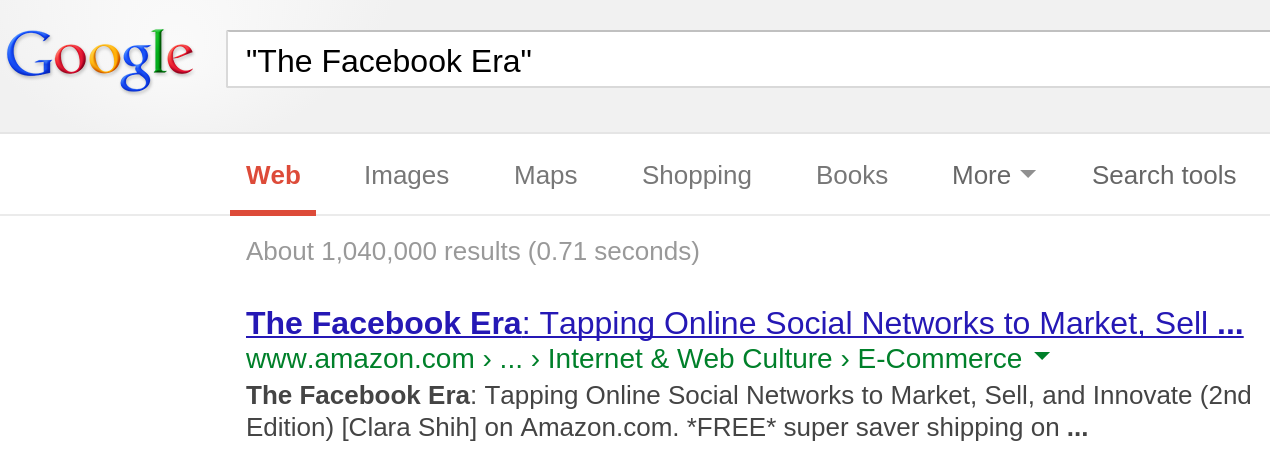
The Facebook Era: 1,040,000 Google results
Hey look! A book: The Facebook Era
Represents: Increased connections with social ties, and ease of discovering personal information.


The myspace Era: 59,500 Google results
Represents: Like Facebook, only earlier, more personal information online, simple creative sharing.
Is it over? Yes. Absolutely. This dude missed the whole thing.


The Blogging Era: 150,000 Google results
Represents: Ability for anyone to publish, in long form, at no cost.
Is it over? Getting there. In 2004, this guy claimed 2014 would finish it up.


The Android Era: 297,000 Google results
Represents: The entry and rapid adoption of Android as a smartphone OS. 
Is it over? No.


The YouTube Era: 210,000 Google results
Represents: The ability of anyone to publish video and have it be seen around the world. Also represents casual video consumption relative to professional 
Is it over? No.


The Dotcom Era: 1,490,000 Google results
Represents: Referred to as much as a bubble as an era these days, the first rush online by traditional services and businesses. Many did exceptionally well. Many more disappeared. 
Is it over? Yes. At least the first round.


The Microsoft Era: 423,000 Google results
Represents: The last few decades of a world where personal computing was dominated by Windows PCs and Microsoft software.
Is it over? Many people think so. In fact, a "Post-Microsoft Era" has been discussed.


The Steve Jobs Era: 67,900 Google results
Represents: Steve's personal impact on the world of technology, design, marketing and one of the most successful companies in Valley and tech history.
Is it over? Unfortunately, yes, as Steve passed away, but his impact lives on.


The Netflix Era: 41,600 Google results
Represents: On demand instant access to a wide variety of films and TV shows, and the business impact for those in more traditional markets. A disruption of Hollywood.
Is it over? No.

So what era are we in? If you went by total numbers, the Dotcom Era had the most Google results, but that's historical by nature. The Facebook Era is in second place, with Google properties, including YouTube and Android having nearly as many when combined. The iPad era is still strong, with Twitter putting on a good rising show, and Microsoft being high in the rankings, given its market penetration.

Other good options I either didn't run or tested but cut so this post isn't a mile long... "The Yahoo! Era", "The Amazon Era", "The Google Glass Era", and more... it's all fun. Can you think of others? What's the winner in your view?  

April 18, 2013

TV Tattle Goes Dark After 13 Years


In the fall of 1998, a friend of mine at the Daily Californian student newspaper in Berkeley said he was in a real fix. With housing scarce at Cal, and both of us set to start our senior year, somehow he ended up "between places" and needed somewhere to crash. While I was already crammed into a one bedroom, one bathroom place with another roommate, I told the friend, Norman Weiss, he could crash on my couch. But I was no saint. I charged him $20 a night, figuring I'd make a $100 for the week while he looked for a place. After all, I needed money too. A month later, I was up $600, Norman found a place, and my real roommate, who wasn't in on the "cash for couch" deal, was ready to stop sharing the bathroom.

Norman by most standards was a pretty quirky guy. His social awkwardness was exceeded only by his intensity for finding a story. He was a good journalist, was voracious about hoovering up information, and was always up on the latest gossip at the university, and politics. Our evenings were spent talking about news, rumors and the Web. Shortly after he left my place, he showed me the early stages of his new idea - a website dedicated to links about TV. He was so excited about it and begged for my feedback on the name of the site and first graphics. I don't remember my exact words, but I seem to remember being pretty dismissive. After all, this was before real blogs had taken off, and I didn't care all that much about TV. But he did.

I first highlighted some of this story back in February of 2006, as Norman didn't take my being critical as a reason to stop working on what eventually became TV Tattle. Starting in 2000, and for nearly every weekday the last 13 years, casual television watchers and industry hobnobbers alike have turned to Norman's curated links to get the daily dish on the boob tube. Which is why when he put up a quick text note this week saying he was calling it quits, this move even hit The Hollywood Reporter, who seemingly is shocked by their outing of the quiet, but not truly anonymous, kingpin behind the site.

TV Tattle wasn't the most flashy site by any stretch of the imagination. It was largely text heavy, and images were small, if included at all. RSS was lacking, and social media integration was invisible. It remained a testament to a simpler time of the Web where one guy sitting at his computer, wherever that was, could keep people interested and entertained on a specific topic, due to being more diligent and consistent than anybody else.

Colleagues of mine from the Daily Californian went through a lot in the few years we all shared there. Some stayed in journalism and worked at places like the Washington Post, San Francisco Chronicle, Wired, and the Arizona Republic. Others of us found the magnet of Silicon Valley too much to ignore, and work hard on the tech side of things. But while Norman remained much of an enigma, my every visit to his site was a small link away from those formative days when we had no money, when three guys shared a one bedroom apartment, and gossip on Berkeley's always amusing City Council members was the topic du jour.

When looking to take some time off from the world of tech, I've never stopped being a regular reader of TV Tattle, but now it looks like that choice is being made for me. Good luck, Norman. I hope we haven't heard the last from you.

September 06, 2011

Being Genuine Is the Best Disclosure Of Them All

Even with the purest of intentions, people have bias, which can rise from an infinite number of sources, be they financial, personal, emotional, career-oriented, or any other. The topic of bias and disclosure flares up often in the increasingly complicated world of blogging and journalism, and as many of us both participate and cover the world in which we work, new rules are being adapted, usually with some push back by those for whom the existing set of rules worked well. In 2009, the Federal Trade Commission (FTC) tried to step in and provide guidelines for bloggers with conflicts, asking those who received compensation for their efforts to disclose it. But even if you assume they intend to eliminate bias, they're not even close to answering for all potential bias cases. Not even my gimmicky and fun set of disclosure icons, put together at the end of 2009, can correctly anticipate every situation.

With this weekend's flareup over TechCrunch founder (and AOL employee) Mike Arrington's CrunchFund making headlines again, more lines are being drawn in the sand about what is appropriate for a man of Mike's position to do. His employees have explained they operate independently of his activities. His employer says the rules are different for his organization. His critics have called him names and penned him as having crossed the line. But this topic isn't a new one. It's just got an intriguing name behind it, someone that many of us watch, who draws attention good and bad, depending on your view, thanks to his being visible and arguably, on top, in his field.

More than three years ago (In August 2008), I wrote that "If you look hard enough, conflicts of interest are everywhere." The first topic I brought up back then was if bloggers should cover companies they invest in, and at the time, I said "Investors in a company usually know it very well, especially if it's an early-stage situation, where they will know it better than the general public. It's no secret they'll likely be more positive on the company, but if they're fair and disclose the relationship, you may learn a great deal." In this post, I also said "disclosure is needed" if bloggers joined boards, took day-job positions with a company, or participated in starting or buying a company. It's always good, at least for me, to have the body of work to point to when issues like this come up, as they do regularly. At the end of 2008, again discussing bias, I said, regarding my own preferences, "Even though I like these products, these people, and their ideas, the idea is to continue to be trusted. What liking a product doesn't do is force me to make up things that they don't do, or gloss over clear issues."


It's not my place, as a mere tech blogger and Silicon Valley marketeer, to assess the appropriateness of Mike's new fund. I am not involved, had zero knowledge of it in advance, and don't believe I am impacted by its existence. The story is interesting, and that's it. But the tumult over the discussion is really all about detecting bias and trying to divine one's intent out of their writing - to see if their words can be less trusted due to their outside interests. And that's the crux. Being genuine, transparent and truthful, despite any perceived bias, will always win. Being honest and direct and overdisclosing to the point of amusement, is always better than having to disclose after the fact.


Maybe I should disclose to you that despite never having worked for Mike (we're still talking about Mike Arrington), and having minimal contact over the years, I have never had a bad experience with him. Every experience has been good, be it in person face to face, be it in conversations on the phone, by email, or even Twitter DMs and Facebook messages. The last time I saw Mike was at a swanky Los Altos gathering where we talked briefly. He shook my hand (not something he likes to do) and said it was good to see me. We even talked a bit about Seattle and how he's writing less at TechCrunch. Mike previously invited me to TechCrunch headquarters in Palo Alto (when they were located there) and even gave me the scoop (by a few days) that he had hired MG Siegler away from VentureBeat. You might even try really hard and say that I am biased in favor of TechCrunch because I've previously worked for a company that was covered by the site (when I was working at my6sense), that TechCrunch covered my joining Google, and maybe it's in my best interests to be nice to Mike and the TechCrunch family if I ever want products I am associated with in the future to be viewed nicely. But this points out how hard it is to really determine what's in the author's head. You can't tell me why it is that I wrote something when I did, and you can't know what prompted me to do it.

Enough about Mike. He's a great firestarter for topics though, right?

At the end of last week, there was a quick story on Mashable that listed a few tips on how you could score your next job using social media. It's a pretty typical story for the site - a list style post that has a small number of things you can do to improve your life using the Internet. In the post, the author referenced my joining Google by saying, "take a tip from Louis Gray, whose demonstrated love and dedication for Google+ got him hired as a product evangelist."


With all due respect to the author, whom I don't know, his fast summary was balderdash. I didn't ever say in my post that my love and dedication for Google+ was the reason I was offered a job with Google and he didn't ask. It should be noted I underwent the same hiring process as any other candidate looking to join Google. The same 10+ interviews you have read about, and the interview process started months ago - before Google+ existed. The way I found out Google+ launched was by way of a tweet from Matt Cutts. I didn't get any early look at the product, and didn't get tipped as to when it was launching. The process for my being hired into the social team at the company was well under way before Google+ launched, and I would like to think that reasons I was hired were more tied to my body of work and job history than any excitement about the project itself. (I also haven't cleared this post with Google PR or anyone at Google, and don't plan on making that a habit)

That leads to another level of bias to discuss. After Google approached me late this Spring about possibly joining the company, I was cautious in terms of what I would say about their products or planning. I was cautious not in the perspective of making sure not to say anything that would talk them out of hiring, but in fact, the reverse. I made sure to be just as fair as I always have been, calling out issues that made sense, and praising where it made sense, so that if I were hired or not hired, readers of the blogs would not see any change in my approach. For example, in the months after our discussions began, I said it would take several days to move my music library to Google music and continued to praise Spotify. I even said in mid-July, after more than a half dozen interviews, that I thought Google+ should leverage smart algorithms to personalize the content. I also railed against people pointing their own domains to Google+ instead of their own content, saying "I am hesitant to endorse forwarding your identity to a third party domain you do not control."

But where could I have disclosed "I am currently in the interviewing process at Google"? I couldn't, of course.

Similarly, in the past, I could not disclose if a company I was working with was seeking a venture capital round, an acquisition, a partnership or any number of things where the guarantee of non-disclosure, by agreement, trumped the request for disclosure here. What's more important than seeing if you need every single potential source of bias listed out on the page, as I often do, is if the author has established a record of being truthful, genuine and open to their biases. My posts here and elsewhere are biased, and the number of potential biases that impacts my choices of what I use and what I write about is legion.

Maybe Mark Zuckerberg was really on to something when one of the hallmark statuses available to Facebookers was that of "It's complicated." Life is complicated. It becomes more complicated based on who you know, what you do, who you interact with, what value they provide you, what they say to you and all who impact you and so on. I am confident that even though I am working hard to impact a great project at a visible company, my body of work stands for itself and I stand for something. Bias is complicated and the best way to classify bias is if you can find a direct link to an action that delivers another action which would not have happened without the first. You can try all day to divine the intent of the source, but you can't read their mind. Them being genuine first and always clears it all up.