Showing posts with label Apple. Show all posts

July 30, 2015

Tech Company Shifts Position Sunnyvale as Major Hub for Next Decade

In Silicon Valley, some of the most prosperous cities and most sought after zip codes to live, raise a family and send kids to school, are directly dependent on the proximity to corporate headquarters of the leading technology companies. As some of the biggest companies are running out of room in their headquarter cities, the resulting demand for continued growth is putting pressure on neighboring communities. Sunnyvale looks like ground zero for this next wave.

Cupertino, home to Apple, the most valuable company on the planet, has a median home price north of $1.7 million dollars, up 15% year over year. Mountain View, home to Google, has a median home price above $1.3 million, up 20% year over year. And these high marks significantly trail the more upscale suburban locales such as Palo Alto ($2.44 million average) and Los Altos ($2.65 million average). Quietly sitting wedged between Mountain View and Cupertino, in a state of tug of war between Apple, Google and more companies, like Yahoo!, LinkedIn and NetApp, is Sunnyvale ($1.28 million average). Sunnyvale has not only seen the fastest increase in average home prices over the last 12 months, but is set up to see even more demand as jobs flow to the city. As a biased Sunnyvale homeowner and area employee, this is very interesting to watch.

Bay Area Housing Prices: High and Increasing

As the total land available to new workers entering the area or existing employees looking to leave apartments and find a home near their office stays static, the old rules of supply and demand are taking hold. Sunnyvale home prices are up 23% year over year, at a pace slightly above the surrounding neighborhoods, higher than the aforementioned Cupertino, Palo Alto, Mountain View and Los Altos, but even quicker than Facebook's home, Menlo Park (up 17% y/y), or San Francisco, home to Twitter and many others (up 13% y/y).

Sunnyvale's Average Increase Highest Over the Last 12 Months

So why is this? And who cares? As somebody who has been working in the Valley since the rise and fall of the first dotcom boom in the late 1990s, I've seen ebbs and flows in the economy impact hiring, funding, area traffic and housing prices. Big names that once were major land owners and employers, like Sun Microsystems and SGI, can virtually disappear. But when large companies present stability and prosperity, they can be a magnet for skilled workers. And in the last two years, you have seen major announcements from Valley leaders, like Google, Apple and LinkedIn, announcing new campuses or building into Sunnyvale, as offices in neighboring Mountain View and Cupertino become saturated.

While much press has been spilt over Apple's amazing spaceship campus under construction in Cupertino, what few note is that this work, taking over an older Hewlett Packard lot, is snugly cornered on the border of Sunnyvale city limits, and the company has been snapping up buildings all over the city to manage growth. LinkedIn has been building sparkling new buildings in downtown Sunnyvale and looks poised to move thousands of workers there soon. Google has made headlines as they've taken over buildings from Juniper Networks and even took over nearby Moffet Field.

This expanded pressure from Cupertino on the South border, and Mountain View to the West and North, is pushing Sunnyvale costs and demand upward, much like new mountain ranges are formed under pressure from moving tectonic plates. And this isn't to say that Sunnyvale doesn't already have significant employment hubs of their own. The city's largest employers include Lockheed Martin, Northrop Grumman, Synopsys, Broadcom, Infinera, Nokia, and and many of those I've already mentioned, like NetApp, Juniper and Yahoo!. But the new occupants in the city come armed with significant war chests and momentum, almost certainly strong enough to ward off any turndown in the hot tech economy or an eventual recession.

The stats are Sunnyvale are fairly pedestrian as Bay Area cities go. The last census reported just shy of 150,000 residents, and a workforce of nearly 120,000. The city has adapted to economic shifts, from agriculture to defense to microprocessing through Silicon Valley's first wave, and now, the Internet. With Google bordered to the East by water and marshlands, and Apple by rolling hills of past Highway 280, the growth point is aiming straight at Sunnyvale. Watch this space.

Disclosures: I work at Google, and live in Sunnyvale.

October 14, 2014

What If We Redid the 2000 .Com Monopoly Edition for Today's Web?


In the year 2000, as the .com bubble was at its peak, it seemed new tech names were going to rapidly eclipse the old guard. Emails and downloads were new conversation topics, and if you weren’t still on AOL, debates would ensue over which ISP you should choose, or which search engine or portal was the best. Sun was the dot in .com and Linux seemed poised to take over the desktop. Obviously, not everything turned out that way, even if some of the names are still around, and even strong.


The 2000 .Com Monopoly Board

One of the fun collectibles that came out of this time was a .com edition of Parker Brothers’ Monopoly. Instead of properties around Atlantic City streets, you had websites. Community Chest and Chance were replaced with Email and Download cards. And you couldn’t buy property for a few hundred bucks, as everything was in the millions of dollars. Not too soon after the game came out (and of course, I still have it), the .com market was decimated, as the companies of the future weren’t built for the present. Now the game board itself looks like a relic of a short-lived era gone by.

The 2000 List of Companies and Categories


As something of a lark, and thought exercise, let’s consider who would take these 2000 era companies’ spots on the board. I’ll go first with my take on today’s cast of characters.


Dark Purple
2000 .com Monopoly edition: Sportsline.com and FoxSports
2014 .com Monopoly edition: Deadspin and ESPN.com


Commentary: Back in 2000, ESPN, as part of Disney, didn’t have a great approach at owning its web presence. It was part of the Go.com family, one reason it missed the original .com board. Now, ESPN represents sports on all media. Deadspin is an exceptional alternative with sharp commentary that is a must read for serious sports fans. (Apologies to SB Nation)


Light Blue
2000 .com Monopoly edition: GeoCities, Oxygen and iVillage
2014 .com Monopoly edition: Pinterest, SnapChat, and WhatsApp


Commentary: The 2000 edition definitely had a bent toward community. With iVillage and Oxygen, two of the three properties were focused on women. GeoCities didn’t age well and was retired. Pinterest, SnapChat and WhatsApp have become some of the fastest growing communities for pretty much all ages and both genders.


Light Purple
2000 .com Monopoly edition: Shockwave.com, Games.com and E! Online
2014 .com Monopoly edition: TMZ, Buzzfeed and Reddit


Commentary: Shockwave? Really. Let’s move on. For fun entertainment and burning hours of Web surfing, TMZ, Buzzfeed and Reddit can’t be beat. Reddit is a tough one to categorize, as it calls itself the Web’s front page, but it’s knocked off Digg, Slashdot and others for that title.


Orange
2000 .com Monopoly edition: Priceline, Expedia and eBay
2014 .com Monopoly edition: Square, PayPal and Yelp


Commentary: eBay could easily be a repeat in 2000 and 2014. Priceline and Expedia are still doing fine. But Square and PayPal are how the Web does business these days, while Yelp is often the place to go for recommendations on what to buy or where to go.


Red
2000 .com Monopoly edition: The Weather Channel, About.com and CNET
2014 .com Monopoly edition: Dropbox, Instagram and Tumblr


Commentary: About.com looks like a content farm, and while CNET’s still alive and kicking, there’s been nothing to talk about since its CBS acquisition. The Weather Channel? Please. There’s an app for that. And more than just finding content sites, anybody can create and share content globally with apps like Instagram, sites like Tumblr and share it on Dropbox. (Apologies to WordPress, Box and others)


Yellow
2000 .com Monopoly edition: eTrade, Monster.com and Marketwatch
2014 .com Monopoly edition: Wikipedia, LinkedIn and Twitter


Commentary: Monster.com and eTrade were monsters in 2000. I still use eTrade regularly, but they’re not known for their monkey-centric Super Bowl ads any more. Marketwatch is a snooze. Now, people get their financial and business data from each other via LinkedIn, in real time on Twitter, and check its veracity on Wikipedia. (Apologies to Seeking Alpha and StockTwits).


Green
2000 .com Monopoly edition: Ask Jeeves, Alta Vista and Lycos
2014 .com Monopoly edition: Microsoft, Amazon and Apple


Commentary: In 2000, Search engines took the entire final row of the Monopoly board. But the positions of Alta Vista, Lycos and Ask Jeeves weren’t strong against innovators that got stronger in the next decade. Now, diverse infrastructure plays like Microsoft, Amazon and Apple (for many reasons each) occupy this highly valuable section of the board.


Dark Blue
2000 .com Monopoly edition: Excite@Home and Yahoo!
2014 .com Monopoly edition: Google and Facebook


Commentary: That Yahoo! was the Boardwalk of 2000 is telling. Excite@Home was a $6.7 billion megamerger in 1999, but by 2001 was pretty much in steep decline. Without intending too much bias toward my current employer, Google and Facebook are the 1-2 when it comes to the Web today, from the top destinations to hours spent, tools deployed, etc - and both play a role in discovery for everyone.


Railroads/Stations
2000 .com Monopoly edition: Nokia, MCI Worldcom, Sprint and AT&T
2014 .com Monopoly edition: Verizon, Comcast, Netflix and YouTube


Commentary: Worldcom? Whoops. Nokia? Whoops. Things change, and companies don’t always adapt quickly. The megalopoly of AT&T is now most like Comcast’s ISP/cable monolith, and Verizon (including their FIOS offering) is the big carrier to be dealt with. Fighting the good fight, and using a ton of bandwidth in the process are Netflix and YouTube, which are essential media mediums on every device.


Utilities
2000 .com Monopoly edition: Linux and Sun Microsystems
2014 .com Monopoly edition: WiFi and Cloud


Commentary: We’re still waiting for the year of the Linux desktop, and Sun is now somewhere in Oracle’s beautiful campus. But while you could take a stab at a language or a platform, like Python, Ruby on Rails, or even PHP, generically its best said that the storing of data and access to that data are the true utilities of 2014. Pervasive WiFi (or 3G/4G) and Cloud power every app and every site.


Summary: The Web is dramatically larger, and more global, now than it was less than two decades ago. This admittedly English-first version of the .com Monopoly for 2014 misses out on the international communities like Baidu, AliBaba and others. There’s no place for the Uber and Lyft rivalry, and while Tumblr was included, it’s hard to put Yahoo! on the board, which probably isn’t 100% fair. I wanted to find a spot for Spotify and Hulu, but failed. I’d be ecstatic to see if Parker Brothers was up for another run at the web centric board, and you know I’d buy it.


Disclosures: I work at Google, which is a customer, partner and competitor with many of the names on this board. Putting them on a Monopoly board is not an opening for the company (or any other on the board) being a monopoly joke.

May 02, 2014

Staying Ahead of the Curve on Tech Trends Isn't Trivial

When it comes to picking choices in tech, making the wrong decision on formats, manufacturer, or version can set you back in terms of dollars, leave you with rapidly obsoleted hardware, or find you investing time in something that provides you with non-optimal returns.

As an early adopter, you have a higher tolerance for risk and you take bets on product direction before the rest of the population may agree with you, and your choice to move one direction can act as the initial spark in a good situation, or as the canary in the coal mine, in a negative one. This thought crossed my mind as we saw the news yesterday to Sony's recent struggles, largely tied to their ongoing challenges hawking Blu-ray.

As Sony was quoted in the Verge, "demand for physical media" was "contracting faster than anticipated," and they were left holding the bag. But this really shouldn't have come as a surprise. More than three years ago, I said I was through with physical media, and I haven't looked back. Between streaming video and audio services like Netflix, Spotify and Google Music, or eBooks from Google Play and Amazon, the Web has taken over where physical media couldn't compete.

And let's be honest for you Netflix users? How many of you still get the DVDs? Netflix is a perfect example of a company that saw the transition coming and pivoted to where the trend was going. Now they're overwhelmingly known for their streaming services instead the traditional red envelopes.

The last five years have seen pronounced trends that in hindsight are impossible to ignore, from the rise of smartphones and debut of functional, popular, tablets, and the integration of social networking in all aspects of society. You can debate the ebbs and flows of financials for some of the larger social networking sites, but you can't deny their immediate impact.

On the tablet and smartphone side, there were two obvious trends that people could recognize right away if they kept an open mind. The first was that the iPad was going to be a hit. The second was that Android, due to its partner-friendly approach and rapid iteration, was the horse to bet on.

Without pulling an +MG Siegler and calling this post "I was right. Let me tell you why...", I'll highlight a few bits from both topics.

Let's Talk iPad

Immediately reacting to the iPad's introduction in January 2010, I didn't go over the moon and claim the new consumer tablet would solve world hunger and eliminate illnesses in our lifetime. But I did see it for exactly what it was, concluding, "They are going to sell a ton of these machines, and you'll see them in places you never expected. Casual computing and content consumption are going to drive it." That's exactly what happened, with the hindsight of four-plus years.

The iPad may actually have sold too quickly and been too successful a product to keep Apple beating expectations, but it found a niche between the smartphone and the laptop, and set the stage for the tablet being the first computing experience for my young kids.

Companies that bet against the iPad (or tablets in general) have found themselves swimming upstream, defending an antiquated platform and in some cases, extracting revenue from fatigued customers, whose numbers are decreasing.

Let's Talk Android

While Apple was pushing the iPad and doing tremendously well, iOS wasn't the smartphone OS I ended up enjoying, for a whole bunch of reasons. Six months into the iPad's lifespan, I turned in my iPhone and turned to Android, saying at the time, "a bet on Android is a bet on the future. I am betting on an ecosystem and an application environment that encourages best of breed developers to move their product to a growing population of smartphones, and I expect to reap the benefits. "

There's no question in my mind now that was the right move - and you have to keep in mind that was more than a year before I entertained the opportunity of joining Google myself. I saw the trendlines that pointed to Android being the quantity leader, with greater partnerships and a fast-growing developer ecosystem that brought top apps to the hundreds of millions of users, and that's exactly what happened.

Let's Talk Smaller Tablets


Soon enough, the first generation iPads I bought aged, and another trend emerged - of the small form factor tablet, starting with the Samsung Galaxy Tab, which I preferred, and later the Nexus 7. This 6-7 inch form factor was a perfect fit for customers, as you could see with the rise of the Galaxy Note, ever larger standard smartphone sizes and the rise of the Kindle Fire and Nexus 7 line. Even Apple capitulated eventually with their own iPad Mini, although they're not usually the ones to admit they were late to an idea.

So what am I getting at? I'm not here to tell you I have a crystal ball that tells the future. But you can see, with your own eyes and experiences, what the trends are going to be, and being stubborn because something has always worked one way doesn't mean it's a good idea. You have to evolve as a user, as a developer, as a businessperson, or as a company, to make sure you're impacting that change and choosing wisely. Or you'll end up with a home full of VHS tapes. Don't forget to Rewind.

Usual Disclosures: I work at Google which is behind the Android operating system and is a partner or competitor with many of the companies in this post, like Samsung, Apple, Amazon, Netflix, Spotify and more.

January 31, 2014

In Tech, In Order for X to Win, Y Doesn't Have to Lose


While it's somewhat hard to imagine now, with Apple seeing incredible success, it was less than two decades ago when the company, facing a small market share, and minuscule developer interest, had to pull a rabbit out of its hat to ensure longtime survival. That surprise came from an unexpected partner - longtime nemesis Microsoft, who in 1997, not only gave the then-beleaguered company a much-needed cash injection of $150 million, but also promised continued updates to the then-essential Microsoft Office suite, required to keep Macintosh's hopes alive as a viable platform.

Amid the shocked faithful, who responded with boos over making Internet Explorer the default browser for the Macintosh, instead of the arguably more Mac-like Netscape Navigator, CEO Steve Jobs said the unforgettable phrase easy to forget in an environment where it's commonplace to pit technologies against one another:
“If we want to move forward, and see Apple healthy and prospering again, we have to let go of a few things here. We have to let go of this notion that for Apple to win, Microsoft has to lose.” (Source: YouTube)
Turns out, as with many things, he was right. Microsoft, despite the company's many challenges, still is worth more than $300 billion, and saw income of more than $16 billion in the most recent quarter. When it comes to operating system choices, usually one picks Macintosh or Windows (and not both), or mobile OS choices, one could pick iOS or Windows phone (and not both), but both companies have managed to have significant places in the tech world for the last two decades.

Rarely does the winner take all.
Fast forward from Steve's words in Boston in 1997 to today - a world where big companies like Google, Apple, Microsoft, Amazon, Facebook and others command significant visibility and influence - but comparably younger companies like Twitter, Dropbox, Tesla, Nest (pre-acquisiton), Uber and others manage to also carve out interesting opportunities and become big companies themselves.

It's often assumed that if one "wins", another has to "lose". If Facebook wins, does Twitter lose? If Android wins, does iOS lose? If Amazon wins, does Google lose?

As a user of these technologies, and someone who watches the market closely or writes about these technologies, I see lines forming - not just of people who prefer one technology or one company relative to another, but of people who also display an equal and opposite reaction, to strongly dislike the company or technologies less preferred.

Those decisions have odd echoes. It's assumed that if you like the iPhone, then you must prefer Apple Mail over Gmail. If you like Windows Phone, you must also prefer Bing search to Google search. And if you have a blog that covers the minutiae of Apple's comings and goings, that documenting any negative opinion about their perceived competition should be highlighted with equal or higher volume.

Simply stated: I disagree, and think we can do better. You can like one company's vision or products even if you purchase from another one. It can be possible that all the major players find a space where they are successful. And the best products are built when it's the users' values that are at the forefront, rather than a false battle started to strengthen the position against another player.

Larry Page, Google's CEO, addressed this point at Google I/O last summer, when he said:
"Every story I read about Google is 'us vs some other company' or some stupid thing, and I just don’t find that very interesting. We should be building great things that don’t exist. Being negative isn’t how we make progress. Most important things are not zero sum, there is a lot of opportunity out there."
Recently, The Verge wrote a great in-depth piece about being a fanboy, asking "Have you ever loved something so much it hurt?" showcasing a number of examples of people so consumed about making sure people knew which side of these battles they were on that they were unforgiving in their tone with anyone else who disagreed. I believe you can have a strong preference, and can evangelize a product or platform, like I do often with those I enjoy, without having to cut down alternatives or those who've selected a different way.

The world is a very large place. There are many millions of people who haven't yet purchased smartphones, tablets or PCs, let alone decided on their favorite OS or apps. There is room for many small companies and big companies alike to innovate and do incredible things. There's room for us all to intellectually choose to be fair and review each new product on its merits and stand for those things we believe and like without needing to tear down alternatives. It might be fun, but we can do better.

Disclosures for transparency's sake: I work at Google, which makes some of my personal favorite products, like Android, Gmail and ChromeOS. It can be assumed Google occasionally competes with other market participants like Apple, Facebook, and Microsoft.

(Images via Dreamstime, which is an excellent resource)

January 07, 2014

Books Step Behind the Curtain of Tech's Leading Companies


Nearly three years ago, I made myself a public promise to stop buying books, CDs, DVDs, or basically any form of media that took up any space. (See: Physical Media Has To Go. I'm Digital Only From Here.) With media stores on practically every platform, whether you prefer Apple's, Google's or Amazon's, and streaming entertainment available from Spotify, Netflix and the aforementioned three, you can get just about anything you want straight to your computer, phone or tablet. So my all digital diet hasn't slowed me down a bit.

The end of 2013 brought us an unusual array of tales on technology going behind the public faces of some of technology's biggest names, including Apple, Google, Amazon and the newest $30 billion kid on the block, Twitter. So I spent a good amount of the holiday break taking in stories, with their own various embellishments, covering the challenges of building a mobile operating system at Google and Apple, the executive tug of war and pivot of Twitter, the focus on design in Jony Ive's laboratory, and how Amazon has craftily executed on its plan to become the single store for everything under the sun.

Taking in the tales of Silicon Valley companies is something I'll likely never get bored of, even if I'm covering the news as a blogger, living the news as an employee, or enjoying the benefits as an end user. So to get all four of these books at about the same time is an embarrassment of riches.

As I've read each of the books on Google Play, I've tried to be a good Web citizen and provide a rating and a short review. If we're connected on Google+ and you look at the book on Play, you'll probably see my take. If you aren't, or we haven't synched yet, here's a quick run through of what I thought on each title. Each title links to Google Play, where you can pick it up too.

Hatching Twitter (Author: Nick Bilton)

Review: "Many characters needed to make a mere 140. Politics over tech, and very public... similar to many startups that aren't quite under the microscope."

Expanding: As someone who's covered Twitter as a blogger for some time and used the service extensively for five years, I had hoped for more insight into how the Twitter team took on technology scaling challenges, worked through product decisions and managed the fast-growing community. Bilton focused primarily on the office drama at the highest levels, and the day to day challenges seem to happen practically invisibly. Also, as noted in my review, as a veteran of some challenging political environments in startups, the executive turnover is not unique to Twitter, but it's unusual for it to become so public, or for the company to survive even with the infighting.

Jony Ive: The Genius Behind Apple's Greatest Products (Author: Leander Kahney)

Review: "Good story. Very one sided. Jony is an exceptional mind working on high quality and highly desired products. The author recaps the highlights and approaches the subject as if Apple is infallible and perfect, which get tiresome. Jony is made out to be a deity. The truth is already incredible. The fable is not needed."

Expanding: Jony Ive and Apple make incredible products. The iPod and iPhone and iMac are great examples of that. I liked Jony's origin story and how he was forged in the UK before making his way to Cupertino. What I liked less was the over the top, breathless deification of Jony that went well beyond what I felt ws necessary. It was so sugary, one had to put the book down every few minutes until you could get enough strength to start again. That's no slight to Jony or Apple, of course.

The Everything Store: Jeff Bezos and the Age of Amazon (Author: Brad Stone)

Review: "The best book on tech in 2013 An intriguing dissection and chronicling of a truly modern company's rise to market dominance."

Expanding: The story of Amazon was by far my favorite of this group. What's striking is the drive behind Jeff Bezos and team to take on incredible challenges, and just get it done. Amazon, through perseverance and ingenuity, skated through the hardest times in the Web 1.0 crash, and came out a world leader, starting new businesses and categories at a pace and scale hard to fathom. If you had to read just one of these four, I'd pick this one.

Dogfight: How Apple and Google Went to War and Started a Revolution (Author: Fred Vogelstein)

Review: "Good stories and current! Only a few obvious inaccuracies, but well intended."

Expanding: This was a fun one, as someone who prefers Android to iOS, but has been a heavy user of both. As someone who knows some more color to much of the stories, I found some of the author's summaries and shortcuts to simply be wrong. I was mostly willing to forgive that, considering the book was entertaining and insightful. I only hope the parts that I liked were true. As a Googler, it actually gave me more knowledge about individuals on the team and their own efforts that I didn't have before, so I appreciated that.

If you're like me, and you live and breathe technology and the Silicon Valley, these four books are a great way to go beyond the day to day headlines and clickbait you see on the "news of the minute" sites. If you are an entrepreneur or even just an office drone like the rest of us, you could learn something, be it the why, or the how, but you can't say any of these books left you more lacking for knowledge at the end than when you started. So check 'em out - digitally.

Disclosures: Yes, I work at Google. Google makes Android and Google Play, and could be a partner or competitor to Amazon, Apple, Twitter, Spotify or Netflix, depending on which product or feature you're thinking about.

October 09, 2013

Balancing Act: Building for Both Future and Current Users

As companies mature and gain an installed user base, it can become easy to continue forward with incremental and iterative updates that bring features that improve customer satisfaction, but much more challenging to step outside the comfort zone and try something new. Usually, with rare exceptions, to create a new idea and marketplace, it takes new people and a new company with a new goal.

In Silicon Valley, it's more accepted that you will challenge the status quo and take a higher level of risk. Companies' ability to innovate is often measured by how much they spend on research and development, but new products that haven't yet debuted often take attention away from users on the products that are bringing in revenue today. How you manage this balancing act of preparing for a future, while managing the present, can have dramatic impact on your quarterly earnings sheet, and how you're perceived by your customer base.

One of the most well-known quotes bandied about in front offices comes from sports legend Wayne Gretzky, who said, "I skate to where the puck is going to be, not where it has been," which can be boiled down to preparing your company and product line for future years, not for what's already happened. Companies like Google (where I work), Apple, Tesla and others are well known for creating new product lines for future customers and helping convince new audiences that their inventions will have an impact on their lives.

But to create new services best categorized as potential can come as risk if you take your eye off the ball and discard existing customers and their interests. I remember having a discussion with Apple's Ellen Hancock way back in 1997, when she was speaking at Berkeley's Macintosh Users' Group (BMUG). To hear her story, Apple, deep in a mess of trouble at that time, had big plans to revamp their operating system to a next-generation OS called Copland, but hadn't planned any updates to their existing product for more than a year.

Her quote, from my story in the Daily Cal that day: "I said, 'What do we have planned between July 1996 and December 1997?' and they said, 'Nothing...' I said, 'I think that's strange -- we have 25 million users; don't you think they want anything?'"

Somehow, in the excitement over Copland, Apple had asked their 25 million user installed base to wait around and be patient for them to get their act together. Hancock, who no doubt painted her role as a glowing benefactor, pushed the company to make improvements to the aging Mac OS in parallel, bringing value to that installed base, while the company continued efforts on the future product that never did quite make it out the door. (Postscript: Hancock was later demoted by Apple CEO Gil Amelio and had run-ins with Steve Jobs, according to the Wall Street Journal) 


In my own career, I've seen this push/pull relationship between future product lines and enhancements to existing lines rear up regularly.

In my eight years working in Marketing at BlueArc, a network storage provider, from 2001-09, I often found we would put practically all our engineering resources on one product line instead of another, instead of assigning some product leads to one task and a second group to the other. We would go "all in" on the high end product, launch it, and then turn around and go full bore on the low end product, and then repeat. There was no balance at all - the result of having a scarcity of people available and trying to compete with market heavyweights with significant resources.

In the meantime, while working on the successor to the current generation of hardware, our existing users practically served to annoy us with their problems which we hoped to eliminate once the new new thing came out. There always came a point in the support chain when we would find them an upgrade path to the next generation - if simply to alleviate the problems with the existing one.

Even earlier, when I was at 3Cube from 1999-2001, we had two product lines. One was a Web faxing service that wasn't sexy, but brought in practically all our revenue, especially from broadcast faxing customers. The second was a conference call and early stage Web meeting service. As I highlighted way back in 2006, our meeting platform was the first volley into building an online office suite called OfficeCube. Our small engineering resources were all focused on this future product - to promote the next stage in our growth, even while our existing customers saw innovation in our core service stall. I remember aggressive and frustrating discussions from our business development and sales lead who begged for us to do something to promote the product we were getting our money from, going so far to call our future suite vaporware - which eventually turned out correct.

For smaller companies, especially startups, where revenue has not materialized, a change in course to a future product is well-known as a pivot. It's easier to pivot when you're not walking away from an installed base and needing to have revenue each quarter than it is to tell an established company to change course. Apple's pivot from PC maker to lifestyle device maker took years and incredible effort - and their success is so well-known in part because it's so challenging. Other companies previously well-known for their hardware and software leadership turn, like product managers going the VC route, in companies that live off service and consulting revenue instead.

The topic of branding and marketing is a long one, with libraries full of books on what defines a company's personality and culture. When I see brand extensions from companies I know, I'm always curious what they're trying -- if this new product is a move to evolve their story, a grab at a growing market, a desire for an increased balance sheet, or if they can solve an issue for customers that nobody else can. When you start to tell your own customers that you represent something new now, and that what they've known you as and expected from you is changing, you had better know you're making the right move, and not abandoning what's concrete for something grounded mostly in potential.

Usual Disclosures: I work at Google, which is in a variety of businesses. This isn't intended as a commentary on any of those projects. I don't currently own any stock in Apple or Tesla, but have before and might again if the price is right.

October 01, 2013

Developing for the Web or for Classic Mode

Apple's transition away from Mac OS 9 to Mac OS X is more than a decade old at this point, which means an entire generation of computer users may never have been exposed to the "Classic" Mac OS, which launched in 1984 and evolved for the next few decades before being put out to pasture.

I remember, as if it were yesterday, my own delight at hearing the deliveryman knock on the door and leaving behind a package which contained a retail box with Mac OS X 1.0 on compact disc, which promised to completely change the way I interacted with my computer, bringing with it a new and modern look, a new kernel and more.

It Looks Great, But What About Printing?

Living on the bleeding edge by installing this first version of Mac OS X meant it had some obvious holes. For one, I couldn't print. For another, I couldn't play any DVDs. So while some of the features were exciting, it was clearly limited. These limitations, and general skittishness over new technology, led many people not to dive into Mac OS X right away - and some software developers, most notably Quark and Adobe, dragged their feet on committing to the new OS, waiting for the market to demand it. In the meantime, we users had to live in a "one foot in, one foot out" experience, with "Classic" applications launching inside of Mac OS X, displaying the traditional Apple menu bar, the traditional Finder and all other bits one would expect from an older Mac.

This awkward time had developers forced to make a choice. Would they create applications solely for OS X, continue on a path of developing for OS 9, or ship both and risk a gap in features? It's, pardon the pun, a classic dilemma of developing for a known and existing market, or preparing something for a future market. In time, Classic faded away, with Steve Jobs famously holding a burial for it at the WorldWide Developers Conference in 2002. All the big vendors, from Adobe to Microsoft, shipped for Mac OS X. Printer drivers eventually came along, as did the ability to run DVDs and do everything Mac OS 9 could.

The Desktop is the New Classic. The Web is the New OS X.

I feel we're at a similar crossroads now in development, at least on the desktop. As a fulltime ChromeOS user, I don't ever install proprietary software outside of my browser - but I also don't feel limited in what it is I can do. I can print, using Google Cloud Print to my Canon printer at home. I can play all my videos on Netflix or Google Play and my music through Spotify or Google Music. I can run all my productivity apps on Google Drive, edit photos in Pixlr and so on. Even at a time when traditional operating systems are the significant market share leader, I think we've reached a point where developers looking to reach the widest numbers of potential users are better off making a product for the Web than they are by picking a desktop platform - and in those very rare cases where I find out an application needs to be downloaded to even run, I'm surprised.

When you fight against the momentum of the Web, you lose. And while this doesn't mean every part of the Earth has ubiquitous high speed broadband - far from it - I do believe we are at an inflection point, like all those Mac developers were 10+ years ago, where one would need to choose between building for the platform that's known or to the platform that's unknown. And just like in the Mac OS X scenario, the Web as a platform may have a few holes, but the Web's modern browsers are becoming stronger and more robust at a pace I'd argue is outstripping improvements in our traditional desktops.
The Pixel is My Machine of Choice and It's All Web.

My Data Follows Me On Every Device.

In 2011, just after I joined Google, I talked about how I used Chrome all day long, and used multiple browsers to separate my business profile and my consumer ID. Since then, I've moved completely to ChromeOS and Chrome has debuted on both Android and iOS, so you can sync your data to practically any smartphone and never miss a step. Working closely with the Chrome Developer Relations team here at Google, I get to see the browser get faster, and become an even more robust platform for creating rich applications, with exceptional video and sound.

By living completely on the Web, as I mentioned last year in my post on the future of storage being none at all, any computer that has Web access is my computer. Hardware is simply a conduit for my access to my data and my preferences. Once I log in to my accounts through the browser, I should be able to pick up right where I left off, and I shouldn't be limited based on whatever client software or plugins may or may not be installed on this machine.

Pick the Platform for the Future.

Hindsight is 20/20, of course, and we have the benefit of history to fall back on, which clearly shows developers were right to present a fast track for migration away from the creaky OS 9 and start coding for OS X. While Apple's incredible success over the last six-plus years especially has been due to the company's work on iPhones and iPads, had Mac OS X never delivered on its promise, the company would certainly be a shadow of itself. The direction to a more modern OS proved to be the right one.

Now, again, we have a choice - to a more modern platform with more opportunity for a rapidly-evolving set of users for whom the Web and anytime access are a given, and for whom nearly all their time is spent in the browser. Making the leap as a developer to a lesser-known path may involve some risk, but unlike that time at the beginning of the last decade, you don't need the overwhelming majority of a small market base to upgrade and get to your product. Most of those online are already there - and they want your app.

Usual Disclosures: Yes, I work for Google. I work in Developer Relations and think about this stuff a lot. It doesn't mean I have any bias for or against any of our real or assumed competitors.

August 19, 2013

The Twitter Google Netflix iPad Dotcom YouTube Facebook Era

As technology has weaved its way into practically every aspect of our lives, it has become something of a challenge for historians, journalists and others to try and encapsulate this new era of near-pervasive Internet, dramatically reduced barriers to publishing, and obsessive gadget accumulation.

I grew up in a world where a whole generation of people could be summarized easily, defined by population bumps like the Baby Boomers, a shared experience in battle, as Tom Brokaw frequently cites in The Greatest Generation, or quite simply, by the assigned letter given to those born in a ten to fifteen year period, like Generations X and Y. Now, newsmakers and analysts alike are trying to explain just what this new era should be called. Is there one device or one company or one shared experience that defines us?

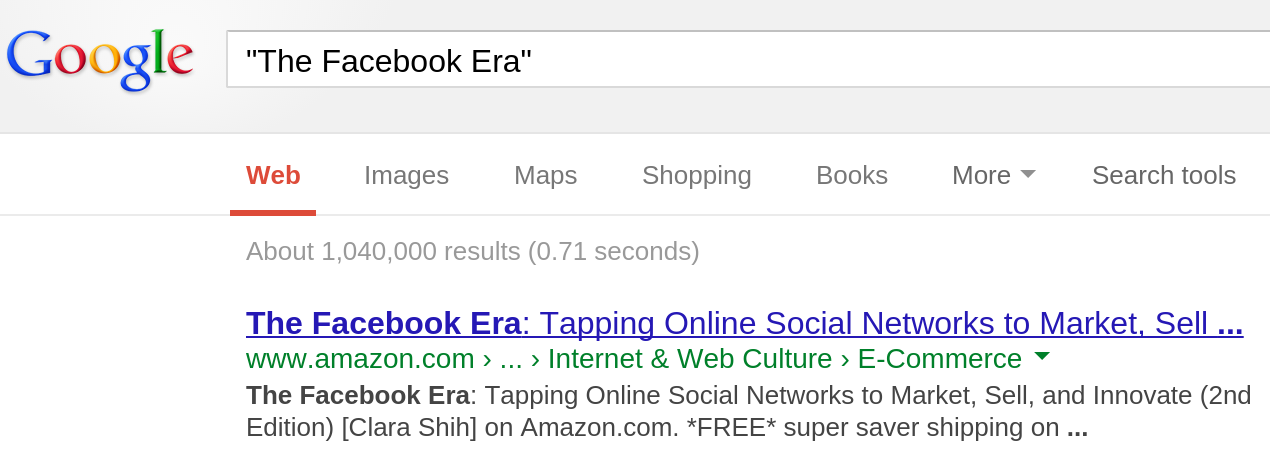
With some quick research, it's clear there are many players vying for the elite status of owning our tech-savvy era. I tapped into Google (disclosure: I work there) for a few examples. Let them play out and see if you favor one over another or have a better option. All screenshots current as of Friday, August 16th, 2013.


The iPod Era: 69,100 Google results
Represents: The iPod at peak was more than half of Apple's revenue, outpacing Mac and all software sales. The iPod was a cultural phenomenon representing fashionable portability of digital media and personalization of music listening.
Is it over? Yes. According to AppleInsider, the iPod Era ended in 2010.


The iPad Era: 132,000 Google results
Represents: The first successful tablet computer disrupted the old way of doing many things, and picked up where Apple's iPod and iPhone had left off.
Is it over? Probably not. The iPad Era launched in 2010. Debate from AdAge questions if it's done.


The Google Era: 259,000 Google results
Represents: Near-instant retrieval of information, and a reduced need to memorize. Ability to scale.
Is it over? Nope, unless you think Business Insider is onto something.


The Twitter Era: 401,100 Google results
Represents: Near-instant ability to communicate and a real-time medium.
Is it over? No.


The Facebook Era: 1,040,000 Google results
Hey look! A book: The Facebook Era
Represents: Increased connections with social ties, and ease of discovering personal information.


The myspace Era: 59,500 Google results
Represents: Like Facebook, only earlier, more personal information online, simple creative sharing.
Is it over? Yes. Absolutely. This dude missed the whole thing.


The Blogging Era: 150,000 Google results
Represents: Ability for anyone to publish, in long form, at no cost.
Is it over? Getting there. In 2004, this guy claimed 2014 would finish it up.


The Android Era: 297,000 Google results
Represents: The entry and rapid adoption of Android as a smartphone OS. 
Is it over? No.


The YouTube Era: 210,000 Google results
Represents: The ability of anyone to publish video and have it be seen around the world. Also represents casual video consumption relative to professional 
Is it over? No.


The Dotcom Era: 1,490,000 Google results
Represents: Referred to as much as a bubble as an era these days, the first rush online by traditional services and businesses. Many did exceptionally well. Many more disappeared. 
Is it over? Yes. At least the first round.


The Microsoft Era: 423,000 Google results
Represents: The last few decades of a world where personal computing was dominated by Windows PCs and Microsoft software.
Is it over? Many people think so. In fact, a "Post-Microsoft Era" has been discussed.


The Steve Jobs Era: 67,900 Google results
Represents: Steve's personal impact on the world of technology, design, marketing and one of the most successful companies in Valley and tech history.
Is it over? Unfortunately, yes, as Steve passed away, but his impact lives on.


The Netflix Era: 41,600 Google results
Represents: On demand instant access to a wide variety of films and TV shows, and the business impact for those in more traditional markets. A disruption of Hollywood.
Is it over? No.

So what era are we in? If you went by total numbers, the Dotcom Era had the most Google results, but that's historical by nature. The Facebook Era is in second place, with Google properties, including YouTube and Android having nearly as many when combined. The iPad era is still strong, with Twitter putting on a good rising show, and Microsoft being high in the rankings, given its market penetration.

Other good options I either didn't run or tested but cut so this post isn't a mile long... "The Yahoo! Era", "The Amazon Era", "The Google Glass Era", and more... it's all fun. Can you think of others? What's the winner in your view?