Showing posts with label iTunes. Show all posts

September 12, 2011

In-App Purchases: By Account or Device?

In a world where the Web is increasingly consumed on mobile devices, and applications on iOS, Android or other platforms continue to proliferate, developers are turning to in-app purchases to drive revenue, not just for premium applications, but for free applications that often get you in the door, but entice you to pay up for additional features. But what many developers aren't preparing for is a world where consumers have multiple devices, but carry the same apps - putting the customer's data at risk, tied to a single device, even when a centralized cloud solution seems like a reasonable and much more modern, alternative.

Traditionally, premium software vendors have asked customers to pay on a per-install basis. Want to run Adobe Photoshop on multiple computers? You have to pay a multi-user license. Want to run Microsoft Office for the whole family? Get a family pack. But on the mobile side, thanks in large part to Apple's leadership on the iTunes store, and other app stores, including the Android Market (tied to one's Google account), premium and free applications are synched on a per-user basis. Want to upgrade your iPod or iPhone? A sync with iTunes should get your apps back. Purchase the latest Android tablet or phone? Log into Google with your account, and the Android Market will start feeding you your apps.

That said, synchronization of content between devices is comparatively poor. For every cloud-based app like Gmail or Spotify that recognizes your ID and displays your information on every device, one finds applications that live on your phone or tablet, and don't communicate to any parallel installs you have. (See iTunes' guidance on this issue) This leads to the very common issue known by any Angry Birds addict, who finds themselves conquering the same levels from phone to phone to computer or even on Chrome, instead of starting where they left off. If you love killing pigs and burning time, that's wonderful, but I'd bet many people would find it valuable to log in with their account on any device, and continue where they left off. Some apps, like Barnes and Noble's NOOK app, do this very well, but many miss the target.

The situation becomes even more complicated with the advent of in-app purchases. Forget about the Mighty Eagle (just one dollar per level!) in Angry Birds. You can purchase weapons and tools galore for sports games and strategy games on your smartphone, but many application developers are making the purchase much like they did in the traditional sense - assigned by device, not tied to your Apple account or your Google account. That means that not only do your premium purchases not follow you from device to device, but even worse, if you have to reinstall your mobile OS for whatever reason, you've lost the in-app purchase data, and probably a bunch of the app's history as well.

Living on the bleeding edge of early adopterdom as I do, I've learned to be flexible with the occasional bumps. I got hit with this in-app issue this summer when I had the chance to reinstall Honeycomb on my Android tablet from Samsung, only to lose the in-app purchases I'd made on the 9 Innings baseball game, along with dozens and dozens of games played and players acquired. While I didn't have to rebuy the app itself, which is great, I was starting on Opening Day all over again. That's nuts.

I can understand application developers wanting to ensure they receive appropriate payment for their apps being downloaded and enjoyed. I think the functionality of in-app purchases is a great expansion of mobile commerce. But in a Web-centric mobile world with centralized accounts, storing one's application data on the device, without backup in the cloud, seems short sighted. Many of us carry multiple devices, and may some day upgrade our phones and tablets. It'd make more sense for me that we can do so without fear of losing our progress and our premium buys.

August 17, 2011

Spotify Playlist Sharing Can Make You DJ for the World

On Friday, I mentioned Spotify's recent update that brought artist radio to the on demand music service, aiding for music discovery through similar bands and genres. But one of the main ways to discover music on Spotify is through your friends, thanks to the ability to design dynamic playlists and subscribe to any you find interesting. The social element, should you choose to leverage it, means you aren't just making playlists for yourself, but for anyone who wants to listen, making finding a new song even more exciting, as you can pass it on to your listening circle.

Having built my Spotify playlists largely for myself over the last two years, I haven't done an amazing job of curating them, and honestly, it's probable that the first one (Louis' Spotify) has gotten a bit stale. Even I don't listen to it as much as I used to. But I was jolted into paying attention when Facebooker Tudor Bosman, formerly of FriendFeed and Google, pushed me to keep updating the playlist. Apparently it is good background music to code to, and I wasn't doing my job well.

Tudor Asks Me to Keep My Spotify Playlist Flowing

With him now firmly in mind as my target audience, I know am even more interested in finding new music worthy of being added to the playlists. I even went back and cut many of my early adds, knowing I wanted to get the set right. Even if Tudor is my only listener, a good DJ just wants to be happy by making people dance. (Little known fact - I was the station manager of our campus cable radio station in high school and logged hundreds of on air hours) So now when I bump into a great song on Spotify, I add it to the playlist and imagine Tudor seeing the new song fall into his queue.

My Spotify Playlist Needs Some Updating for Listeners

Of course, Spotify's not the only service that has allowed for shared mixes. Apple's iTunes launched iMixes years ago, and I even wrote about my first one more than five years ago. But since the launch of iMix, Facebook blew up and Twitter debuted. This, in addition to other networks, has set the foundation for increased sharing one to one and one to many. Spotify posts have made up a good amount of my Twitter stream, and I've found new bands in my in box on the service, some good and some less so. 

Unlike Apple's iMixes, which if I remember correctly were to be published once and never edited, Spotify's playlists are dynamic. As I add or drop songs, the subscribers get new content and new arrangements. No good DJ plays the same set twice, and the same is true here, even if the subscribers are virtual.

August 12, 2011

Spotify's Artist Radio is Music Discovery, Pandora Style

While I've been head over heels for Spotify going back two years now thanks to its increasingly deep music library on demand to my laptop and mobile devices, integrated social sharing with friends and high quality sound with practically no buffering, I have seen some pushback from people who, seeing it for the first time, found it great for playing music you found, but not great for finding new music, in the same way that Pandora and Last.fm are known.

But there is a solution. It's called Artist Radio, and the company quietly pushed it out at the end of July without much fanfare. The combination means you can get the musical serendipity you like about Pandora and Last.fm, the social recommendations from friends, and yes, all the music you can eat on your own.

Here's how it works:

1. Search for any artist in Spotify (Examples: Underworld, The Cars, Blink 182)

Searching for Underworld Gives me a Track List

2. Click the artist name in search results.

The Underworld Artist page shows hits, albums... and see that at the top?

This brings you to the dedicated artist page, complete with their Top Hits, Albums, and even lower, compilations where their music appeared. Almost all artists have a short bio, as well as a list of "Related Artists", one fast way to find similar music. But there's more.

Underworld Artist Radio Plays More than Just Underworld...

3. At the top is a tab called "Artist Radio". Artist Radio performs the same way as an artist's channel plays out in Last.fm or Pandora. If you select Underworld as your artist, Spotify will play songs not just by Underworld, but by bands including Orbital, Fluke, DJ Shadow and more. Dr. Dre sets up Snoop Dog, Eminem and N.W.A. Tori Amos plays music from Kate Bush, Bjork, Suzanne Vega and others. You get the idea. Without having to go find more music yourself, Artist Radio streams a set of new tracks to you until you hit the stop button.

As longtime Pandora and Last.fm fans will attest, finding new music from artists that are similar to music you already like is a great way to find new bands, new albums, and keep your music library fresh. Spotify hasn't talked a lot about this for its new US audience, but the combination of related artists, artist radio, and social recommendations probably puts the service ahead of all the others in terms of total offerings. So for me, someone who hasn't paid any money to iTunes music for years (aside from upgrading to iTunes Plus for Google Music) and who just disconnected Sirius XM Radio to save a few bucks, I enjoy letting Spotify play DJ. So if you tried Spotify at first and missed this feature, come back and check it out.

July 14, 2011

Spotify's US Launch Goes Well as Listeners Flock for Invites

My experience with early access to Spotify in the US has been nothing short of game-changing in terms of what I expect from my music, and after my having said so for about two years, I know a good number of folks got fatigued of the promise, and just wanted the company to ship already. Today, as was much-anticipated and well reported, Spotify did open its doors in the US, bringing the massive on-demand music library for desktop and mobile devices to the world's biggest music market. The service was open via invitation only, as many found themselves refreshing their email boxes, waiting for the invites to arrive. Luckily, thanks to my ongoing relationship with the company, especially their Head of Special Projects Shak Khan, I snagged a dedicated URL with invites and passed them around on Google+, Twitter and Facebook before I had to zip off to something resembling a real job this morning. The link is here: http://www.spotify.com/us/louisgray/

In case it wasn't obvious, go get it ... now. I'll wait.

After much waiting and an equal amount of hyperbole, the arrival of the music app took on a life of its own, overshadowing the actual delivery of a new challenger that could change the way many of us consume and share music - as much as Napster and iTunes did in their own times.

Quickly stated, Spotify is a streaming music application that offers the deepest legal library of music available for multiple platforms. Unlike the lock-in faced from the iTunes/iOS side of the world, I can get to my Spotify library from any Mac, Windows or Linux computer, and any Android or iOS device. In addition to having incredible instant access to music with almost zero buffering, even if I have never listened to a track before, I can link Spotify to my Facebook social graph, share tracks and playlists with friends, and browse their own listening preferences to discover new music.

Spotify Highlights My Artists, Tracks, Friends, Starred Songs and Much More

In the last two years, when I heard of a new band or a new album, invariably I checked Spotify to see if the music was available there first, and in almost every case it has been - often weeks or months ahead of iTunes, Amazon and others. I often put Spotify to the "name an artist or song" challenge to friends who tried to find some lesser-known band to stump the service unsuccessfully, and then would skip to a later part in the song without any hiccups.

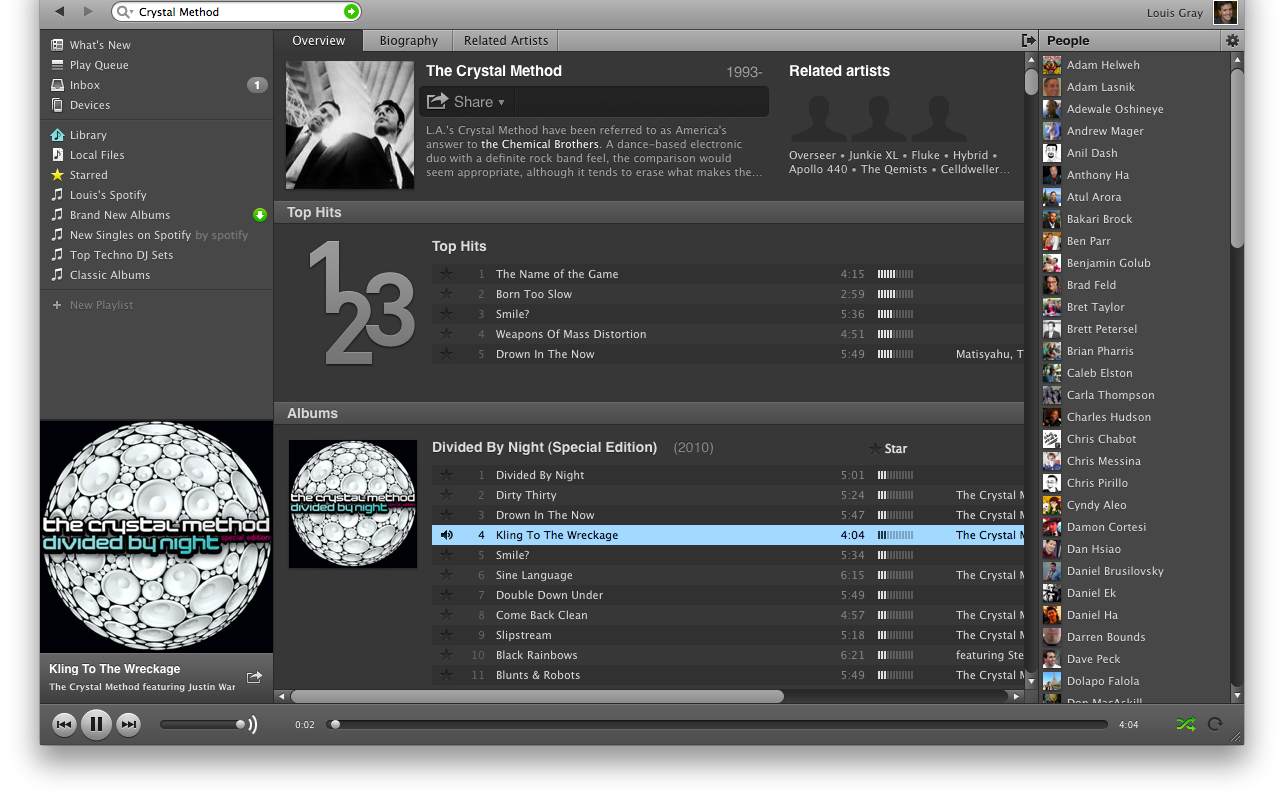
The Crystal Method playing on Spotify. Note the Scrollbar's Size for So Many Tracks!

Through the wait for Spotify's arrival, much attention was placed on the service's plan to continue with a free option for listeners, which scared the heck out of music labels. After much finagling, they landed a way to offer a free, entry price and premium price for the service. Considering premium is only $9.99 a month, it's a steal, period, and I'd expect serious conversions to the higher models. Spotify has also reportedly provided upwards of $60 million in music royalties to artists just in Europe alone in the previous year, putting them second highest behind iTunes. Add the USA to the mix and obvious virality thanks to social networking, and that number is bound to jump.

Pro Tip: Subscribe to the New Singles Playlist to Get New Stuff Immediately

As many skeptics have stated, Spotify does not enter greenfield territory, being flanked by Rdio, MOG and other streaming services, including the grandfather of the bunch, Rhapsody. The company's app is serviceable, but not beautiful, and music discovery could see some improvement. But that hasn't stopped practically everybody I know (myself included) from getting addicted to the service and using it with practical exception of all else. The flexible combination of downloads, streaming, playlists, sharing, and pure high quality sound sets Spotify apart from the rest, and you could see A-list artists as excited about the debut as we have been.

My Friend Charles Hudson's Profile on Spotify

As my invite URL link bounced around the social networks, emails started getting delivered late in the evening, and everybody who has been graced with a Spotify invite almost immediately sees the value and knows this changes their game. I am glad I haven't lost my purchased music converted from iTunes to Google Music, and love that GMusic is in the cloud, for Chromebooks' sake, but Spotify's got me in every other place. Sometimes, even after all the hype, things are better than expected or stated. With Spotify, this is one of those times. You owe it to yourself to try, if you've been locked out before. I am so glad I no longer look elitist with my early access. Go get it.

http://www.spotify.com/us/louisgray/

July 07, 2011

Spotify In the US: Of Course It'll be Great and Affordable

Spotify's long drawn-out arrival in the United States has been rumored and rerumored over the last two years, drawing fatigue from those both eager to get their hands on the service and those covering the space, some of whom have compared the nascent cloud-based music service to the much-delayed Duke Nukem Forever. In the meantime, US-based services like Rdio have emerged as real competition, alongside music lockers from Amazon and Google, and Apple's iCloud, which dropped last month with a feature set that was somewhat underwhelming to those who had epxected Spotify-like features from Cupertino.

In recent months, more news has trickled out from Spotify in terms of their expanding their US office in New York, and capturing deals with the dinosaur US labels, who haven't shown their innovation or eagerness to adopt their sales strategies in recent years, both cozying up to Apple and then cowering in response to their every move. Yesterday, Spotify in a fairly understated way said yes, their launch in the US was imminent, though no date was given, and now you see people speculating on pricing.

After initially having free access to Spotify starting in late 2009, I converted to a true paid for premium plan early this year, at $9.99 a month, bringing Spotify's huge music library to my desktop and all my mobile devices - made even better with solid integration to my Sonos S5 wireless speakers throughout the house. I do not expect that when Spotify officially launches that I'm going to see any kind of price hike, and I am adamant that this is the best deal going. Theoretically speaking, although I prefer lower prices of course, I would probably pay upwards of $30 a month to get Spotify access, just for the feature set they have today.

Due to the delays around Spotify and much ongoing hype, some from here, those who have been on the outside looking in might be tired of the promise and continue their skepticism until they can download the app and gain access to the service - but what was once a pipe dream looks like its coming very soon and at a great price. So if you're tired of hearing about it, you don't look like you have to wait much longer. It's the #1 reason I almost completely stopped using iTunes.

June 23, 2011

YouTube, Android Offer Alternative to iTunes Film Rentals

One of the new product announcements at Google IO in May was the introduction of movie rentals from the Android Market. Following the path beaten by Apple with its iTunes and Apple TV pairing, popular movie rentals can be picked up for the typical price of $2.99 or $3.99 each, are watchable in the next month and playable for 24 hours after you start. It's familiar, but new for Google, who added the option to their marketplace a month ago, making one less reason one has to be shackled to iTunes. The video rental service is powered by YouTube, who has clearly shown they know how to push Web video content to hundreds of millions of homes worldwide, and is ready to try longer-length content.

As mentioned frequently here, I've been a longtime iTunes user, and have slowly migrated away from the platform, thanks to increased use of Spotify and Google Music on one side, NOOK on the other, and now, movies, by way of Android Market, on top of Netflix Instant. The focus is not so much an anti-Apple vendetta, but just finding new ways to consume rich media on my changing array of devices. The more Android and Chrome I have in my house, the less iTunes is an option - until Apple changes its mind.

Some Top Titles On Android Market (Powered by YouTube)

The promise of the Android Market offering is to play these movies right in your Web browser, on any of your Google account-enabled devices. There's no need to download the movie (as iTunes does), but you instead start streaming after an extremely minimal amount of buffering, at either 320p or 480p. Purchases are sent to the account you have registered with Google Checkout, and the item shows in your Android Market purchase history. All straight forward.

Streaming "Just Go With It" On Chrome Via Android Market

In the last two days, I pulled down Adam Sandler's romantic comedy "Just Go With It" and Vince Vaughn's "The Dilemma". Both $3.99, I can play these videos on the Web (and even Google TV's Chrome App) and expand to full screen. In our on demand world, the experience is on par with Apple TV or Netflix Instant, and your service preference depends on the device you're using or the title you want. Using the Android Market interface is actually just a front end for YouTube's full-length feature movie rentals (see all of them here), including films like The Hangover, Harry Potter and The Deathly Hallows, The King's Speech, Knocked Up and many others. It's yet another example of Google trying to push to the browser what traditionally has been handled with desktop client software.

YouTube Reminds Me to Watch The Movie I Rented

My Rented Films Visible on YouTube

I tested the video rentals on my Mac, in both Chrome and Safari and on the CR-48, as well as on Google TV. Essentially, if the app can play YouTube videos and you can sign in with you're Google credentials, you're good to go.

My Receipt Delivered Via Email, Like Any Other Google Checkout Purchase

At Google I/O, it was promised that ChromeOS (and these rentals specifically) would bring more offline access for those outside of broadband streaming. I assume those will come soon, to solve for the poor souls stuck on airplanes who still want access, and might still be going to Apple to shell out three or four bucks at a time.

June 07, 2011

The Split Definition of Cloud Suits Those Speaking

Like any good Mac user and tech fan, I absorbed yesterday's announcements with Apple with great interest - knowing the OS updates will be hitting my laptop in a few months' time, and the iOS feature bumps will reach our array of iPod Touch and iPads at home - eventually seeing the best of these new features trickle out to non-Apple systems (including our Androids) thanks to the continued leapfrogging we see in this closely followed industry. But where Apple struck was where one would expect them to - in a manner that suited their interests. It's not necessarily always best for the future, but what's best for them. All money-driven companies would love to shape the future to meet their needs.

The most heavily anticipated updates from Steve Jobs and crew yesterday pertained to their introduction of iCloud, the next generation of MobileMe and iTunes. With Google and Amazon having announced music lockers, and streaming services like Spotify, MOG and Rdio in the mix, Apple's big move into the cloud was much-discussed, as news items followed each label, signature by signature, and watched the tea leaves to try and anticipate what Apple would deliver.

Apple used the term iCloud to represent the near-synchronization of digital media between a host of devices, from music to movies, books and photos. Buy once and play anywhere was the idea. No more moving of data back and forth. That's good stuff - and much was made of the $25 a year iTunes Match, which would push all your music, purchased on iTunes or not, to your other devices. Very clean, but oddly misrepresented, I believe. Apple says that iCloud stores your music, and its description page strictly states "your music is stored in iCloud", while the music automatically appears on your registered devices. But it's not streaming, and it's not as if when you are playing your music that you are doing so from their cloud. You're still doing it from your local device.

In contrast, we have seen two major business models from more acceptably-labeled cloud music services. The first, like Google Music, has you upload all your tracks (which can take a while) and then you can play them in a Web browser, any Web browser with your Google credentials, and play any time you like. The music is hosted in the cloud and streamed to you. The second, like Spotify and others, lets you tap into their available tracks, including playlists you've made from that library, and stream it to you.

Apple did not announce either of those approaches yesterday. They kept with their device-centric model which is making them billions of dollars and quite honestly, simplifying the Web and applications for millions of people. As I joked with one ardent Apple fan yesterday, Apple makes other people's inventions beautiful. They do quite a bit of innovation on their own, of course, but they sure do know how to take other people's ideas and make them look fantastic. But they didn't turn their back on their devices, despite talk of making them second-class citizens.

Google's approach on being truly Web-centric, and not tied down to specific devices, supports their business model, of course. They are making money from Web services (and associated advertising) while commoditizing hardware, which we will see with a big kickoff in a few weeks with the launch of the first ChromeBooks. The ChromeBooks, including the CR-48 which I've been using since December, bring you the Web and nothing but the Web. Sign in with your ID and get your content. Sign in with somebody else's ID and get their content. It's a fantastic idea and one that clearly supports their own business strategy. Their cloud interpretation supports what makes sense for them.

The divergence between these two players' strategies was in clear display yesterday. As a Mac user who has multiple Apple devices and a host of iTunes files, having them everywhere is cool. But I did also make the move to put them in the cloud (Google's version) and love the fact I can get to them from anywhere. Having used the CR-48 a ton lately, it's eye-opening to think of how the hardware is practically disposable. Assume you're logged out and it gets stolen. So what? Go buy a new one. For the price of a high-end iPod, you get everything back. No lost data or preferences. Google's interpretation of the cloud, which matches their interests, has some kind of real value to the user, and so does that with Apple.

If I was looking for a big announcement from Apple yesterday to keep me on iTunes instead of Spotify, it didn't come yesterday. I didn't see a major reason to stick with MobileMe/iCloud instead of Gmail and Google Docs either. But I absolutely see real value in their introductions, and anytime you see major companies slugging it out on quality for their users, everybody wins. But don't expect them to tell you what the future holds, unless you know that their projections are directly in line with what they can sell you today.

May 27, 2011

How to Scrobble Your Google Music Plays to Last.fm

Google Music is very much a beta product, but one that is going to get a lot of attention as it becomes more widely available, competing in the online music world with Apple's forthcoming cloud music player, Amazon's cloud player, and Spotify, which thus far has focused on desktop or mobile applications to play on-demand tunes.

After taking a few days to upload my music to the cloud, I'm enjoying getting access to my tunes on any computer I want, from practically anywhere. But the service doesn't do a few things that are practically a must for me - first, update Last.fm with my listening history, and second, play to my Sonos S5 setup at home, leaving me to listen through my laptop or phone's speakers.

Last.fm integrated into my Google Music Player

After politely venting about these product holes on Twitter this morning, the first of these two holes was solved. Daniel Slaughter, a Web Developer at Grand Valley State University in Michigan alerted me to a project of his that brings Last.fm scrobbling to Google Music, letting the OCD side of me enjoy the music again, while keeping my statistics up to date.

Google Music Player updating Last.fm

His project, simply titled Google Music With Last.fm, is a script that runs on FireFox 3 or 4 with Greasemonkey installed, or of course, Google Chrome. To get it running, I downloaded and ran the script, and a new Last.fm section showed up in my Google Music. Once I had authenticated the application to update my personal Last.fm account, the song plays and history started to rack up.

If you're one of the early folks to gain access to Google Music Beta, and you miss the Last.fm integration that practically every other music player (including Spotify and iTunes) offers, you'll want to get this script going. Very easy to add and very clear to see the benefit. Nice work, Daniel.

May 19, 2011

Google Music Move: Days of File Transfers Ahead

Around noon on Wednesday, I fired up my old laptop, downloaded Google's Music Manager, and started the process of uploading my vast, but long-neglected, music collection to the cloud. Assuming the migration is complete, I'll have a Web-based repository for all the music I've purchased, as a companion to all the on-demand music I can find using Spotify - a match I like a lot. More than 30 hours later, thousands and thousands of my songs are on Google Music in beta. Yet, there are thousands more to go - highlighting a process that may be a challenge for users who may consider making a similar transition. And once they are uploaded, it's not clear if there's a way to get them down from the system if I want to move again.

My blogging colleague MG Siegler, he of ParisLemon and TechCrunch, argued yesterday that Google's move to open up a music locker (as Amazon did) without first gaining expensive deals with the music labels, has essentially locked up the market for Apple, who is quite unwilling to lose their leadership position in the market. He argued that the complexity of moving one's library to the cloud, instead of a simpler, faster way of matching your library to a known database and providing you access (as LaLa once did) would be a major stumbling block for the curious consumer. Putting MG's pro-Apple bias aside, there is some truth to that, if a known brand has a simpler solution and an official relationship with approved music downloads, the value to the cloud locker from a competitor is not obvious.

Downloading 1,945 high quality iTunes Plus tracks

As you know, migrating one's library out of iTunes and to a secondary location, be it Google Music or anywhere else, cannot happen for DRM-locked content. To strip one's iTunes library of the DRM, one must first pay Apple upwards of $.30 per track to upgrade to iTunes Plus. For a library like mine with thousands of tracks, this upgrade can (and did) cost hundreds of dollars - a steep pair of handcuffs, considering one doesn't get any new music in the deal. Converting to iTunes Plus doesn't actually upgrade the songs directly, but downloads brand new tracks in their place, and you have the option to delete the old files.

With a goal of completing this process, come Hell or high water, I gave Apple more than $340 yesterday to upgrade 1,945 tracks - at the same time as I had already told Google's Music Manager to upload my non-DRM tracks to the cloud. After about an hour, Apple sent me an email to say my tracks were ready, and I could begin the downloading process. So I set my old Mac aside, and put it to work, downloading the nearly 2,000 tracks at the same time as Google was uploading thousands more. Good thing I have unlimited bandwidth...

Google's Music Manager Has Uploaded 3,000+ Songs So Far

With my iTunes library now fully Plusified, Google Music has full go-ahead to get my music and that's happening. At this pace, it's likely the first pass of my full library will complete mid-day or late tomorrow, about 48 hours after I started. This process would take longer if it were on my primary machine, doing other tasks, or constantly interrupting the move by putting the machine through normal on/off paces.

Assuming the process completes, I am excited to have all my music in the cloud, searchable and playable from any computer where I am logged in. But as one person asked me, what if Google Music goes the way of Google Wave? I don't think it will, of course, but what if I want to take my more than 50 gigabytes of music down from the cloud, back to a desktop, or move from this service to another?

My Top Songs from iTunes Are Making it to Google Music

One admirable passion Google promises is the support of Data Portability. Its Data Portability Project is focused on letting users move data in services and out of services. You can see the conflicts over data ownership flare up especially in the battle with Facebook, who let users pull in Gmail contacts, but didn't let Google do the reverse. So I am a little surprised to see there isn't yet a way to bring data out of Google Music. Yes, it's brand new and early, but there's no talk, unless I missed it, about getting your music downloaded - be it one track or many. You can delete songs from the service. You can edit them and all their metadata, but you can't move them once they're uploaded. This means if you don't fully believe that Google Music will be around forever, you might still want to keep a second copy somewhere.

There is no doubt a considerable back story to the labels' fights with Google, Apple, Amazon and Spotify. I've heard people say there are hundreds of millions of dollars being promised up front and the biggest payer wins. Google said at Google IO that the expectations were prohibitive and they couldn't agree to such arduous terms. If Apple offers a comparable service on the cloud that knows one's iTunes purchasing history, and can eliminate the need to upload and store songs, but get the benefits of cloud, it will have a leg up in usability. I expect in coming months we will hear more from the Google Music team about improving migration and just how we can be sure we can always own our music.

May 17, 2011

Review: Google Music Beta On Android and the Web

While Apple's iTunes player and associated family of digital devices (namely iPods) is the ten ton gorilla in the digital music space today, competitors are setting up to poke holes in Cupertino's current position, with the on demand socially-oriented music streamers like Spotify and Rdio on one side, and the music lockers like Amazon and Google Music on the other, while Apple is largely expected to counter with its own cloud-based offering in the not too distant future. The music industry being what it is, a near monopoly run by people a little tired of having their businesses eviscerated by smart geeks with software for the last decade plus, no one service has been able to get everything it wants all at once. Spotify's US entrance has been slowed repeatedly, while Google and Amazon stopped short of signing all the labels, launching their service as solo silos, with later deals expected to fill holes. It's a crowded field with much riding on who gets access to what music and in what form.

On that backdrop, Google Music opened up in beta as part of Google I/O last week, not delivering the seemingly infinite music library I've enjoyed from Spotify over the last 18 months or so, but instead, giving a music player in the cloud on any modern browser - pushing me to find my non-DRM music files and transfer them into the cloud for later playing. Not limited just to Chrome, the service plays well with Safari and Firefox on the Mac, and an accompanying Android app accesses the same library - providing you access to your tunes from just about anywhere - convenient once you've achieved the task, but still feeling like homework when you first get started.

Music Manager Gets Me Started with Google Music

As noted Sunday, my main media Mac (an older generation MacBook Pro) has the lion's share of my music, with the MacBook Air having a few hundred songs only - all my activity having leaned to Spotify for the last two years. Nonetheless, I downloaded the Music Manager from Google, told it where to find my music, and for several hours this evening, the application uploaded my MP3 files to my Google Music locker, leveraging my iTunes metadata to correctly assign song details, including artist, genre, and even how many times the songs were played.

The Music Manager Uploads My Tracks to the Cloud

The Result Is All My Artists and Albums On the Web

As Google Music can only post non-DRM tunes, of the 500 or so songs I have, just under 150 were found to be available without Apple's lossless formatting. Music Manager installed itself as a control panel on my Mac and uploaded tracks two at a time to the cloud in the background. I have to imagine that with larger libraries numbering thousands or tens of thousands of songs, this process will no doubt take days or weeks, so if you can use a non-production computer, or can set the job to take place overnight, you're probably better off.

If the Songs Have DRM, They're Not Going Anywhere

You Can Sort Songs By Genre, Artist, Name or Album

In this regards, for traditional iTunes users, Apple may have a leg up in its proposed cloud strategy, pointing to your previous iTunes purchases as being "owned" by you, while you're responsible for uploading or flagging the others from your own collection. The process of uploading seems cumbersome, but should only have to be done a single time. Alternatively, it'd have been great to check my own database of music against a central database owned by Google, who could simply "unlock" tracks or albums for me, skipping the actual data transfer process. But with no deals done, the music locker is simply an empty bin for me to fill, even if the metadata assigned to some of my songs is incorrect.

My Albums On the Galaxy Tab 10 Android App

As my songs started to populate Google Music online, the same familiar user interface most of us know from programs like iTunes, WinAmp and others is displayed, listing the song names, times, artist, albums and play count. Instead of a five star Apple-like rating, you can thumbs up or down individual tracks, but other attributes are the same - including the ubiquitous shuffle feature, and "Instant Mixes" which parallel Apple's "Smart Playlists" feature.

Seeing My Deadmau5 Songs On the Android Google Music App

Playing songs is straight forward in the browser or on the Android app. Click the track you like, and as with iTunes, you can use your keyboard to control most playback - using arrow keys to go forward or back, and hitting the spacebar to pause the song. Other aspects of the service are also similar, including editing track data, although you can't batch edit songs, and as the service is from Google, an Instant Search-like field is available at all times, so if you want to find an artist, song or album, start typing and that from your library will surface.

Searching on the Google Music App In Android

On the Android side, I tested the Google Music app on the new Honeycomb-enabled Samsung Galaxy Tab 10.1 that all Google IO attendees (press included) received last week. As the system recognized my account was tied to my own library, all songs posted to Google Music in the cloud were available on the device - with no downloads needed. On both Web and tablet, the music quality is very good, and i wouldn't expect otherwise.

Playing a Track On Android On the Galaxy Tab in Google Music

After nearly two years' experience on Spotify, the sheer nature of the cloud music is not dramatic, but getting the opportunity to convert my iTunes library from something that is currently locked down to spinning disk on a single computer and a few iPods to something I can access anywhere is no doubt going to be liberating - just like it will be when Apple finally brings their own cloud option, or when I tag my own library within Spotify to auto-add the songs I've purchased elsewhere.

From my talks with people close to the cloud music wars, the dollars and aggression being tossed about between players is intense, in a powerful cascade of one-upmanship from one player to another. Right now, it doesn't appear that Google has paid the top dollar needed to put all the labels in their court and out of Apple's hand, and Spotify is the little guy compared to a major league tug of war between Google, Apple and Amazon. Until this all gets sorted, Spotify remains the best option for me to get music I don't already own, and Google Music is an increasingly convenient option for the music I already do. For my Android-centric world that hasn't messed with iTunes much lately, it's good to know I can welcome back my old albums in my life again.

Google Music can be found in beta at http://music.google.com and the accompanying app can be found on the Android Market here.

April 19, 2011

Physical Media Has To Go. I'm Digital Only From Here.

Moving across town last summer was a real eye opener in terms of seeing how tied we still are to physical things. Beyond all our sundry items needed to survive, there were boxes upon boxes of nice-looking and possibly interesting books and other media - DVDs, CDs, the occasional VHS tape nobody had bothered to toss. All of them took up room, and made for heavy lifting. But there's no real good reason, beyond nostalgia, to ever get any more. I want all my music, photos, videos and books to be electronic, and I want everything else gone - even if it looks great on the bookshelf. Same goes for my kids. Once they're done with their board books, I want them to get used to eReaders. By the time they reach school, textbooks should be relics of the past anyway.

Thirteen years ago, Apple did away with floppy drives on the iMac, ushering in a world where people did well enough to email items via attachment, or in later years, burn copies to compact discs. Ten years ago, I dumped my hundreds of cassette tapes in the garbage moving from one home to another on the Peninsula. Three years ago, I donated hundreds of my CDs to a coworker who liked the same music, and emptied my bookshelf to another friend who didn't mind dog-eared Stephen King and John Grisham novels. Even DVDs are too unwieldy at this point. For software installations, one installs once and the DVD is subsequently irrelevant. Purchasing DVD movies is completely silly in a world with significant storage space, and Blu-Ray never even entered my mind.

Now practically the only physical media I bump into is when a book author wants me to do a review, or when coffee table books are passed along as questionable gifts. Even USB flash drives are starting to feel like old media to me at this point.

In a world where I am constantly connected to some gadget, be it a phone, a tablet or a laptop, it takes serious will power to unplug and dust off an old tome whose number of uses is limited. The books I've been sent to review are piled in a corner on my desk - some probably good, but I might even buy the digital version rather than lug around a heavier three-dimensional copy. The stray Netflix DVD we have around the house just causes me to nag my wife into making our subscription digital only, and everything else I just want to give away in a massive garage sale - cheap!

The long-desired paperless office remains elusive, but for much of the home, it can be obtained. My music is streamed on Spotify, with some playlists and artists saved as digital files. My movies have a short shelf life, typically the 24 hours allotted by Apple TV before they disappear. And I've been reading all my books on the NOOKColor and on the Google Books app. There was a time when people would argue it was worth paying a premium for the physical copy of an item, but now it seems they should have to pay me for the inconvenience.

Being digital only means that exceptions to the rule can fall through the cracks. Bills delivered in the physical mail don't get paid as quickly. Notifications from the DMV can get missed, and late fees occur. It's a problem that hasn't been perfectly solved, and it could just be me making an excuse. But as I see it, if there's an option to go digital, that's my choice. With bandwidth and storage space being what they are, my infrastructure isn't optimized for yesterday's media delivery.

March 28, 2011

What iTunes Needs to Take on Spotify, Rdio & Google

Ever since I gained early access to Spotify in late 2009, I've practically abandoned iTunes for purchasing music. A once-addicted iTunes user who racked up thousands of paid downloads, the only time I ever launch the multipurpose entertainment application these days is to synchronize iOS apps to the iPod Touch, or do a futile search of its TV library to see if Season 5 of Dexter has shown up (it hasn't). But with the widespread expectation that iTunes will eventually launch in the cloud alongside a streaming subscription option, the update has the potential to directly take on Spotify before the fledgling service gets its US land legs, leaping well ahead of Rdio in brand recognition, and doing battle with the still unavailable Google Music - whenever that arrives.

For digital music connoisseurs, the benefits to all these interesting players vying for our business is that we will have more sources for good content on practically every device, and for the most part, at prices that make sense. The availability of competition ensures market rates will be driven down to the point of affordability for most, especially the ardent fans who absolutely "must" have every new album from favorite artists. That the companies are taking different approaches to the market also ensures we'll have a choice of how we want to consume our music - mobile, desktop, a la carte, subscription, or any other way.

iTunes Previews a new Tiesto Album for Purchase (No Streaming)

iTunes' market weight is tremendous. It has been widely rumored they are using their muscle to scare labels away from joining forces with Spotify, withholding artists' positions on highly visible pages within the store that have significant impact. The service, once spartan in terms of catalog, has grown to carry both new releases from practically everyone to deep catalogs from those long since gone. But in the 8 years the store has been open, a few things have been consistent - including the idea that customers want to "own" their music, not rent it, and subscription plans are nowhere to be seen. This has led startups like Spotify and Rdio to become more fashionable alternatives to savvy listeners - and these listeners are both loud and loyal.

Rdio Also Previews the Same Tiesto Album for Streaming

Assuming that iTunes, Spotify, Rdio and Google Music all offer comparable pricing, around $9.99 a month for unlimited play, as both Spotify and Rdio do now, the question for which service makes the most sense hinges on a few major features, namely:

1) A deep catalog of artists and songs

One of the most impressive things about Spotify has been my ability to search for practically any song or artist and find the right answer, often along with a number of remixes for the specific track, or inclusions in compilations. Searching across Rdio shows that in most cases, the catalog is on par with that of Spotify, which makes sense if both firms have executed deals with the same music labels. Spotify seems to have more older albums from artists, and doesn't suffer from restrictions I often bumped into with Rdio regarding availability of full-length streaming in my region.

iTunes Displaying a Nirvana Box Set

In order for iTunes in the cloud to compete, they need to debut with their full catalog, not a trimmed version of options (like they did with the Apple TV 2).

2) Fast access to new releases

If I see a new album is out from my favorite artist, my first stop is to find it on Spotify. If it's there, I can be streaming the new album immediately, or saving it to my playlists. I even have a playlist just for new albums, so I can add entire albums and delete them after listening to the tracks enough times. iTunes will need to match or exceed the speed of competitors to make the service my first stop.

Spotify Showing the Same Nirvana Box Set

3) High quality integration on mobile

It sounds silly to mention this for the company that brought us the iPod, but for iTunes to be a win for me again, it needs to be cross-platform for mobile operating systems. Spotify is available on both iOS and Android, while Rdio is developing for iOS, Android, Blackberry and Windows Phone 7. What do you think the chance is of iTunes coming to Windows Phone 7 soon?

4) Zero buffering

Once a song is streaming on Spotify, it's almost magic to click at any point in the song and have it pick up. After so many different services lag after one moves within the song, the instant gratification is welcome. iTunes has always had high quality with the service being download-centric, and I would hope their cloud could keep up.

Playing Rihanna's S&M On Rdio

5) Social integration and Sharing

Ping is not the social network where I want to share my music, and it absolutely is not where I want to share my playlists with friends and discover their music. The smart thing would be to stick with what you know best, and pick the leaders for the rest. Spotify integrates with your Facebook social graph to show fellow users, while Rdio lets you find friends on Facebook, Twitter, and a host of email providers.

Of course, sharing songs, artists and playlists to social networks like Facebook and Twitter, or by email, would be a prerequisite for a service like this. Enter your social credentials once, and go.

Playing Rihanna's S&M on Spotify

6) Fantastic Discoverability

One weakness to the online music game is discovering new music and artists. If you've gone fully digital, related artists and music will be increasingly important, contrasted to the old days of trusted DJs and radio stations. Without strong discoverability from accurate related items and social clues, the digital music space becomes a broker of sorts, where users get what they look for, but little more. One concern with iTunes here is the division between discoverability and highlighting artists driven by business deals.

Deadmau5 on Rdio - Streaming

7) Portability of Real Music

If you are a paying subscriber to Spotify, you can download playlists so they are available to you in offline mode. While iTunes has long held to the download and own mantra, this should not change dramatically with streaming. I should be able to download songs to my PC or my phone with no problem, with appropriate DRM.

The Deadmau5 Catalog on iTunes

If iTunes can deliver feature-equal functionality to that of Rdio and Spotify, with the same catalogs and pricing, it's probable they will remain the market leader thanks to their massive headstart, software downloads, and access to users' credit cards. Even if they debut something that's almost as good, that would be good enough for most iTunes diehards. What concerns me about iTunes in the cloud, more than pricing issues or flexibility of devices, is them potentially using their market muscle for exclusives that hurt users. For as much trouble as the Beatles deal was, it's no surprise they're iTunes-only for now, but I don't want to start hearing more and more artists saying they are sticking to one digital music store.

For Spotify and Rdio, looking the giant in the face, they've got to go big quick, for streaming and a deep catalog alone cannot make them the number one player against somebody like Apple, who is bound to catch up. As for Google Music, like many of Google's products, they have to clearly communicate why cloud is better this time. Just because something is cloud-based doesn't always make it more desirable. Google will clearly have direct access to Chrome and Android users, which gives them a market, but they too will have to do more than hold serve.

I'm not an iTunes music customer right now. I pay for Spotify Premium, and have paid for Rdio the last few months, though I'm closing the pro account today thanks to its clear overlap with Spotify. If iTunes walks into this space like a bull in a china shop, tossing out new proprietary protocols, higher prices and exclusivity of artists, I'll stay away from iTunes, even on my Mac. But counting out the market giant is silly. I am rooting for Spotify and Rdio (and Google Music) to hurry up before the iTunes Cloud behemoth arrives, but rooting for quality music, fast access and great social links across all platforms, and we should all realize the unsung big player in this space is Facebook. If they choose Rdio or Spotify as their market partner, that would change the game - or they could be yet another player.