Showing posts with label Search. Show all posts

January 30, 2018

Real Valley Stories: Search Marketing With the Open Directory Project

Editor’s Note: Part 12 in an irregular series of stories from my many years in Silicon Valley. Part 11 talked about the time I got called into HR's office to meet with lawyers over industrial espionage. This time, a story involving gray hat search engine marketing in the early days of the Web.

DMOZ is now closed. 

Believe it or not, before the world of automated spiders that crawled the entire Web and ranked the results for your searches, much of the way we found content on the Internet was thanks to manual updates from an invisible army of directory editors. Yahoo! defined the initial dot-com era, with its hierarchical oracle making or breaking traffic downstream, as sites were organized and shuffled into categories by unseen text tweakers, much like the editors of Wikipedia try and keep its tens of millions of article pages up to date, with a seemingly fluid mass of edits to keep the live encyclopedia current.

But Yahoo! wasn't the only Web directory. Rich Skrenta and others, also behind Web 2.0 efforts Topix and Blekko, introduced the Open Directory Project, referred to as DMOZ, for it was hosted on the directory subdomain of the Mozilla.org site, with an objective of harnessing contributions from around the world (like Wikipedia), to build a directory, similar to Yahoo!, that could plug into any site that wanted to host one. In a time when many sites were seeking Internet traffic and riches by acting as the front page for the Web, attaching the open directory project to your portal could give you an edge and not require you to bring on a ton of staff.

As with Yahoo!'s directory, a company's inclusion in the DMOZ directory could act as a binary gate as to whether or not potential users would find you. In 1999, working as a Web marketing manager for a Web startup that offered internet faxing and conference calls, I found myself irked to see that our services were not included in DMOZ. Making things worse, the categories I would expect to see us listed in seemed slapped together and without an official owner. Given my understanding of the space and knowing our many competitors, I registered an account and requested to moderate the relevant category.

The DMOZ Internet Fax Listings from 1999 (via Archive.org)

Not too long afterward, I was given the option to update the category, including those of our competitors. As it was nearly two decades ago, I honestly don't remember if I used my company email or a Yahoo! email or equivalent, but I didn't try and disguise where I worked. My application had gotten through.

FaxCube from the year 2000.
When I did log in, I found the content in a state of abandonment. There wasn't much you could do with a site's listing. Give it a title, a link, and a short description, literally about a dozen words. It was fairly impossible to differentiate services from one another, especially in a commoditized space where the core function was pretty straight forward. But I cleaned up the descriptions for all the entries, including our competitors, to accurately display their offerings. Some offered email to fax services, while others offered the reverse. Some offered broadcast faxing. Some required a proprietary fax viewer, and others were completely Web based. That kind of thing.

When content was edited in DMOZ, edits would later propagate downstream. Sure enough, my colleagues noticed a spike in Web traffic to our main sites, with referrers coming from all the places DMOZ was set up. For no cost, I had a clear impact in our customer acquisition funnel, and maintaining the DMOZ became part of my ongoing work.

Later, DMOZ added the option to highlight two entries in the group, which were solely up to the moderator. This, of course, gave me the option to expand from a gray area, to clearly going over the line into promotion. It went without saying I thought our service was the best, and highlighted it at the top. I also chose to highlight a partner site (the Netscape Fax Center) that was white labeling our service, essentially the 1 and 1A positions.

This got even better when we soon realized DMOZ was fueling search results for AOL. The more people who searched for Internet Faxing on AOL, the better we were to see results.

DMOZ listings for Internet Telephony in early 2000. (Via Archive.org)
In early 2000, we introduced a new Web based conference call and meeting product. Addicted to the free traffic from DMOZ, my team asked me to see if I could get our content similarly included on whatever the equivalent was for Internet conferencing. I poked around, and, again, applied to be an editor for the Internet Telephony page. It wasn't a perfect fit, but it was pretty good.

Again, I got approved, and again, I added our sites, and again, I promoted our main site and a partner site to be included as the pair at the top of results. Again, we started to get plenty of Web traffic from DMOZ and its downstream partners, accounting for more than double digit percentage of our traffic to both properties. But this time, it wouldn't last long. Maybe it was the clear marketing copy promoting both services, but one day, I logged in and saw our service demoted to the standard results, with another in its place. I reversed the change, and it wasn't too long until there was a debate upstream as to whether these listings were in good faith.

PhoneCube, in all its glory, from 2000.
Not too long afterward, my moderation rights had been removed from both sections. I'd essentially been fired from my side job of gray hat SEO, long before most of us knew what that meant. And yes, my engineering peers lamented the loss of traffic, as our more organic listings, on AOL search and elsewhere, didn't carry as much weight, once we became one of the fold.

Had I just stayed content to include our services in the listings, or even just to stay a moderator of the less exciting Internet faxing space, it's possible I could have been editing text descriptions for our sites and our competitors indefinitely. But pushing our own products and our partner sites turned out too good to be true. The "Wild West" Internet traffic rush didn't last forever, and, as it turns out, neither did our products. I was laid off after we couldn't get a funding round closed at the beginning of 2001, and a few months later, the company was parceled off to become part of Oracle (see 2006 post). Some of my colleagues still work there nearly two decades later. As for DMOZ, it too shut down a few years ago, a relic in the world of Google and Facebook.

Disclosures: This whole post is a disclosure! I worked at 3Cube during this time. I work at Google now, a perceived competitor to whatever Yahoo! and AOL call themselves now. And as I work on Google Analytics, this is not a post about SEO to all you SEO/SEM folks.

January 10, 2018

Linking Less and Talking More: Disappearing Web Mentions


The World Wide Web was designed to primarily do three things - inform, discover and connect. A globally connected series of documents could instantly bring you to the thoughts and experiences of someone across the world. In the earliest designs of the Web, it was through hyperlinks that you would find those new voices. Links brought you new sources of data, and those downstream documents led you even further to new people and ideas.

As the Web evolved, and incorporated photos, videos, streaming, and all manner of media, discovery expanded to include search. Without an explicit link, you could still find pointers to new content in the results of your query. Destination sites, acting as content hubs, would surface new content, usually within their network, of recommendations you might like. Ads, essentially links with pretty pictures, would offer another exit.

WebCrawler: One of the Web's first search engines
When blogging was the main medium of first person information sharing, prior to the rise and later domination of real time social streams, the way we discovered new voices was through links to others. I'd mention those I agreed with and highlight, with more links, those I didn't. One popular feature in practically everyone's sidebar was a blogroll, to show those with closest ties or just who we liked to read. And there were custom search engines, like Technorati, which when combined with tools like Google Alerts, could let you know when somebody mentioned you on the Web.

Technorati: The original blog and link search engine
But over time, a number of things happened to chop away at this fluffy cloud of friendly discovery.

1. Many Blogs Gravitated Toward Internal Linking, Not External Linking
The big sites realized that keeping visitors on their own site was more profitable and aided their metrics more than sending them away did. And while there is obvious irony in my posting to my own discussions on this from the past, we actually had lengthy discussions about these internal linking practices in 2007 (Part two and part three
Arguments a decade ago in favor of internal linking were that site visitors were familiar with companies and topics discussed, and could see previous coverage by their publication to learn more if they weren't. And any link off site started feeding the ad revenues of a potential competitor.
2. Dedicated Blog Search Sites Didn't Graduate to Quality Businesses
Technorati was a specialized blog search engine that skipped the general Web and went directly to blogs for its content. Its leaderboard of bloggers was closely watched, as were trending topics on the site that led to see what the blogosphere was discussing. But it was seemingly always in financial trouble, and has pivoted beyond recognition to whatever it is now.  
A 2010 interview I had with the company's leadership team claimed a pivot to quality, but their CEO was gone a year later, and so are pretty much all the discovery tools that initially aided me to find some of the best voices of the Web 2.0 era. And yes, Google Blog Search quietly disappeared not too long afterward.
3. Blog Discussions Pivoted to Real Time Streams and Sharing
As I noted in 2009 (yet another internal link, am I right?), linking between communities was declining in favor of retweets on Twitter or sharing into the stream. The microburst of a little site traffic would provide that one time dopamine hit, but not leave a trail for later web spiders to find.
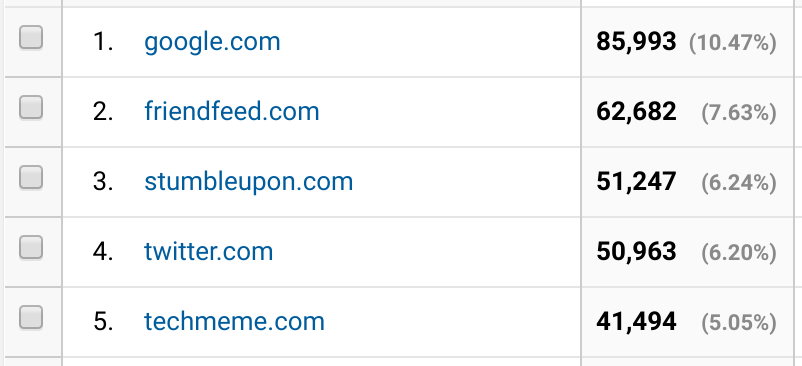
My top referring sites, via Google Analytics, from previous years

As the social streams of Twitter and Facebook took over, and bloggers (me too) got distracted, the share became the canonical mention. Your mentions on Twitter, or your notification of shares on Facebook, were faster delivered and easily quantifiable. And individual profile owners are quite unlike the publishers looking to deep dive into their analytics to discern where traffic came from.

Today, Brent Simmons laments the result of all the mentions going to the streams and leaving the Web. With links decreasing, and blog search being a relic, he yearns for a way to find again how his business is mentioned on the web or when he is being linked to. Joe Gregorio, like me, wistfully remembers analysis of referral logs to find how people found you... all through links.

Simmons' proposal is a limited one, keeping it to the MacOS/iOS community. A small project like that shouldn't be too challenging, but it speaks to a bigger problem, where the connections we once demanded are an afterthought behind the latest viral tweet and trending Facebook share. Streams are ephemeral, but the Web was built to last. It'd be great to see new voices building, informing and connecting again.

Disclosures: I work at Google and am on the Google Analytics product. So I think about publisher tools and visitor stats more than most.

January 03, 2018

How a Google Home in Every Room Gives My Kids Answers All Day


Some time last year, we installed five Google Home units in our house. One was placed in the master bedroom. One each went in both our kids' rooms, as well as one in the office, and one downstairs in the kitchen. Knowing that asking Google any question was just a simple request away, I was eager to see how the family would adjust to having a friendly assistant ready at any time to go fetch answers. What I've seen is that the devices are used throughout the day, and, often, the kids talk to Google before they talk to me.

OK Google, tell me a joke.

The morning starts with Google Homes sounding the alarm to wake up.

As the kids mumble "OK Google, stop", we have momentary quiet, until they shuffle out of bed and ask Google what the weather is going to be that morning. Obviously, depending on Google's answer, this can mean wearing shorts or jeans, long sleeve shirts or short sleeves. If the answer isn't detailed enough, I've heard the kids ask a second time, asking for the high of the day, which could impact how they prepare for PE at school, or if it's going to rain, and they need to pack an umbrella.

One example from our Assistant history.

As the morning routine begins, the first person downstairs gets to be the DJ, asking Google to play a song, which serves as the background music for breakfast. If the song isn't what they wanted, they simply say, "OK Google. Next song." until one they would prefer comes on.


If it's a weekday, we're most likely off to school and work, and we're all out the door. But if not, we probably have another query to Google Home to see how bad traffic is wherever we are going, how long will it take to get there - or sometimes, how the weather will be at our destination.


When the kids get home from school, Google does more than just act as background music device. My 9 year old twins use the Google Homes to confirm math homework answers to see if they are right, or ask it to sub in if an equation is too hard, or if they are unsure of spelling. The Google Assistant is the parent who is always willing to give an answer and never gets tired. 

With the expectation that Google has all the answers, the type of questions can be fast and furious. "What is hypoglycemia?" "Are hedgehogs nocturnal?" "What state is Boston in?" "What time is it in Sydney, Australia?" "What does salutation mean?" "What day is Black Friday?" "What time is it sunset?"

If Google doesn't know, or says, "Sorry. I can't help with that yet. But I'm still learning!", it's usually followed with sighs of exasperation and amusement, as they follow on with a different query more likely to get an answer.

The most popular question asked of Google Home this last year? By far, a simple one. "What time is it?", followed by "how much time is left on the timer?" for those ever important assigned times when they need to be reading, or when kids are taking turns with a game or a device, and need to hand it off to another child.

How many more minutes are left on my timer?

As homework time wraps up, and the kids find themselves on leisure, as dinner is eaten, and things are tidied up, I can hear them play music in each room as they have access to the world's artists on demand. "OK Google, turn your volume to 50 percent." "OK Google, play Katy Perry."

Do they always get the question perfectly right? No. But the device tries its best to guess and provide the answer - or pushes for another try. "Sorry. I don't understand?" or "Try again in a few seconds."

As bedtime approaches, everyone asks Google to set an alarm for the next day to start the process anew. And yes, if you're wondering, we do disable the devices in the kids' rooms by 9 p.m., so they don't end up rocking out in the wee hours. If they want something so badly they need to ask that late, they can ask me.

Set an alarm and call it a day.

The Google Home devices were such a benefit to our house that they were the go-to gift this last Christmas. Given they were only $29 apiece on the Google Store, I maxed out the order of ten, and shipped them in many directions - to family, to friends and even to neighbors, as they too could see the benefit of a smart assistant that takes the kids' tough homework questions on without complaint, and is more than happy to let you know if it's going to rain.

Just like touchscreens and tablets were so easily made a part of our family's life, from the very first iPads, and through the Nexus line, adding voice-activated devices has been simple and the children don't find them daunting at all. After all, who wants to get a laptop out and type in a query?

Disclosures: I work at Google, obviously. I paid full retail for my devices.


August 19, 2013

The Twitter Google Netflix iPad Dotcom YouTube Facebook Era

As technology has weaved its way into practically every aspect of our lives, it has become something of a challenge for historians, journalists and others to try and encapsulate this new era of near-pervasive Internet, dramatically reduced barriers to publishing, and obsessive gadget accumulation.

I grew up in a world where a whole generation of people could be summarized easily, defined by population bumps like the Baby Boomers, a shared experience in battle, as Tom Brokaw frequently cites in The Greatest Generation, or quite simply, by the assigned letter given to those born in a ten to fifteen year period, like Generations X and Y. Now, newsmakers and analysts alike are trying to explain just what this new era should be called. Is there one device or one company or one shared experience that defines us?

With some quick research, it's clear there are many players vying for the elite status of owning our tech-savvy era. I tapped into Google (disclosure: I work there) for a few examples. Let them play out and see if you favor one over another or have a better option. All screenshots current as of Friday, August 16th, 2013.


The iPod Era: 69,100 Google results
Represents: The iPod at peak was more than half of Apple's revenue, outpacing Mac and all software sales. The iPod was a cultural phenomenon representing fashionable portability of digital media and personalization of music listening.
Is it over? Yes. According to AppleInsider, the iPod Era ended in 2010.


The iPad Era: 132,000 Google results
Represents: The first successful tablet computer disrupted the old way of doing many things, and picked up where Apple's iPod and iPhone had left off.
Is it over? Probably not. The iPad Era launched in 2010. Debate from AdAge questions if it's done.


The Google Era: 259,000 Google results
Represents: Near-instant retrieval of information, and a reduced need to memorize. Ability to scale.
Is it over? Nope, unless you think Business Insider is onto something.


The Twitter Era: 401,100 Google results
Represents: Near-instant ability to communicate and a real-time medium.
Is it over? No.


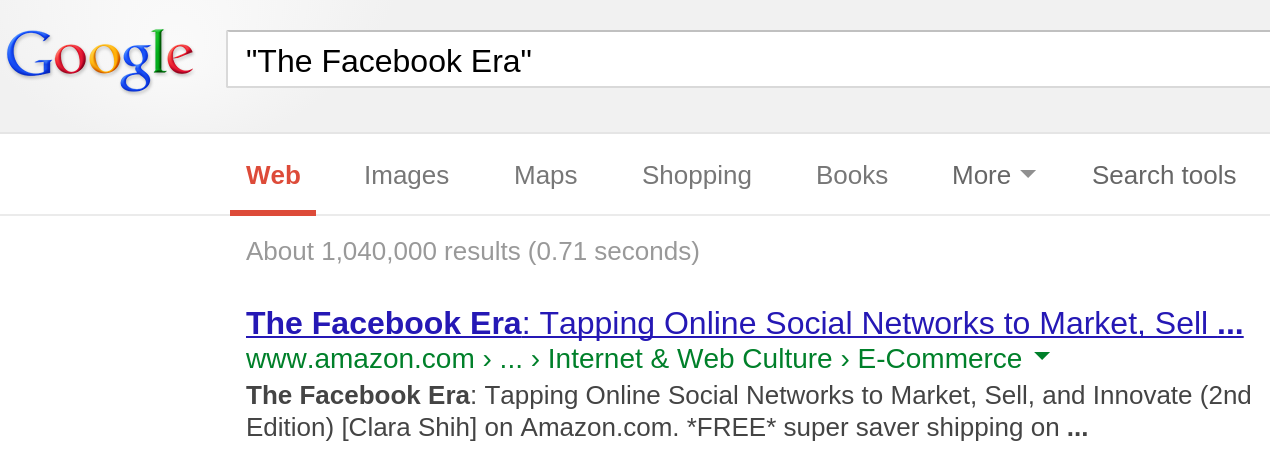
The Facebook Era: 1,040,000 Google results
Hey look! A book: The Facebook Era
Represents: Increased connections with social ties, and ease of discovering personal information.


The myspace Era: 59,500 Google results
Represents: Like Facebook, only earlier, more personal information online, simple creative sharing.
Is it over? Yes. Absolutely. This dude missed the whole thing.


The Blogging Era: 150,000 Google results
Represents: Ability for anyone to publish, in long form, at no cost.
Is it over? Getting there. In 2004, this guy claimed 2014 would finish it up.


The Android Era: 297,000 Google results
Represents: The entry and rapid adoption of Android as a smartphone OS. 
Is it over? No.


The YouTube Era: 210,000 Google results
Represents: The ability of anyone to publish video and have it be seen around the world. Also represents casual video consumption relative to professional 
Is it over? No.


The Dotcom Era: 1,490,000 Google results
Represents: Referred to as much as a bubble as an era these days, the first rush online by traditional services and businesses. Many did exceptionally well. Many more disappeared. 
Is it over? Yes. At least the first round.


The Microsoft Era: 423,000 Google results
Represents: The last few decades of a world where personal computing was dominated by Windows PCs and Microsoft software.
Is it over? Many people think so. In fact, a "Post-Microsoft Era" has been discussed.


The Steve Jobs Era: 67,900 Google results
Represents: Steve's personal impact on the world of technology, design, marketing and one of the most successful companies in Valley and tech history.
Is it over? Unfortunately, yes, as Steve passed away, but his impact lives on.


The Netflix Era: 41,600 Google results
Represents: On demand instant access to a wide variety of films and TV shows, and the business impact for those in more traditional markets. A disruption of Hollywood.
Is it over? No.

So what era are we in? If you went by total numbers, the Dotcom Era had the most Google results, but that's historical by nature. The Facebook Era is in second place, with Google properties, including YouTube and Android having nearly as many when combined. The iPad era is still strong, with Twitter putting on a good rising show, and Microsoft being high in the rankings, given its market penetration.

Other good options I either didn't run or tested but cut so this post isn't a mile long... "The Yahoo! Era", "The Amazon Era", "The Google Glass Era", and more... it's all fun. Can you think of others? What's the winner in your view?  

December 22, 2012

Google Search: Not Just Keywords Anymore


Sometimes I feel like we take amazing things for granted. I asked my wife a minute ago if it was supposed to rain tomorrow. She said, "Good question." So I asked Google. "Is it supposed to rain tomorrow?"

Google was smart enough to figure out I wanted tomorrow's weather forecast for my location. Boom. As for the answer? Yeah, looks stormy. I think I'll file a bug somewhere with the search team to see if they can manipulate the actual results.

December 14, 2012

4 Year Old Sarah Loves the Nexus 7


Quoting from today: "Daddy, you taught me how to use your tablet. You taught me everything I know."

She (and her twin brother, Matthew) are constantly talking to the tablet.

"Google, show me pictures of gorillas."
"Google, show me pictures of a blue lizard."
"Google, show me videos of a zebra."

Google Now is amazing, and this generation knows they can get anything in the world and go anywhere, if they just know what to ask.

/via My Google+ Profile.

December 19, 2011

Time Shifting In a World of Realtime


Nearly three short years ago, the buzz word du jour in tech was “realtime”. Real time discovery. Real time search. Real time serendipity. The explosion of interest in social sharing tools like Twitter, Facebook and FriendFeed (remember this was early 2009) had people (myself included) saying that “Delayed news will no longer be acceptable for early adopters, who will gravitate to the quickest sources of news, wherever they may be.” In practice, while this has occasionally been true, I’ve found a completely divergent innovation to play as big a role in the way I (and others) consume news content and entertainment - that of time shifting, which has remained valuable at a time when most real-time search engines have pivoted or vanished.

Best exemplified by TiVo and other DVRs, preceded by the creaky VCR, the act of consuming media at a time much after its initial airing is so commonplace that live viewings are so uncommon that friends often tiptoe around current storylines for top shows. In some social circles, only the most breaking drama series get the “day it actually aired” treatment - like Breaking Bad, Dexter or Homeland, while everything else goes to TiVo, to be consumed later. (Obviously, I saw the season finales for Dexter and Homeland last night)

News, with some exceptions, can be similarly stored away for later viewing, be it through RSS readers or on your social network of choice. One must not be glued to the real time stream to make sure you don’t miss anything. Instead, the RSS reader traps your own hand-picked links, ready for viewing when you get the opportunity, not necessarily tied to their time of posting.

On the big screen, movies may bank on a massive opening weekend, but with consumers having so many options for entertainment sources, it’s common to see people mention they’ll “wait for Netflix”, which could be months or years away, content to save a few dollars while also getting the comfort of watching in their own home. And if you do find yourself suddenly interested in a show your friends have been seeing which has been out a few seasons, don’t fret, as you can, in almost all cases, catch up - tapping into many options, be they Netflix, Hulu, Xfinity, iTunes or Android Market.

This fall, I made it a personal mission to watch all of Mad Men, after hearing people go on and on about its quality. I powered through it with many late-night Netflix marathons. After finally ordering Showtime, I caught up on this season’s Dexter on Xfinity, and then did the same for Homeland. If my wife misses her favorite shows, she can do the same, tapping into the various video repositories on the web, including the big three networks, typically slower to adapt to the innovation of the web.

I watch my evening talk shows 3 to 5 in a row, from Jon Stewart to Conan, fast forwarding through commercials and skipping uninteresting guests - efficiently getting the best and skipping the rest. It’s almost the same approach I take to my RSS reader or activity on the social networks, skimming, reading, clicking and leaving no prisoners. Even if I’m not constantly connected, and I do a good job of getting close, I don’t feel this sense of missing something.

Realtime reactions to breaking news events, kicked off by an initial discovery, and then rattling around search engines and social media, can’t be duplicated by time shifted content, but for most buckets of content, be they text, audio or video, the drive to be first and in the mix of the story as it is interpreted and curated, is not essential. Advents in information and content sharing over the last few years have instead made “on demand” a reality, getting me what I want when I want it, not when someone else decides for me.

September 21, 2011

10 Google+ Searches You Can Save or Modify

1. TechCrunch OR ReadWriteWeb OR TheNextWeb

For top tech news. If you have other favorites, change the words.
https://plus.google.com/s/TechCrunch%20OR%20ReadWriteWeb%20OR%20TheNextWeb

2. Google+ Search for Google+

Never miss an update about Google+
https://plus.google.com/s/Google%2B

3. Beautiful OR Majestic

What the world finds visually appealing.
https://plus.google.com/s/beautiful%20OR%20majestic

4. lolcat

Hat tip to +Ben Huh 
https://plus.google.com/s/lolcat

5. San Jose (or any location of your choice)

Searches for your city or community.
https://plus.google.com/s/San%20Jose

6. Millions OR Billions

The world of big numbers.
https://plus.google.com/s/millions%20OR%20Billions

7. Rumors

Don't miss a single potential leak.
https://plus.google.com/s/Rumor

8. Obama (or your favorite politician here)

Stay on top of politics or other celebs
https://plus.google.com/s/Obama

9. Oakland A's (or your favorite sports team)

Go teams go!
https://plus.google.com/s/Oakland%20A's

10. Breaking News

Make Google+ your news feed.
https://plus.google.com/s/Breaking%20News

Let us all know some great saved searches you like. +Danny Sullivan is partial to "lol" and "Earthquake".


/via My Google+ Profile

July 25, 2011

Twitter Search Gets Modern Facelift, Index Still Limited

Since Twitter acquired Summize way back in 2008, the company's search engine has been one of the biggest question marks - for while use of the network has risen dramatically, the company has been unable to keep historical data beyond a few days. Recent enhancements, which Twitter termed personalization, help to separate quality updates from junk, but for the most part, the situation with the search engine remains the same. Today, the search engine saw flickers of life with a design revamp that brings the front-end of the engine in line with Twitter's newish Web interface. It also brings forth the "Promoted" search queries which the company is relying on for revenue.

Over two years ago, I talked about how Twitter's search engine became increasingly less useful over time thanks to a shrinking index and oddities, like being unable to find any tweets from specific users, or missing data, even when search operators were used. At the time, I asked if this would be a "temporary blip" which I hoped would "come back soon", but the company has prioritized other features. In the meantime, a deal with Google to provide realtime updates in their search results lapsed. So we're still stuck with the few days of results, just in a prettier format.

The new Twitter Search Front End, Including Top Trends by Your Geo

In addition to the cleaner look of Twitter search, the service also has a new example pop-up for search operators. While the practically ancient "flight :(" example held over from Summize remains, new are example searches including "from:alexiskold", "to:techcrunch" and "@mashable", nods to the GetGlue founder and top blogs who give Twitter a lot of press.

Also included? The optimistic operator: "superhero since:2010-12-27" which says it will return results "containing "superhero" and sent since date "2010-12-27" (year-month-day)". If you do run that query, you'll get responses dating back all the way to July 23, 2011. Where the rest of the 7 months' results are is anybody's guess.

Search Operator Options on the New Twitter Search

Despite one's social networking preferences, the data inside Twitter is extremely valuable. The company really could have a lead on being the realtime pulse of the planet. This makes prioritizing new tweets the most important, but I'd bet the world could benefit from more than a week's worth of content.

July 17, 2011

My Top Ten Favorite Google Products (2011)

Google makes a ton of products. Almost two years ago, thinking about it, I posted my top ten Google products at the time. Google Reader was #1, Blogger was #2 and FeedBurner was #3. Since then, G+ has come into play, I switched to Android and Chrome is on fire. It's time for a rewrite.

The Original Post from Sept. 2009: My Top Ten Favorite Google Products

Here's what I would list now. Eager to hear your own top 3, 5, or even 10.
  1. Google+ (Obviously, this is my start page, I am here constantly)
  2. Android (The mobile OS runs my favorite tablets and phones)
  3. Google ChromeOS (Living in the cloud is a game changer)
  4. Blogger (The easiest, most flexible and stable blogging platform)
  5. Google Reader (Still the best place to follow hundreds of sites in one place)
  6. Google Search (The gold standard for finding anything)
  7. Gmail (Finally my default email, and archive. Buzz is a plus.)
  8. FeedBurner (Takes my blog to the rest of the Web, powered by Pubsubhubbub)
  9. Google Voice (Syncs my phone to the Web with auto-blocking of spam calls)
  10. YouTube (If it happened and is worth watching, it's here. Now with movies too!)
Things have obviously changed in just two years. Android, ChromeOS, Google Voice and Google+ were not on my radar much only a short time ago, and now they're essential. Curious to your own insight and what major services (Analytics, Maps, Earth, etc.) I missed.

/via my Google+ Profile.

July 05, 2011

BackType Buy Latest Boost for Twitter Search, Analytics

This morning, news broke that Backtype, the SF-based, YCombinator founded startup that emerged in 2008 as a blog comments tracker and later pivoted a few times into a professional Twitter analytics company had "gone blue" and joined the mother ship, acquired by Twitter itself. The acquisition is another divider in the haves and have nots for Twitter developers - some who find themselves competing with the realtime short updates giant, and others who find themselves now sporting Twitter badges - TweetDeck included.

The addition brings some a small team of sharp engineers to the growing offices, and expands the company's focus on two pieces that need a lot of help - both search and analytics, though it's most likely the BackType team will be focused on the latter.

Twitter Follower Activity on BackTweets Pro Including Ups and Downs

The company's initial phase, as a comment tracker which let you follow people's engagement on blogs around the Web, was well chronicled here. They were actually listed as the #3 overall new Web service of 2008, and I aggressively predicted they were going to be acquired by the second half of 2009. I even listed Twitter as one of the potential buyers, although my prediction ended up being two years off.

Search Results for "Caylee" Spiking Earlier Today With Influencers, Other Data

After that initial move didn't get the company the traction and/or revenue they hoped, they drafted on the sails of fast-growing Twitter and rebooted with their BackTweets product. In May of this year, they upped the ante with BackTweets Pro, offering detailed analytics for search and user statistics. This appears to have finally been the product offering that gained Twitter's attention. While Twitter has gained a lot in the last few years in stability and UX, the core offerings of the service have been fairly static. Users have had to go to other services to watch individual statistics and see trends on keywords for anything more than a few days. It's surely not a matter of not having the resources or the interest, but it seems to have played a lower priority - something which may change following today's news.

Longtime Twitter watchers also remember 2008 was the time of another acquisition, when they acquired Summize, the basis for today's Twitter search engine, much maligned, but often used. What Twitter has done is learned what pieces of the developer community they can take out like a sniper, and which ones they'd rather not do themselves. Search has never seemed their strength, and we haven't seen many words on making it more fully-featured in a very long time - outside of a lapsed agreement with Google and ongoing relationship with Bing. Considering users aren't making too much noise about it, they've either accepted these shortcomings as long-term realities, or they just don't care. The BackType guys know that companies care about the way their brands are being mentioned or followed, and they just may get their fix from Twitter itself when the products resurface.