Showing posts with label Netflix. Show all posts

October 14, 2014

What If We Redid the 2000 .Com Monopoly Edition for Today's Web?


In the year 2000, as the .com bubble was at its peak, it seemed new tech names were going to rapidly eclipse the old guard. Emails and downloads were new conversation topics, and if you weren’t still on AOL, debates would ensue over which ISP you should choose, or which search engine or portal was the best. Sun was the dot in .com and Linux seemed poised to take over the desktop. Obviously, not everything turned out that way, even if some of the names are still around, and even strong.


The 2000 .Com Monopoly Board

One of the fun collectibles that came out of this time was a .com edition of Parker Brothers’ Monopoly. Instead of properties around Atlantic City streets, you had websites. Community Chest and Chance were replaced with Email and Download cards. And you couldn’t buy property for a few hundred bucks, as everything was in the millions of dollars. Not too soon after the game came out (and of course, I still have it), the .com market was decimated, as the companies of the future weren’t built for the present. Now the game board itself looks like a relic of a short-lived era gone by.

The 2000 List of Companies and Categories


As something of a lark, and thought exercise, let’s consider who would take these 2000 era companies’ spots on the board. I’ll go first with my take on today’s cast of characters.


Dark Purple
2000 .com Monopoly edition: Sportsline.com and FoxSports
2014 .com Monopoly edition: Deadspin and ESPN.com


Commentary: Back in 2000, ESPN, as part of Disney, didn’t have a great approach at owning its web presence. It was part of the Go.com family, one reason it missed the original .com board. Now, ESPN represents sports on all media. Deadspin is an exceptional alternative with sharp commentary that is a must read for serious sports fans. (Apologies to SB Nation)


Light Blue
2000 .com Monopoly edition: GeoCities, Oxygen and iVillage
2014 .com Monopoly edition: Pinterest, SnapChat, and WhatsApp


Commentary: The 2000 edition definitely had a bent toward community. With iVillage and Oxygen, two of the three properties were focused on women. GeoCities didn’t age well and was retired. Pinterest, SnapChat and WhatsApp have become some of the fastest growing communities for pretty much all ages and both genders.


Light Purple
2000 .com Monopoly edition: Shockwave.com, Games.com and E! Online
2014 .com Monopoly edition: TMZ, Buzzfeed and Reddit


Commentary: Shockwave? Really. Let’s move on. For fun entertainment and burning hours of Web surfing, TMZ, Buzzfeed and Reddit can’t be beat. Reddit is a tough one to categorize, as it calls itself the Web’s front page, but it’s knocked off Digg, Slashdot and others for that title.


Orange
2000 .com Monopoly edition: Priceline, Expedia and eBay
2014 .com Monopoly edition: Square, PayPal and Yelp


Commentary: eBay could easily be a repeat in 2000 and 2014. Priceline and Expedia are still doing fine. But Square and PayPal are how the Web does business these days, while Yelp is often the place to go for recommendations on what to buy or where to go.


Red
2000 .com Monopoly edition: The Weather Channel, About.com and CNET
2014 .com Monopoly edition: Dropbox, Instagram and Tumblr


Commentary: About.com looks like a content farm, and while CNET’s still alive and kicking, there’s been nothing to talk about since its CBS acquisition. The Weather Channel? Please. There’s an app for that. And more than just finding content sites, anybody can create and share content globally with apps like Instagram, sites like Tumblr and share it on Dropbox. (Apologies to WordPress, Box and others)


Yellow
2000 .com Monopoly edition: eTrade, Monster.com and Marketwatch
2014 .com Monopoly edition: Wikipedia, LinkedIn and Twitter


Commentary: Monster.com and eTrade were monsters in 2000. I still use eTrade regularly, but they’re not known for their monkey-centric Super Bowl ads any more. Marketwatch is a snooze. Now, people get their financial and business data from each other via LinkedIn, in real time on Twitter, and check its veracity on Wikipedia. (Apologies to Seeking Alpha and StockTwits).


Green
2000 .com Monopoly edition: Ask Jeeves, Alta Vista and Lycos
2014 .com Monopoly edition: Microsoft, Amazon and Apple


Commentary: In 2000, Search engines took the entire final row of the Monopoly board. But the positions of Alta Vista, Lycos and Ask Jeeves weren’t strong against innovators that got stronger in the next decade. Now, diverse infrastructure plays like Microsoft, Amazon and Apple (for many reasons each) occupy this highly valuable section of the board.


Dark Blue
2000 .com Monopoly edition: Excite@Home and Yahoo!
2014 .com Monopoly edition: Google and Facebook


Commentary: That Yahoo! was the Boardwalk of 2000 is telling. Excite@Home was a $6.7 billion megamerger in 1999, but by 2001 was pretty much in steep decline. Without intending too much bias toward my current employer, Google and Facebook are the 1-2 when it comes to the Web today, from the top destinations to hours spent, tools deployed, etc - and both play a role in discovery for everyone.


Railroads/Stations
2000 .com Monopoly edition: Nokia, MCI Worldcom, Sprint and AT&T
2014 .com Monopoly edition: Verizon, Comcast, Netflix and YouTube


Commentary: Worldcom? Whoops. Nokia? Whoops. Things change, and companies don’t always adapt quickly. The megalopoly of AT&T is now most like Comcast’s ISP/cable monolith, and Verizon (including their FIOS offering) is the big carrier to be dealt with. Fighting the good fight, and using a ton of bandwidth in the process are Netflix and YouTube, which are essential media mediums on every device.


Utilities
2000 .com Monopoly edition: Linux and Sun Microsystems
2014 .com Monopoly edition: WiFi and Cloud


Commentary: We’re still waiting for the year of the Linux desktop, and Sun is now somewhere in Oracle’s beautiful campus. But while you could take a stab at a language or a platform, like Python, Ruby on Rails, or even PHP, generically its best said that the storing of data and access to that data are the true utilities of 2014. Pervasive WiFi (or 3G/4G) and Cloud power every app and every site.


Summary: The Web is dramatically larger, and more global, now than it was less than two decades ago. This admittedly English-first version of the .com Monopoly for 2014 misses out on the international communities like Baidu, AliBaba and others. There’s no place for the Uber and Lyft rivalry, and while Tumblr was included, it’s hard to put Yahoo! on the board, which probably isn’t 100% fair. I wanted to find a spot for Spotify and Hulu, but failed. I’d be ecstatic to see if Parker Brothers was up for another run at the web centric board, and you know I’d buy it.


Disclosures: I work at Google, which is a customer, partner and competitor with many of the names on this board. Putting them on a Monopoly board is not an opening for the company (or any other on the board) being a monopoly joke.

September 10, 2014

If Content is Portable, Where You Consume It Doesn't Matter

My good friend and colleague +Adam Singer lit a thought bubble with his latest rant against the dumb pipe of television, saying the formulaic, reality show centric content there is no longer palatable to generations growing up with many more choices - dominated by the on demand, everything's available alternative of the Internet. The summary, he says... is that who actually watches TV is "the old", backed by data from the Washington Post echoing the same.

The argument that the Internet is supplanting TV is one that can't be denied outright, but I believe it's the wrong discussion. What's happening is that the consumers wield incredible power in terms of deciding what they want to watch, when they want to watch it, and where they want to consume it - thanks to dramatic developments in on demand libraries like Netflix, YouTube and others, content destinations, including the smartphone, tablet, and PC, in addition to the TV, and, yes, the humble DVR, which extended the first volley from the VCR (remember those?) and timeshifted our entertainment to take place whenever we wanted it, not when it first aired.

I agree 100% with Adam that a good chunk of the content that fills TV's many channels is low quality stuff that has no redeeming educational value. Then again, the same could be said for much of the Internet and the many social networks we all participate in. Humans love turning their minds off and being entertained. I prefer to not watch reality shows and soap operas, but I do watch TV for live events, and have a list of serial dramas that I watch with my wife - in addition to late night fare like The Daily Show and Conan O'Brien.

One taking a pro-Internet vs TV stance could say, wait. You can watch The Daily Show or Conan online after they air, just like you watch them on your DVR. Sure. You could also, assuming Major League Baseball lets you, watch streaming games live on your tablet through their app. And you can now watch many of those comedies or dramas the same day or later through various network-led outlets online, or on Hulu, YouTube, Netflix, iTunes or some other place.

And at that point, I think the conversation changes. If you're watching The Daily Show online instead of on TV, you've just changed the destination screen, but are still watching the same content. If you're watching a movie on your tablet instead of on your TV, again, you're watching the same content - and the content producers are still bringing you value, whether you're watching on a 5 inch screen or a 50 inch screen.

As an individual, what I've observed in the last decade or so is that as traditional network television has taken fewer risks with their content, and tapped into a soft pudding of reality shows and 24 hour gab events, the premium cable networks are the ones that have delivered an overwhelming amount of perceived high quality content. From Breaking Bad to Dexter, Homeland, The Killing, Ray Donovan, and others, I'm spending a lot more time watching content on AMC, HBO and Showtime than I do on the stalwarts of ABC, CBS and NBC. And I'm paying them money for the privilege.

The success of shows like Breaking Bad on AMC has seemed to lead quickly to top-notch shows like House of Cards and Orange is the New Black skipping the TV route altogether and debuting on Netflix. Netflix marries the quality of premium channels with Internet delivery and on demand, which the new generation likes - leading to binge watching instead of scheduled consumption.

But my enjoying those shows instead of reality tripe on network TV doesn't mean the Internet has won. After all, if House of Cards were to be the exact same, only on CBS, I'd still watch it. When I'm making a decision on what to watch, I'm not selecting the show due to any loyalty to a network, a medium or a device. I'm watching it because I want to be informed or entertained. If the only way I can get live sporting events is on my television, that's where I will go. If the only way I can get House of Cards is on Netflix, that's where I will go.

I never bet against the Internet. I have long been a huge advocate of migrating from analog to digital, and bringing content on demand - all of it - to be available any time anywhere. But it's not a contest to consume on one screen instead of another - even if it makes me seem like an old fuddy duddy.

Disclosures: I work at Google, which loves the Internet, and owns YouTube.

May 02, 2014

Staying Ahead of the Curve on Tech Trends Isn't Trivial

When it comes to picking choices in tech, making the wrong decision on formats, manufacturer, or version can set you back in terms of dollars, leave you with rapidly obsoleted hardware, or find you investing time in something that provides you with non-optimal returns.

As an early adopter, you have a higher tolerance for risk and you take bets on product direction before the rest of the population may agree with you, and your choice to move one direction can act as the initial spark in a good situation, or as the canary in the coal mine, in a negative one. This thought crossed my mind as we saw the news yesterday to Sony's recent struggles, largely tied to their ongoing challenges hawking Blu-ray.

As Sony was quoted in the Verge, "demand for physical media" was "contracting faster than anticipated," and they were left holding the bag. But this really shouldn't have come as a surprise. More than three years ago, I said I was through with physical media, and I haven't looked back. Between streaming video and audio services like Netflix, Spotify and Google Music, or eBooks from Google Play and Amazon, the Web has taken over where physical media couldn't compete.

And let's be honest for you Netflix users? How many of you still get the DVDs? Netflix is a perfect example of a company that saw the transition coming and pivoted to where the trend was going. Now they're overwhelmingly known for their streaming services instead the traditional red envelopes.

The last five years have seen pronounced trends that in hindsight are impossible to ignore, from the rise of smartphones and debut of functional, popular, tablets, and the integration of social networking in all aspects of society. You can debate the ebbs and flows of financials for some of the larger social networking sites, but you can't deny their immediate impact.

On the tablet and smartphone side, there were two obvious trends that people could recognize right away if they kept an open mind. The first was that the iPad was going to be a hit. The second was that Android, due to its partner-friendly approach and rapid iteration, was the horse to bet on.

Without pulling an +MG Siegler and calling this post "I was right. Let me tell you why...", I'll highlight a few bits from both topics.

Let's Talk iPad

Immediately reacting to the iPad's introduction in January 2010, I didn't go over the moon and claim the new consumer tablet would solve world hunger and eliminate illnesses in our lifetime. But I did see it for exactly what it was, concluding, "They are going to sell a ton of these machines, and you'll see them in places you never expected. Casual computing and content consumption are going to drive it." That's exactly what happened, with the hindsight of four-plus years.

The iPad may actually have sold too quickly and been too successful a product to keep Apple beating expectations, but it found a niche between the smartphone and the laptop, and set the stage for the tablet being the first computing experience for my young kids.

Companies that bet against the iPad (or tablets in general) have found themselves swimming upstream, defending an antiquated platform and in some cases, extracting revenue from fatigued customers, whose numbers are decreasing.

Let's Talk Android

While Apple was pushing the iPad and doing tremendously well, iOS wasn't the smartphone OS I ended up enjoying, for a whole bunch of reasons. Six months into the iPad's lifespan, I turned in my iPhone and turned to Android, saying at the time, "a bet on Android is a bet on the future. I am betting on an ecosystem and an application environment that encourages best of breed developers to move their product to a growing population of smartphones, and I expect to reap the benefits. "

There's no question in my mind now that was the right move - and you have to keep in mind that was more than a year before I entertained the opportunity of joining Google myself. I saw the trendlines that pointed to Android being the quantity leader, with greater partnerships and a fast-growing developer ecosystem that brought top apps to the hundreds of millions of users, and that's exactly what happened.

Let's Talk Smaller Tablets


Soon enough, the first generation iPads I bought aged, and another trend emerged - of the small form factor tablet, starting with the Samsung Galaxy Tab, which I preferred, and later the Nexus 7. This 6-7 inch form factor was a perfect fit for customers, as you could see with the rise of the Galaxy Note, ever larger standard smartphone sizes and the rise of the Kindle Fire and Nexus 7 line. Even Apple capitulated eventually with their own iPad Mini, although they're not usually the ones to admit they were late to an idea.

So what am I getting at? I'm not here to tell you I have a crystal ball that tells the future. But you can see, with your own eyes and experiences, what the trends are going to be, and being stubborn because something has always worked one way doesn't mean it's a good idea. You have to evolve as a user, as a developer, as a businessperson, or as a company, to make sure you're impacting that change and choosing wisely. Or you'll end up with a home full of VHS tapes. Don't forget to Rewind.

Usual Disclosures: I work at Google which is behind the Android operating system and is a partner or competitor with many of the companies in this post, like Samsung, Apple, Amazon, Netflix, Spotify and more.

January 07, 2014

Books Step Behind the Curtain of Tech's Leading Companies


Nearly three years ago, I made myself a public promise to stop buying books, CDs, DVDs, or basically any form of media that took up any space. (See: Physical Media Has To Go. I'm Digital Only From Here.) With media stores on practically every platform, whether you prefer Apple's, Google's or Amazon's, and streaming entertainment available from Spotify, Netflix and the aforementioned three, you can get just about anything you want straight to your computer, phone or tablet. So my all digital diet hasn't slowed me down a bit.

The end of 2013 brought us an unusual array of tales on technology going behind the public faces of some of technology's biggest names, including Apple, Google, Amazon and the newest $30 billion kid on the block, Twitter. So I spent a good amount of the holiday break taking in stories, with their own various embellishments, covering the challenges of building a mobile operating system at Google and Apple, the executive tug of war and pivot of Twitter, the focus on design in Jony Ive's laboratory, and how Amazon has craftily executed on its plan to become the single store for everything under the sun.

Taking in the tales of Silicon Valley companies is something I'll likely never get bored of, even if I'm covering the news as a blogger, living the news as an employee, or enjoying the benefits as an end user. So to get all four of these books at about the same time is an embarrassment of riches.

As I've read each of the books on Google Play, I've tried to be a good Web citizen and provide a rating and a short review. If we're connected on Google+ and you look at the book on Play, you'll probably see my take. If you aren't, or we haven't synched yet, here's a quick run through of what I thought on each title. Each title links to Google Play, where you can pick it up too.

Hatching Twitter (Author: Nick Bilton)

Review: "Many characters needed to make a mere 140. Politics over tech, and very public... similar to many startups that aren't quite under the microscope."

Expanding: As someone who's covered Twitter as a blogger for some time and used the service extensively for five years, I had hoped for more insight into how the Twitter team took on technology scaling challenges, worked through product decisions and managed the fast-growing community. Bilton focused primarily on the office drama at the highest levels, and the day to day challenges seem to happen practically invisibly. Also, as noted in my review, as a veteran of some challenging political environments in startups, the executive turnover is not unique to Twitter, but it's unusual for it to become so public, or for the company to survive even with the infighting.

Jony Ive: The Genius Behind Apple's Greatest Products (Author: Leander Kahney)

Review: "Good story. Very one sided. Jony is an exceptional mind working on high quality and highly desired products. The author recaps the highlights and approaches the subject as if Apple is infallible and perfect, which get tiresome. Jony is made out to be a deity. The truth is already incredible. The fable is not needed."

Expanding: Jony Ive and Apple make incredible products. The iPod and iPhone and iMac are great examples of that. I liked Jony's origin story and how he was forged in the UK before making his way to Cupertino. What I liked less was the over the top, breathless deification of Jony that went well beyond what I felt ws necessary. It was so sugary, one had to put the book down every few minutes until you could get enough strength to start again. That's no slight to Jony or Apple, of course.

The Everything Store: Jeff Bezos and the Age of Amazon (Author: Brad Stone)

Review: "The best book on tech in 2013 An intriguing dissection and chronicling of a truly modern company's rise to market dominance."

Expanding: The story of Amazon was by far my favorite of this group. What's striking is the drive behind Jeff Bezos and team to take on incredible challenges, and just get it done. Amazon, through perseverance and ingenuity, skated through the hardest times in the Web 1.0 crash, and came out a world leader, starting new businesses and categories at a pace and scale hard to fathom. If you had to read just one of these four, I'd pick this one.

Dogfight: How Apple and Google Went to War and Started a Revolution (Author: Fred Vogelstein)

Review: "Good stories and current! Only a few obvious inaccuracies, but well intended."

Expanding: This was a fun one, as someone who prefers Android to iOS, but has been a heavy user of both. As someone who knows some more color to much of the stories, I found some of the author's summaries and shortcuts to simply be wrong. I was mostly willing to forgive that, considering the book was entertaining and insightful. I only hope the parts that I liked were true. As a Googler, it actually gave me more knowledge about individuals on the team and their own efforts that I didn't have before, so I appreciated that.

If you're like me, and you live and breathe technology and the Silicon Valley, these four books are a great way to go beyond the day to day headlines and clickbait you see on the "news of the minute" sites. If you are an entrepreneur or even just an office drone like the rest of us, you could learn something, be it the why, or the how, but you can't say any of these books left you more lacking for knowledge at the end than when you started. So check 'em out - digitally.

Disclosures: Yes, I work at Google. Google makes Android and Google Play, and could be a partner or competitor to Amazon, Apple, Twitter, Spotify or Netflix, depending on which product or feature you're thinking about.

December 26, 2013

Now Commerce: Trying to Solve Demand for Instant Gratification


Over the last two decades, the world of retail has transformed from one led by big box retailers who courted shoppers through coupons and print advertorials or splashy television ads, to one where online commerce takes an increasing share of information gathering and eventually, purchasing behavior. Names like Blockbuster and Circuit City will soon be as quaint as Woolworth, Mervyn's and Gemco - symbolizing a generation of stores that didn't adapt quickly enough to take on more nimble competition, who won on scale and speed.

With Christmas 2013 now behind us, the headlines are not just of yes, more shoppers flocking online, mixed in with uncertainty over just how many people were impacted by Target's massive card hacking, but of a completely unexpected surge in last minute buying that doomed shipments by UPS and FedEx, the alpha and omega of delivery systems, connecting the virtual world world with the physical world. But it's clear what's happening. As an increasingly connected Internet populace abstracts the physical world of commerce to an online shopfront, so too vanishes the perception of physical limitations - such as distance, time, and weight.

We are progressing toward a world of "now commerce", where we can order it now, and expect the results practically instantly. The end of 2013 shows we're getting closer, but the system's not yet quite ready for the pressure, even if consumers are.

Simply put: Nobody expected everyone to wait until the very last minute to order Christmas gifts, but everyone did. As UPS told BusinessWeek: "We had our peak projections, and the volume has passed our projections." So all the models failed.

Web giants like Amazon and eBay learned over their young existence to do whatever possible to keep their sites up and keep transactions flowing. Slow load times, inaccurate shopping carts and price mismatches can sap users' patience and reduce trust. So they've prepared for massive amounts of scale - leading to Amazon's supporting upward of 426 transactions a second at peak time, without crashing. But it becomes even more challenging to prepare a physical delivery system like UPS or FedEx for scale of 2 to 3 or 10 times expectations, which is where the system broke, and barring big changes, we should expect this again.

2013 Brought Google Shopping Express to the Bay Area

Take a look at two notable bits of news from two big players in 2013 - the first being Google Shopping Express (disclosure: I work at Google) and the second being Jeff Bezos' announcement of shipment by drones. The promise of both? Even faster fulfillment to customers. In Google's case, they've partnered with retailers in the San Francisco Bay Area to ship under the Google Shopping Express brand, and deliver in specified time windows, just like Safeway.com or traditional meal delivery. Amazon's promise is to take its already fast Prime shipping down from a few days to possibly a few hours. Now, instead of wondering what day you could get something, you just have to know which hour.

Four-plus hours from order to delivery at my door.

Like many others this Christmas season, I put e-commerce to the test with a last-minute order - looking to cross some items off my shopping list, having them come at the last possible moment, to avoid discovery and reduce clutter in my home. So with the knowledge that Google Shopping Express had a noon cutoff on Christmas Eve to deliver that day, I placed an order just after 11, and selected a time window for delivery between 1 and 5 pm that afternoon. As you can see from the screenshot in my email, the gifts were delivered just over four hours later, to my door - not only saving me a trip to the store, but providing near instant gratification.

Often, one's vision of the tech future is colored by the Star Trek computer - one which responds to voice commands, and can produce physical objects by request. It's been said Google is obsessed with building the Star Trek computer, and innovation like the world of 3D printing makes this vision of virtual to physical conversion seem more possible. But before we get that, we're already seeing a generation of people who expect things to happen instantly. One can instantly turn on Netflix or iTunes or YouTube and see practically any piece of video ever made. One can turn to Spotify or Google Music and get any song on demand and play it on any device, practically anywhere, assuming you have enough bandwidth. We expect it immediately, and growl if buffering makes it imperfect.

So you can see this coming, can't you? The consumers are expecting instant gratification. We're getting incredible service when it comes to entertainment. We can order practically anything virtually and delivery windows are tightening. We know what we want, and we want it now.

Disclosures: I work at Google, which runs Google Shopping Express and in various ways competes with Amazon. Google also owns YouTube and in various ways competes with Netflix. My house is an Amazon Prime household and our kids watch way too much Netflix.

August 19, 2013

The Twitter Google Netflix iPad Dotcom YouTube Facebook Era

As technology has weaved its way into practically every aspect of our lives, it has become something of a challenge for historians, journalists and others to try and encapsulate this new era of near-pervasive Internet, dramatically reduced barriers to publishing, and obsessive gadget accumulation.

I grew up in a world where a whole generation of people could be summarized easily, defined by population bumps like the Baby Boomers, a shared experience in battle, as Tom Brokaw frequently cites in The Greatest Generation, or quite simply, by the assigned letter given to those born in a ten to fifteen year period, like Generations X and Y. Now, newsmakers and analysts alike are trying to explain just what this new era should be called. Is there one device or one company or one shared experience that defines us?

With some quick research, it's clear there are many players vying for the elite status of owning our tech-savvy era. I tapped into Google (disclosure: I work there) for a few examples. Let them play out and see if you favor one over another or have a better option. All screenshots current as of Friday, August 16th, 2013.


The iPod Era: 69,100 Google results
Represents: The iPod at peak was more than half of Apple's revenue, outpacing Mac and all software sales. The iPod was a cultural phenomenon representing fashionable portability of digital media and personalization of music listening.
Is it over? Yes. According to AppleInsider, the iPod Era ended in 2010.


The iPad Era: 132,000 Google results
Represents: The first successful tablet computer disrupted the old way of doing many things, and picked up where Apple's iPod and iPhone had left off.
Is it over? Probably not. The iPad Era launched in 2010. Debate from AdAge questions if it's done.


The Google Era: 259,000 Google results
Represents: Near-instant retrieval of information, and a reduced need to memorize. Ability to scale.
Is it over? Nope, unless you think Business Insider is onto something.


The Twitter Era: 401,100 Google results
Represents: Near-instant ability to communicate and a real-time medium.
Is it over? No.


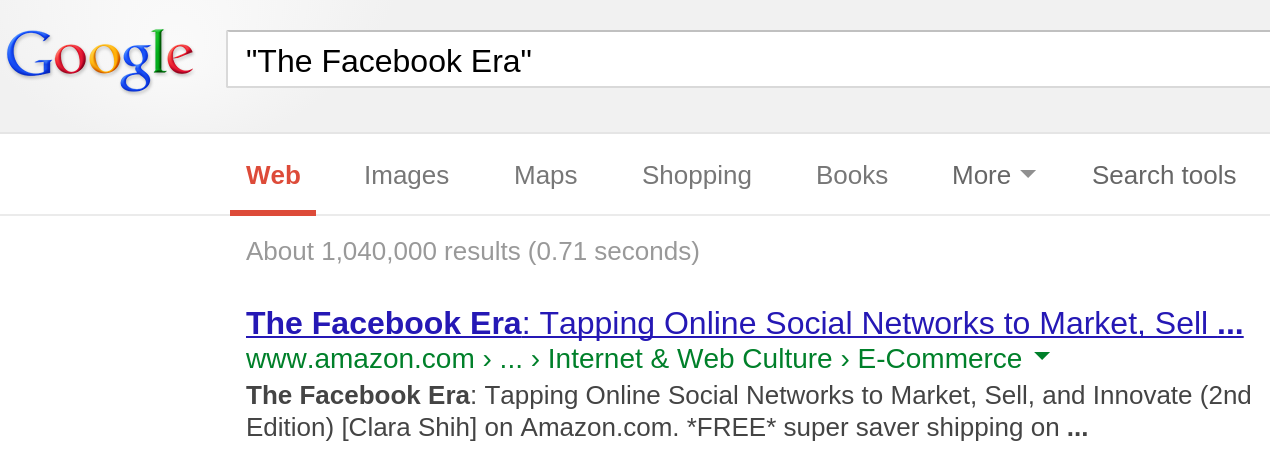
The Facebook Era: 1,040,000 Google results
Hey look! A book: The Facebook Era
Represents: Increased connections with social ties, and ease of discovering personal information.


The myspace Era: 59,500 Google results
Represents: Like Facebook, only earlier, more personal information online, simple creative sharing.
Is it over? Yes. Absolutely. This dude missed the whole thing.


The Blogging Era: 150,000 Google results
Represents: Ability for anyone to publish, in long form, at no cost.
Is it over? Getting there. In 2004, this guy claimed 2014 would finish it up.


The Android Era: 297,000 Google results
Represents: The entry and rapid adoption of Android as a smartphone OS. 
Is it over? No.


The YouTube Era: 210,000 Google results
Represents: The ability of anyone to publish video and have it be seen around the world. Also represents casual video consumption relative to professional 
Is it over? No.


The Dotcom Era: 1,490,000 Google results
Represents: Referred to as much as a bubble as an era these days, the first rush online by traditional services and businesses. Many did exceptionally well. Many more disappeared. 
Is it over? Yes. At least the first round.


The Microsoft Era: 423,000 Google results
Represents: The last few decades of a world where personal computing was dominated by Windows PCs and Microsoft software.
Is it over? Many people think so. In fact, a "Post-Microsoft Era" has been discussed.


The Steve Jobs Era: 67,900 Google results
Represents: Steve's personal impact on the world of technology, design, marketing and one of the most successful companies in Valley and tech history.
Is it over? Unfortunately, yes, as Steve passed away, but his impact lives on.


The Netflix Era: 41,600 Google results
Represents: On demand instant access to a wide variety of films and TV shows, and the business impact for those in more traditional markets. A disruption of Hollywood.
Is it over? No.

So what era are we in? If you went by total numbers, the Dotcom Era had the most Google results, but that's historical by nature. The Facebook Era is in second place, with Google properties, including YouTube and Android having nearly as many when combined. The iPad era is still strong, with Twitter putting on a good rising show, and Microsoft being high in the rankings, given its market penetration.

Other good options I either didn't run or tested but cut so this post isn't a mile long... "The Yahoo! Era", "The Amazon Era", "The Google Glass Era", and more... it's all fun. Can you think of others? What's the winner in your view?  

May 18, 2012

Web Data Caps Not Prepared for Pervasive Connectedness

Comcast (Xfinity) made headlines yesterday with its discontinuation of a standard 250 gigabytes a month cap for its residential users, in favor of a new format, which starts at 300 gigabytes a month, with the option to buy more. As a residential customer, I had noticed they stopped tracking our net usage in April, as after continuous growth in our home's Web traffic, the number shockingly (and incorrectly) displayed it was stalled at 56 Gigabytes, following a 162 GB month in March, up about 20 percent from February, and in turn up nearly 40 percent from January.

The main rise in our home for data consumption is two-fold, with my kids' adoption of Netflix and YouTube on our various tablets, and our own use of Google+ hangouts for live video interactions with others on the social network, including extended family and remote friends. As I watched our monthly data consumption increase, it looked like we would be on track to hit Comcast's data cap of 250 Gigabytes somewhere in the second half of the year, barring changes in our behavior or an eventual topping out - and that doesn't include the various megabytes taken down over 3G and 4G from our Android phones and Chromebooks.


Typically, limits imposed on users are indicative of one of two matters - the first being a lack of robustness in the system, which has proven incapable of supporting a change in customer usage, and the second being bad actors within the system, who for whatever reason, consume a dramatically greater amount than the average customer. It's easy to point at illicit file sharing, pornography or piracy as the reason for these caps, but with increased use of cloud computing, high quality video consumption and web communication, including VoIP and video chat, what used to be the exception is threatening to become the new normal. The wonder is if the infrastructure can adapt to consumer needs, or if even more disruption is needed.

The face to face to face video chats of today and near instantaneous downloads of feature films that we take for granted, even in HD, seemed improbable five years ago and impossible 15 years ago. One has to wonder what could be made possible in the next five to 15 years going forward, with advancements in software codecs, fibre outlay and wireless standards. My kids are growing up in a world when they expect any TV show to be accessible on any device whenever they want it, and it's unlikely they'll ever understand the sounds of a dial-up modem, let alone references to floppy disks, analog address books and rotary phones.

Traditional infrastructure providers like Comcast and others who find themselves making incremental changes in a world that seems ripe for significant change and disruption make me feel like they are solving for today's problems without preparing for big changes that are on the way. Even their newest proposal, to start allocations only 20% ahead of previous limits, with warnings to those who hit these new limits, seem short-sighted. The answer, for me, is to prepare for a world with 10 times the bandwidth we have now, when not only every show ever is available to any device at any time, but possibly anything at any quality, anywhere.

If my kids and I, in our casual use, can start to bump up against caps designed to slow down illegal use, just imagine the damage we could do to these artificial caps with a more round the clock schedule and even more devices. Even my thermostat and my scale are connected to the web now. It's time we stopped playing with small percentages and started getting ready for a real Internet of things, or... scratch that... an Internet of every thing.

Disclosures: I work at Google, which is working on Google Fiber in Kansas City, and provides products like Google+ hangouts, YouTube, Android, and Chromebooks, and could be considered a competitor or partner to Comcast and Netlfix.

October 03, 2011

Web Video's Challenge of Inventory, Portability


Last month, Netflix CEO Reed Hastings set off a tech media firestorm with the announcement of a split between the company's streaming business, which would bear the original Netflix name, and its DVD by mail business, now known as Qwikster. Much of the discussion centered around two parts - the first being Netflix's price increases announced this summer, and the second, focus on the name of the new business, which sounded way too much like Amway's sub-brand, Quixtar. But both flareups circumvented the real trajectory of Netflix making a choice to decrease its attention on the physical media world, one I publicly said I walked away from this Spring. With a smart combination of online video properties, including Netflix, YouTube, iTunes and Hulu, you can have your entertainment needs satiated practically any time. However, there remain gaps of content and availability from site to site, thanks to exclusivity deals with entertainment owners, copyright and who knows what else.

Apple's initial foray into renting movies (and later television shows) online, combined with the release of Apple TV units, made it easy for me and my family to select movies on demand, and watch them almost instantly. After some buffering, the selected title would be in our living room and could play that evening. Back in 2007, when Netflix was not streaming, the opportunity was available, in my opinion, for Apple to seize the market, through introducing a subscription service. (See: How Apple Could Crush Netflix Now) But it didn't happen. Apple didn't go the subscription route, Netflix evolved, and no doubt Hollywood studios were afraid of Steve Jobs having as much power over their titles' success as he did in the music business. In time, Netflix figured out streaming, kept the subscription model intact, and presented another choice for online video. Even better, Netflix did something that Apple chose not to do - embracing the Web by allowing for in-browser movie plays, and releasing mobile apps for practically every phone and tablet. (See: Netflix Edges Closer to Making the Perfect Web Video Site)

While Apple did a great job of bringing films and TV into my living room or laptop, Netflix did a better job of making them portable. In addition to box office wins, I've seen full seasons of shows like Dexter and Mad Men through Netflix, available on any laptop and through most connected TV devices, such as Google TV, TiVo and the Nintendo Wii. Netflix gets the Web, and is so simple to use that my 3 year old twins spend a lot of time running the Netflix app on our iPads. I'm often amused to see the recommendations that come my way from Netflix after Matthew or Sarah have spent an hour with Nickelodeon and Sprout shows for toddlers.

Similarly, YouTube's tie-in with the Android Market has also embraced the cloud for streaming video. As I wrote in June, you can rent films on the Android Market, and watch them on YouTube from any computer. That too is very convenient, and there's no entrance fee requiring subscription. Meanwhile, Hulu has access to some shows (like my personal favorite, Peep Show) that you can't get anywhere else - and there's the catch. Much like in the old days of instant messaging, where services were splintered without standards for interoperability, consumers are left to have multiple accounts from multiple places and remember which shows and titles are where. An evening's entertainment can come down to which device you have in which room, which services are supported and which titles are available for which place. It's easier to deal with for the cloud-backed properties, like Netflix and YouTube, but less great for the others. Nobody's yet got it 100% nailed.

Additionally, what all of these services miss is the opportunity to satisfy the home viewer who wants to see movies currently playing in theaters. I've been begging for this for more than three years now. (See: Think Apple Would Dare To Take On the Movie Theaters?) As a parent of three kids three and under, planning for a babysitter to cover the hours when my wife and I would attend a movie is a challenge, one that will no doubt cost much more than the face value of the tickets. So most of the time, the theater experience is unavailable. Meanwhile, most families' home theater systems are getting even better. I would have to bet the availability of in-theater titles to play at home would have real value and I know I would pay a premium for it. I would have seen Moneyball this weekend, if it was available, but being homebound means either we have to wait, or we have to seek out illegal downloading alternatives - which aren't ever a good option.

Spotify delivered the reality of a near-infinite music library on demand. Practically any title in the world (or so it seems) in high quality with no downloads or delays. The movie equivalent is still missing. No doubt this is a harder quest, but it's one worth conquering. Any time you see knowledgeable people debating Netflix's streaming movie inventory online, you hear concerns about its library. The company is closing deals to make that better, but they're quite expensive. Apple hasn't budged on a subscription model. YouTube remains best known for amateur videos, while that's expected to improve. And who knows what's happening with Hulu? Not me.

As broadband becomes more ubiquitous, and traditional entertainment leaders get innovative on their own about reaching customers, partnering with all services, I expect the portable cloud model to win, as it always does. Things are much better now than they were two or three years ago, but there's much more room to go. I hope in two or three more years in the future, we'll be laughing about how hard it was to get the titles we wanted anywhere.

Disclosures: I work at Google, of course, and you can decide if that impacts how I discuss Google TV, Android, YouTube or any of Google's perceived partners or competitors. :)