Showing posts with label Steve Jobs. Show all posts

August 19, 2013

The Twitter Google Netflix iPad Dotcom YouTube Facebook Era

As technology has weaved its way into practically every aspect of our lives, it has become something of a challenge for historians, journalists and others to try and encapsulate this new era of near-pervasive Internet, dramatically reduced barriers to publishing, and obsessive gadget accumulation.

I grew up in a world where a whole generation of people could be summarized easily, defined by population bumps like the Baby Boomers, a shared experience in battle, as Tom Brokaw frequently cites in The Greatest Generation, or quite simply, by the assigned letter given to those born in a ten to fifteen year period, like Generations X and Y. Now, newsmakers and analysts alike are trying to explain just what this new era should be called. Is there one device or one company or one shared experience that defines us?

With some quick research, it's clear there are many players vying for the elite status of owning our tech-savvy era. I tapped into Google (disclosure: I work there) for a few examples. Let them play out and see if you favor one over another or have a better option. All screenshots current as of Friday, August 16th, 2013.


The iPod Era: 69,100 Google results
Represents: The iPod at peak was more than half of Apple's revenue, outpacing Mac and all software sales. The iPod was a cultural phenomenon representing fashionable portability of digital media and personalization of music listening.
Is it over? Yes. According to AppleInsider, the iPod Era ended in 2010.


The iPad Era: 132,000 Google results
Represents: The first successful tablet computer disrupted the old way of doing many things, and picked up where Apple's iPod and iPhone had left off.
Is it over? Probably not. The iPad Era launched in 2010. Debate from AdAge questions if it's done.


The Google Era: 259,000 Google results
Represents: Near-instant retrieval of information, and a reduced need to memorize. Ability to scale.
Is it over? Nope, unless you think Business Insider is onto something.


The Twitter Era: 401,100 Google results
Represents: Near-instant ability to communicate and a real-time medium.
Is it over? No.
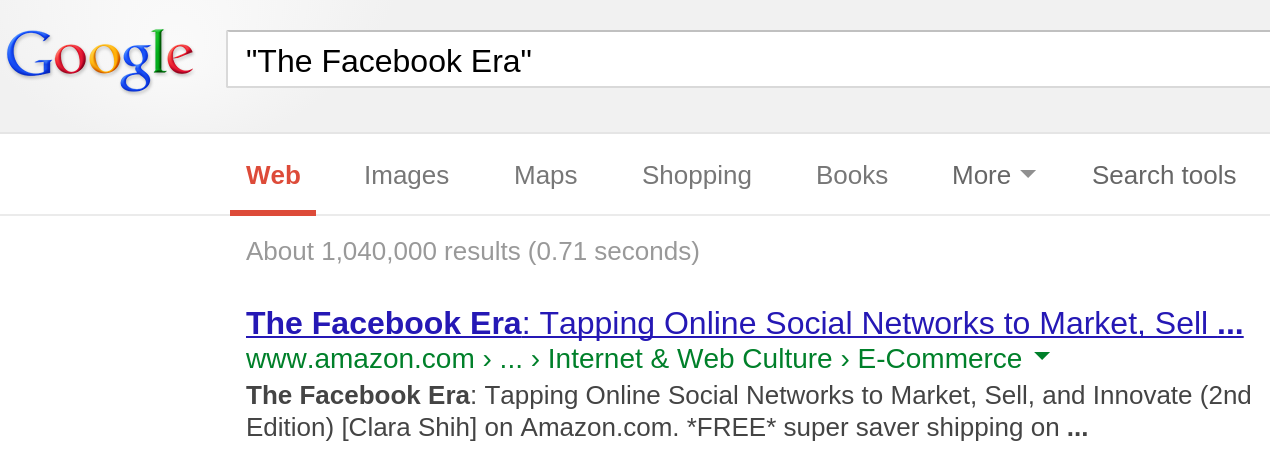

The Facebook Era: 1,040,000 Google results
Hey look! A book: The Facebook Era
Represents: Increased connections with social ties, and ease of discovering personal information.


The myspace Era: 59,500 Google results
Represents: Like Facebook, only earlier, more personal information online, simple creative sharing.
Is it over? Yes. Absolutely. This dude missed the whole thing.


The Blogging Era: 150,000 Google results
Represents: Ability for anyone to publish, in long form, at no cost.
Is it over? Getting there. In 2004, this guy claimed 2014 would finish it up.


The Android Era: 297,000 Google results
Represents: The entry and rapid adoption of Android as a smartphone OS. 
Is it over? No.


The YouTube Era: 210,000 Google results
Represents: The ability of anyone to publish video and have it be seen around the world. Also represents casual video consumption relative to professional 
Is it over? No.


The Dotcom Era: 1,490,000 Google results
Represents: Referred to as much as a bubble as an era these days, the first rush online by traditional services and businesses. Many did exceptionally well. Many more disappeared. 
Is it over? Yes. At least the first round.


The Microsoft Era: 423,000 Google results
Represents: The last few decades of a world where personal computing was dominated by Windows PCs and Microsoft software.
Is it over? Many people think so. In fact, a "Post-Microsoft Era" has been discussed.


The Steve Jobs Era: 67,900 Google results
Represents: Steve's personal impact on the world of technology, design, marketing and one of the most successful companies in Valley and tech history.
Is it over? Unfortunately, yes, as Steve passed away, but his impact lives on.


The Netflix Era: 41,600 Google results
Represents: On demand instant access to a wide variety of films and TV shows, and the business impact for those in more traditional markets. A disruption of Hollywood.
Is it over? No.

So what era are we in? If you went by total numbers, the Dotcom Era had the most Google results, but that's historical by nature. The Facebook Era is in second place, with Google properties, including YouTube and Android having nearly as many when combined. The iPad era is still strong, with Twitter putting on a good rising show, and Microsoft being high in the rankings, given its market penetration.

Other good options I either didn't run or tested but cut so this post isn't a mile long... "The Yahoo! Era", "The Amazon Era", "The Google Glass Era", and more... it's all fun. Can you think of others? What's the winner in your view?  

October 05, 2011

Steve Jobs: An Irreplaceable Icon

The world's outpouring of affection for Apple cofounder Steve Jobs is remarkable. In a time when scandal and tawdriness make headlines, and the foolish are revered, Steve represented something else - an intelligent, perfectionist approach to creativity, aimed at the greater good to constantly refine and bring value, through technology - and somehow won the hearts of the people. Amidst a world of awkward poor dressing techies, Steve exuded class and presented himself as being above the fray. His presentations were a masterpiece. His products were art. He took a world consumed with cutting margins and making it up in volume and made it emotional - a status symbol. He helped define a generation of computing and electronics in hardware and software, and became the man on a pedestal by whom all other CEOs and innovative tech leaders are measured - a tall task for the current crop and those to follow.

The last 4 or 5 years of uncertainty around Steve's health (and I feel like I know him so well that he should simply be referred to as Steve) were the unspeakable story - the deep hope that he could surprise us all - again - with "One more thing" and show that he had somehow beaten cancer and proven his immortality. All while fighting unspeakable challenges at home and in hospitals, he and his extended team churned out more and more products, hit after hit that built Apple into the highest-valued company in the world. Each keynote worried us that it would be his last. His very figure was dissected by cheap online tabloids trying to score a few million page views, and we rejected the opportunity to have this new shrunken image burned into our pupils, because we knew that despite his newfound frailties, Steve inside remained the lion we all knew.

For 15 or so years, Apple and Steve Jobs have once again been whole - practically synonymous. College students everywhere can't remember a time when Steve was not leading the company. But for those of us who suffered during the dark days of Apple, when the word "beleaguered" followed the company everywhere, and showing up with a Mac in a world that was going Windows was a conversation starter, knowing you were different.

It's not just that Steve did his job better than anybody else when he was on top. It was that he took a company in the middle of a very public suicide and turned it around, using the perfect mixture of humility when it was needed, and arrogance when it too was needed.

During the summer before my junior year in college, I remember my roommate, almost with a cat call, announcing that Gil Amelio, then CEO of Apple for a mere 500 days, had resigned. Yet another obvious example that Apple was doomed, and we would have to settle for something less than great for the rest of our computing days. Even I had almost given up. But this presumed bad news was the turning point that brought the original visionary who made the Mac what it was to the company that could make history again. Almost nobody saw it coming. Not even the geeky among us who said we would give up our Mac when you pried it from our cold dead fingers knew what was coming. Not even those of us who held our AAPL shares in the single digits and cheered when the company market cap passed $4 billion had any idea of what the next decade would bring. If we had, we would have put our life savings on it.

Why is the world reacting to the passing of Steve in the way that it has? Why has the President of the United States taken the time to remark on his passing just hours after Steve left us for what's next? Why did the leaders of practically every tech company on the planet express their heartfelt loss and appreciation for the man's accomplishments? Because Steve stood for something. He personalized the fight for the user so absent in a world of drab number-pushers unwilling to take chances. He personally stood for making change for humans that made products desirable. He was, to many, a hero - even to those who found themselves going against Apple in the market.

In the last few years, as we've all started to think about the inevitability of Steve's passing, as cancer doesn't give anybody any slack, writers have all had the chance to write their premature obituaries, to share their favorite stories of Steve - to tell their first experiences of the Mac or the iPhone or the iPad or anything else that made Apple have an impact on them. I now have three children who will grow up in a world without Steve Jobs, who will be forced to hear from me stories that make him sound like Thomas Edison and Henry Ford wrapped up into one. I have but the one blip of a memory of when I saw him at an early Apple Store in Palo Alto, when being his perfectionist self, he answered a support question I had. I am glad I saw a keynote of his at MacWorld in person a full decade ago. Even as some of my preferences changed in terms of my own computing and mobile choices, I never lost faith in Steve and his fight.

The world lost a vibrant 56 year old man. In a world where people regularly crest over 100 years old, and CEOs melt into their chairs into their 80s, Steve could not beat cancer. There were no karma points for being the best in the world for what he did and being an inspiration to all who saw him, knew of him, came into contact with him, and understood him. And this is just wrong. It is a major reason why underneath all the praise and wistfullness and sorrow, there is also anger, and frustration that a man who had already given so much, who had so much more to give, was taken from us too soon. This is unacceptable.

Tim Cook and the rest of the Apple team have an impossible task, to satisfy the millions of Apple fans and the tech world who has grown used to expecting the impossible from the company and seeing it exceeded. I have no doubts that Steve has trained his successor and management team well, that they know the right way to build products and make things beautiful and magical. But in a world of copycats, Steve remained without equal for decades, a cut above the rest. There will be no replacing Steve. Just an end to an era, and the start of a new landscape, where he moves into the history books instead of current events.

I do have a heavy heart tonight. I say it without melodrama, without a need for others to feel shared sorrow, but for reality. The whole world lost somebody special today, and we will never get him back.

August 25, 2011

The Time I Asked Steve Jobs an iPod Support Question

What would you do if you unexpectedly came face to face with Apple's world-famous CEO, Steve Jobs, who had been credited with launching or assisting with most of the major transformational events in personal computing over the last thirty years? Shake his hand? Tell him how much you love Macs? Ask to take a picture? If you're me, you try to play coy and ask if he could help you with a support question - because that's exactly what I did in my first run-in with the revered, yet reportedly mercurial Apple exec, who as you know, announced he was resigning his post as Apple CEO yesterday, moving up to the chairman of the board role.

Back in 2002, Apple was just getting started with the company's retail store initiative, and among the first stores to debut was the venue in Palo Alto on University Avenue. Living in Belmont, not too far north of the shop, I thought I would lazily take a Saturday afternoon and check out the newest Mac laptops. Like any good Mac fan, even if I wasn't exactly in the market to upgrade, I felt it my civic duty to check them out and get familiar. But when I entered the store and glanced past the display of white laptops, I spotted something much more interesting - as Steve Jobs himself was in the store, having a conversation with the store manager. From what I gathered, the pair were talking about contingency plans of what to do if the weather went bad - and how the worst thing you could do was have to shut down the store. The world has heard how Steve got involved in the little nuances of many of the company's products, so it's no surprise the retail store launch was much different.

As you can imagine, trying out new trackpads and screen resolutions on Macbooks immediately seemed less important. So I positioned myself with my back to Steve and fussed around with the closest computer's dock, clicking aimlessly while I wondered if I would get a chance to talk to Steve myself. After a few minutes, the manager parted, to the back of the store, and I turned around to talk to Steve. Not wanting to be a complete fanboy and putting him at unease, I coyly asked if he was a "Certified iPod genius"... a play on the store's Mac geniuses. Looking at me somewhat amused, knowing that I knew who he was, no doubt, he said, "As a matter of fact, I am."

I then told him how I had been one of the first to purchased the company's initial white 5 GB iPod MP3 players, and that no matter how much charging I did of the device, battery life was atrocious and had gotten to the point I was considering taking it back or getting it repaired. I asked what I should do. He said that the issue was a "known bug" and that a fix was going to be rolled out shortly. Having recently seen an iPod update that was recently recalled, I asked him if that was the one he meant, which had been "rolled back". He said yes. In the meantime, he told me that I should leave my iPod unplugged overnight until it ran down to zero, and then charge it up, and all would be well.

By this time, the store's manager had returned, and was standing nervously next to Steve. It seemed he was concerned Steve had been exposed to the common visitor and clearly couldn't wait to step in and continue their conversation. So I told Steve thanks, adding, "thanks for all you do", a knowing nod to his history without gushing about it, and I left the store. After meeting Steve, no laptop or box software could have been more fulfilling.

Steve Jobs' news yesterday is being read as the latest bad news in a series of bad news stemming from his much-discussed health issues over the last few years. His job change is by no means an obituary, but many are seeing it as the end of an era - the PC industry's elder statesman and one of the world's top visionaries and creative minds stepping further into the shadows. I once wrote that I wished Steve Jobs were immortal and that I would teach my children about Steve Jobs as they grew up. For what we have seen as users is a hero and a real legend in our lifetime who changed the world, something we can all hope to do in a very much smaller way. But the man is still with us and I hope this isn't the last we see of Steve Jobs, the legend who was humble enough to expose a smile and answer some 24 year old's iPod support question on a rainy day in Palo Alto.

Good luck, Apple, and thanks, Steve.

July 08, 2011

Special Edition iPads With Steve Jobs' Signature

One of the geeks here at Teens In Tech has a special edition iPad engraved with Steve Jobs' signature. Only 100 were made for Apple employees working on the iPad product.


June 07, 2011

Steve Jobs Proposes Spaceship-like Future Apple Campus

Sitting where I do in Sunnyvale, driving ten minutes South can have me on the Apple campus, and driving ten minutes North lands me at Google in Mountain View. With both companies hiring like mad and buying up the surrounding real estate in their respective communities, it's likely that I'll be surrounded by Goople in just a few years. As far as I'm concerned, that's great. More money for the area, more jobs, and more innovation, even if the two companies are occasionally not the biggest fans of one another.

Tonight, Steve Jobs stepped down from the lofty pedestal most of us hold in our heads for him and presented at Cupertino's City Council meeting to offer his vision for a much-needed second Apple Campus, a futuristic flying saucer like building which he said could hold upwards of 12,000 employees, up from the less than 4,000 who inhabit the company's headquarters at 1 Infinite Loop. As he told the council tonight, Apple has been buying or renting all the surrounding office space they can in the city, and some of it just isn't good.

The Proposed New Apple Campus (via Video Still)

Like Apple's hardware and software, this proposal has a distinct design - one that borrows from the company's experience in building its hundreds of retail stores. Job says there is no straight piece of glass in the entire building, which makes a continuous circle, with its innermost part being a central courtyard. "We know how to make the biggest pieces of glass in the world for architectural use, and we want to make the glass, specifically for this building, curve all the way around the building."


Much like the beautiful, if not commercially successful, G4 Cube, Jobs' says this design "is pretty cool." His approach to the council is humble, one of storytelling, a position where he says Apple is "growing like a weed", and wants very much to continue being part of the city. It's an incredibly human presentation from a man who does this better than pretty much anyone - taking his story to the people he needs to help. I can't imagine Larry Ellison of Oracle or Steve Ballmer of Microsoft not only doing this, but doing so in such a compelling way that makes you want to help.

No matter your computer or mobile preferences, or thoughts on Apple's approaches in other markets, you can learn a lot from the way Steve Jobs does business. Even this presentation to the council is worth watching. I hope that we see this campus built practically in our backyard.

January 19, 2011

The Best Thing Apple Does Is Ignore Everyone Else

Yesterday, Apple announced earnings that were record-setting for the company, with blowout numbers on iPads, iPhones and Macs. The sales far outstripped practically every analyst estimate, and even the most optimistic amateur guesses. The fantastic news for Cupertino's money machine came just one day after the news that CEO (and legend) Steve Jobs was going to be sidelined for a third time for an undisclosed medical issue for an uncertain amount of time. Intriguingly, after the company proved it was firing on all cylinders, again, well beyond expectations, one once again sees feedback from the peanut gallery offering suggestions for where the company should go next, and how it should handle the executive transition. Luckily for Apple's customers and shareholders, they're ignoring you. They've proven quite good at it, and they should continue.

Apple being a public company doesn't necessarily mean they need to be managed by the people, in some sort of communist undertaking. The qualification that the company is public requires they do what is in the best interest of their shareholders, and the numbers prove they have done so - without any doubts.

Apple's stock value is up 298 percent from the beginning of 2009. This contrasts with a 110 percent rise for Google stock, a 48 percent rise for Microsoft, and a 32 percent rise for HP. And when faced with a similar uncertainty related to Steve Jobs two years ago, Tim Cook (and the rest of Apple's deep bench, which is growing) executed dramatically well. The company is the highest-valued tech company in the world, and at this pace, may soon become the most valuable company in the world, period.

While there are some aspects to Apple's opaqueness which are frustrating, as a user, a shareholder, or press, the company has proven it doesn't need to heed public opinion when it comes to running its business. The company famously doesn't leverage focus groups to design upcoming products, and they don't have the transparency into employee's thoughts as you see with more blogosphere-friendly companies, including Google. I would suggest that one of the major reasons I've personally drawn closer to Google and its employees in the last few years, possibly at the expense of my loyalty to Apple, has been due to ease of access and fast feedback, but this formula is not demanded by all.

So here we are, not a full day beyond the company's blowout earnings call, and already you can see stories in the tech community, calling for a clear succession plan at Apple. With headlines like those from Marketwatch saying "Apple should make Tim Cook its CEO" and people already clamoring about unreleased specifics regarding the rumored iPad 2 and iPhone 5, the best thing Apple can do is ignore all the noise. They've proven for several years now that they don't need your guidance when it comes to how they manage their business, how they hire personnel, how they release products, or how they engage in relationships with partners.

If Steve Jobs says he hopes to be back at Apple soon, and the company tells you that he is going to be active in strategic decisions related to the company, while Tim Cook runs day to day back in Cupertino, then that's the long and short of the story. Done! They've proven they can do it before and they will again. They have given us no reason to doubt them.

I have the utmost confidence that if Steve Jobs were to disappear tomorrow from the Earth, no doubt transcended to Heaven like in Blblical times, rather than passing away due to mortal death, the company has a plan to keep going. Apple is much more than one person now. Jobs is an enigma - the guy tech titans dream about becoming when they grow up. But for as much noise that is drawn up around this company and every little move they make or don't make, it's great they aren't paying attention and managing the company by committee. If only Microsoft and others could execute half as well.

So stop it with your silly headlines telling Apple what they should do next. They know, and you don't.

November 26, 2010

Apple's War On Android Escalates, But No Total War Yet


Apple's lock on the iTunes application store is legendary. In contrast to more "open" marketplaces that don't rely on centralized editorial control, iTunes applications are hand-reviewed by Apple employees, and the company controls what gets in and what gets out, what applications are featured, and can take weeks or even months to give your application the thumbs up. As the company's competition with Google and Android has escalated in the last year plus, we've heard stories of developers not being able to mention the alternative mobile OS in their products, and have seen those which are iPad-only getting significantly more play with Apple's marketing muscle. Today, headlines were made after one publisher's Android-centric magazine was blocked, not because of any rules infringement or legalities, but due to its content. The idea that Apple would start to police the subject matter of content in its store beyond its also-famous war on pornography, is eye opening and has many people wondering how much power the company intends to wield on the store. As of now, the ruling looks overreaching - and to be honest, it's also wildly inconsistent with existing content already available.

One major weakness for the iTunes review process is that it actually involves humans on both sides. That sounds silly, but it also gives Apple leeway if one rep overstepped his bounds, assuming that an Android-centric magazine would have no place on iTunes. It's easy to see a menacing Steve Jobs in the darkness pronouncing there is "one true phone" and that no others shall be mentioned, but it's just as likely it's a mistake. I hope it is, for the alternative is far more dramatic - one that spells an extremely unfriendly environment from a company that for the most part has its users fawning over its every move.

Curious to see how hard it was to find Android related content on iTunes, I looked around this evening, and while it's not easy to find, it's also not impossible, especially if you branch over to the iBooks section of the store.

Hey Look! A Magazine that Mentions Android on iTunes!

I even found a smartphone-centric magazine in the App Store that looks like it regularly features Android content and reviews. Smartphone Essentials Magazine uses Android as one of its keywords, and the application displays Android phones on some of its covers. If centering on Android is verboten, it looks like featuring it is just fine.

The iBooks section of the iTunes Store is overflowing with Android titles, highlighting Android apps marketing, Android application development and top apps on the Android platform for business, games and entertainment. There are books on free Android apps and wireless apps, reference apps and geeky guides. The simplest of these float for $2.99 apiece, while the developer tomes check in as high as $35.99.


Android Books Galore in the iBooks Section of iTunes


Staying in the iBooks section, and flipping the search from Android to Google also doesn't show the impact of mass censorship and whiting out of competition one could expect if Apple had escalated the war of words to an unprecedented level. The bookshelf shows "What Would Google Do?", "Marketing in the age of Google", and many more titles on analytics, ads and SEO.


What Would Google Do? Not Censor, Probably.


In the Android market, which doesn't have the notorious human filters to it iTunes does, searching for iPhone doesn't come up empty either. There's O'Reilly Media's Missing Manual, iPhone themes to skin Android, and more. Don't let the fact that less than 50 people have downloaded the missing manual fool you, it's there, even if it isn't very popular.


The Android Market Isn't Afraid of iPhone


Brutish bullheadedness on the part of Apple to try and force consumers, publishers and developers into a predefined world of what's acceptable and what's not fatigues my good will toward the company and the platform. The beauty of its apps, core OS and devices may be unmatched, but I fear they are on the brink of misusing their market position in a way that would raise fierce scrutiny if it was somebody else performing the evil deeds. The company should not expect its exclusionary behavior, if it is indeed true, to go unchecked, for even if it is not in a monopoly position, it is playing an unacceptable role with considerable market power. I cannot adhere to the belief that this company knows what is best for me and for all its customers every single time.

Apple and Google have an uncomfortable relationship now. Google's apps play a core role on the iPhone. Google search is the default engine on the iPhone and in Safari. But Apple is clearly threatened by Android and is squirming under the heat coming with the platform's market growth and feature creep that arguably brings it to near-parity in quality. That the iBooks section does not shy away from showing Android titles gives me hope that this ban is an exception to the rule and that we're not on a slippery slope that damages consumers and developers. Google would never remove Apple and Mac or iPhone results from their search engine, and the company helpfully offers Mac hardware to employees, and will keep doing so until some theoretical future where Chrome OS notebooks usurp that role.

As a businessperson, I get Apple doesn't want to help the enemy. I understand they are not a government entity, required to offer constitutionally-protected free speech. But I do not like the role they are playing as arbiters of morality and markets. The company has proven it can compete and do extremely well in offering high quality software and hardware in desktop and mobile, and should focus on marketing its own brand without its power to pretend alternatives exist.

Want to make customers forget about competition? Make something dramatically better and execute. None of this censorship garbage.

October 31, 2010

20 Halloween Scares to Put Fear Into Every Apple Fan

20. Wowed by IE 9 for Windows, and to tick off shared rival Google, Apple abandons Safari in exchange for promised browser development by Microsoft.

19. Apple products deemed security risk to carry on planes by TSA, must be placed with checked baggage for all flights.

18. Apple abandons USB and 802.11 and forges their own standards body, reporting to themselves.

17. Apple actually acquires Facebook for $40 billion. Mark Zuckerberg said to ascend to CEO position by 2012.

16. John Gruber of Daring Fireball is to be added to the company's board of directors.

15. MobileMe to be replaced by a new messaging system built on Apple's social network, Ping, accessible only through iTunes.

14. Riding a wave of over-confidence, thanks to the recent string of successes, Steve Jobs reintroduces the G4 Cube, the Dalmatian and Tutti Frutti iMacs, and yes, the hockey puck mouse.

13. During a company board meeting, Al Gore asserts that he did, indeed, invent the Internet. The other board members, swayed by his amazing charisma, agree Apple will backpay Gore royalties for each machine, dating back to the early 1990s, which had Web connectivity.

12. International trade strife between China and the United States flares up, and Apple's subcontractors discontinue making new iPhones, Macs, iPads, and more. Suicides actually increase.

11. After so many MacBook Air owners realize their hinges break shortly after their warranty expires, a class-action suit bankrupts the company.

10. HP bundles next generation Palm devices with every desktop, laptop and server sold. Palm becomes new mobile standard.

9. Windows Phone 7 is Really Really Really Good. No wait, Really.

8. Apple retail store insulation found to contain asbestos. Even worse, Steve Jobs demanded it be included.

7. Adobe copyrights the word Flash and extends the word to contain all Flash drives. A settlement mandates all flash drives come preinstalled with Flash.

6. With the introduction of Microsoft Office 2011 for Mac, Outlook becomes the standard Mac client and Apple Mail is retired.

5. Entertainment industry colludes to deny Apple access to music and films on iTunes store. Only Disney/Pixar and indy offerings left.

4. Tim Cook leaves Apple to take the CEO position at Dell.

3. SCO rolls back to life, and somehow obtains an injunction against Apple's Mac OS X, due to its UNIX underpinnings, stopping all Mac sales.

2. AT&T announces contract to extend iPhone network exclusivity through the end of the decade.

1. News breaks that Steve Jobs actually perished during liver surgery in Tennessee in 2009. What you have seen in the last year-plus has been a zombie.

June 07, 2010

iPhone 4 Is Nice, But It's Not Enough to Slow Android

I am running in danger of sounding as much an Android fanboy as I ever was an iPhone fanboy, so let it be known even if the subject is changed, the internal debate continues to rage, and the enthusiasm to make the right choice, fairly, is still the same. Like most of you, I wondered how Apple and Steve Jobs could wow us with the latest iteration of iPhone, and whether it would be enough to attract those of us considering Android as an alternative - most specifically the new HTC EVO or similar devices - to come back to the Apple fold.

With Jobs' keynote complete, it looks like Apple is making some good moves with high quality imagery, cameras, and smart integrated apps like iMovie and FaceTime, but I didn't see anything that made me feel I have made the wrong choice. I stand by the belief that Android has achieved parity with Apple in many respects, is superior to the platform in a few ways, and has the momentum behind it with an ecosystem set up for continued growth - not held down by the still-stunning ineptitude of a major partner like AT&T.

The iPhone 4 update focused on improved screen quality with more pixels, the long-awaited introduction of multi-tasking, HD video recording at 720 pixels, a fast Apple A4 processor, the introduction of a front camera, and two pieces of software - iMovie for editing of film clips on the iPhone, and FaceTime for video calling, assuming both parties have iPhone 4 models.

The introduction of multi-tasking and a front-facing camera both are catch up features to the latest Android models, including the aforementioned EVO. The iPhone is no doubt thinner than the EVO, and speed and battery life measures are subjective. But Apple's complete silence on wireless hotspotting, tethering, and finding an alternative to the boat anchor of AT&T were a big miss. While the company can trot out market share statistics showing installed market share for iPhone devices ahead of Android, it certainly seems like the onslaught of capable devices running Android are eating into Apple's share - and that's something which fancy iAds aren't going to fix.

If I were an Apple developer today, I would be very happy with the company's revenue sharing policies and attempts to further improve monetization with iAds. I might even take them at face value when Jobs said they were approving the overwhelming majority of applications submitted to the iTunes store. But I would absolutely make sure I was also coding my applications for Android. I believe that if I were starting a business built on mobile applications today, I would start by coding for the Android platform, as there is a greater chance to gain first mover advantage in that marketplace, and to become a revenue leader as the tide rises. Code for Android first, and iPhone/iPad second.

What I was looking for today was not a device that offered feature parity or similarity to what I have now somewhere else - on a platform that isn't limiting me to the manufacturer or to the carrier. I wanted more flexibility and more functionality. An iPhone 4-only parlor trick of video calling much like that on AIM or Skype or Yahoo! Messenger from the last decade isn't what is going to make my phone buying decisions made up, but instead, a promise to create a high quality experience for all aspects of my using the device.

AT&T has failed that litmus test of quality and has done so consistently for years. Today, Apple had the opportunity to look customers in the eye, and either apologize for the poor service we have come to accept from AT&T and Apple, and the missed promises, or better yet, offer an alternative. They didn't. That tells me either they do not fully understand the magnitude of the problem, or they think they can get away with continuing to ignore it.

Apple, I didn't want a thinner iPhone that's slightly faster and better looking. I wanted a promise that the new one would make phone calls, act as a fantastic Web device, and provide 3G access to other devices. Today, you didn't do that, and it's disappointing. A smartphone can't be smart if it's married to a company as dumb as AT&T.

Steve Jobs' Opportunity: Apple Products are for Humans

At 10 a.m., Apple CEO Steve Jobs will take the stage once again at WWDC, no doubt introducing the next generation iPhone, along with its already previewed iPhone OS 4 software, as part of what will hopefully be many announcements in the day, which point to the future of the company and its application ecosystem. His remarks will come at a time when Apple as a company is tremendously strong, firing on all cylinders, with the launch of the iPad looking like a tremendous success. Yet, in the background, the company's iPhone juggernaut seemingly looks like it is vulnerable, thanks to continued momentum from Google, Android, and Sprint's record-setting sales of the newest device, the HTC EVO (which I've discussed at length the last few weeks).

Steve Jobs is a master visionary for foretelling the future of tech, and also a master salesman, convincing you to think he was the leader, in the occasions when Apple is actually late the game. He and Apple have been among the best in convincing customers that features or products are not needed, or markets are not interesting, right up until the minute they introduce their own version. At this WWDC, Jobs will need to convince those watching and listening not only that the company's present is strong, but that their future is as well, that they can remain atop the charts in the smartphone race, in the face of the onslaught from Mountain View. One way he can turn this tide is to turn Android's marketing around against them - taking on the harsh, metallic, robotic, messaging directly, and say that in contrast, Apple's products are designed with soul, by humans, for humans - connecting with one's emotional side in a way that Google hasn't traditionally been able to do.

As far as robots go, the Android robot is cute - friendly and appealing even. So too are the code names for the Android releases themselves, each sounding like a calorie-rich dessert one would lust for. But, at the end of the day, it's still a robot, and Google, so far, hasn't been known for a soft, creative, approach. The stories about the company being data-driven and letting the numbers tell the story have reigned supreme, often being pointed to as one contributing reason behind the company's false starts in social, and, amusingly, the lack of a Google Sports to go alongside Google News. In contrast, Apple is all about emotion, and creativity, and how one feels about an experience - be it on the desktop, on a tablet or from a mobile phone.

Apple once said its operating system was so divine that "you would want to lick it". Licking and loving? Human emotions, not something robots desire to do. I don't see Google wanting you to lick your Nexus One or your Droid Incredible any time soon. They just "do". And even though I am enjoying my Android experience still, I am working around some of the lameness when it comes to non-humane error messages, non-intuitive software design and things that take more steps than they should, which Apple already tackled in the simplicity department long ago.

Do you know the primary use for the pair of iPads we got the first day they hit stores? Playing YouTube. Now, before you say that's a Google product (which it is)... what I left out is that the primary users are my nearly two-year-old kids. The two of them are constantly on the iPad, browsing videos or playing simple arcade games. That we have two iPads for the two kids is a must, for when one is in the room, they are fighting over it. The simplicity and human approach Apple took to the iPad is so well executed that the twins don't hesitate in learning how to approach new apps and to swipe between screens. But when they look at my EVO, they're pretty much lost.

Jobs may not try and present iPhone as the alternative to Android at WWDC, in the same way Google presented itself as the alternative to iPhone at Google I/O. Maybe he doesn't want to give them that much credit. It's just as likely that he will tell us how much better iAds are to AdMob, or tell us how many more cool apps there are for iPhone and iPad than there are for Android. Maybe talking about one's human nature and personality is too much of a throwback to Jobs' hippy days, but it's certainly an opportunity, one that would resonate with many people considering their computing choices going forward. We're not robots, and Apple is a touchy-feely company who understands touch and feel better than anybody else in tech. Therein lies the opportunity to remind customers.

June 02, 2010

Descending Into a Nation of Bloggers: How Steve's Right

Steve Jobs, unfiltered, seems to be the most attractive interview in the tech world, bar none. That's why his opening up at AllThingsD last night continues to make waves in the tech news world, as his every word is dissected, repeated and spun. The extremely quotable Jobs dropped a number of interesting insights and remarkable candidness for the leader of the technology industry's largest company, and arguably one of the most successful, with legions of loyal customers, and a similar number of would-be competitors. One of his most remarkable quotes regarded the challenge of supporting high quality content, and an editorial press, contrasted with what he saw as a descent into a "nation of bloggers".

Rather than react in an emotional way, pounding out paragraphs to pooh-pooh Jobs' dismissiveness of an entire craft - of which I am obviously part - one has to understand his perspective, and how Apple is impacted by the world of blogs, to see how he could come to his conclusions.

In a world when many many businesses are becoming more open, sharing short updates on Twitter, single paragraph announcements and events on Facebook, and regular posts from thought leaders and executives through blogging, Apple seems to be on the outside looking in. They are notable for their continued closed approach, one built on secrets and surprise. Of late, Steve Jobs has opened up a bit, acting as a one man social media machine with e-mails to customers and bloggers, and penning longer notes on the Apple.com Web site, like that on Flash from last month. But Apple not only doesn't really need to participate in this world, but honestly has not seen much benefit from the army of Mac bloggers. It's no surprise that Steve has the opinions he does about bloggers, and the company needs them less than many others do.

The funny thing about Steve Jobs is he's been doing this for a long time. He was on the cover of Time and Fortune, BusinessWeek and Newsweek decades before the first blogs. His return to Apple in 1997 came as the Internet was ascending, but the term blogging was practically unknown. This was two years before Ev Williams and team started their blogging software at Pyra Labs, and two years before Brad Fitzpatrick started LiveJournal. In his time at Apple, Steve Jobs and his team has never really suffered for a lack of news. The mainstream media, from the aforementioned press to the Wall Street Journal, New York Times and others, have been available to review the company's products, to report on their news, and to dissect the company's typically rosy financial results.

Meanwhile, for the most part, Apple and Mac coverage on blogs can be divided into three camps - Apple fans, Apple haters and Apple rumor seekers.

Those who love the company and its products are almost mythical in their obsessions and loyalty. Those who hate Apple are similarly entrenched, if not always as vocal. And those who are constantly seeking to undermine Steve and Apple's launch schedule and product roadmap have expanded from a once-niche industry to something much more mainstream. And in many cases, Apple has had to take aim against blogs to protect their positions.

Apple's conflicts with bloggers have been well documented. Apple sued anonymous posters on AppleInsider for leaking product photos, including the G4 Cube, before their time. Apple sued the then anonymous author of Think Secret, for discussion of an unlaunched product, called "Asteroid", a new audio interface for GarageBand users. And of course, most recently, Gawker Media paid to gain access to a prototype next generation iPhone which may or may not have been stolen. And yes, Apple is going after those guys too. (This doesn't even go into his latest e-mail trading with Ryan Tate at Valleywag, a coworker of mine from a decade-plus ago.)

As far as Apple is concerned, in contrast to what they see as professional and respectable coverage of their products in the still much read mainstream media, the bloggers have really been nothing but trouble, with the drawbacks and amateur approach outweighing any potential benefits from consistent fandom selwehere. The Macintosh rumors industry, which I have largely ignored of late, is in constant flow, since Mac OS Rumors kicked it off in the mid nineties, and it's no wonder why Apple has taken this approach to not trust the industry as a whole.

Can one separate the term "blogger" from one who blogs, and not feel like Apple and Steve Jobs are slamming an entire informal industry? Of course. There are absolutely some very well written, professional, editorially focused blog networks out there. There are a lot of individual bloggers who do a great job expressing their thoughts on Apple and many other companies. But for one of the world's best Marketers, blogs are little help at all. Of course Steve Jobs wouldn't want the nation to "descend" into one full of "bloggers" who target his company with falsehoods and borderline criminal activity. Of course he would like to control the message and keep the element of surprise.

Steve's comments don't mean that Apple wants sites like The Unofficial Apple Weblog and The Apple Blog to go away, but Steve is calling for decorum that he just isn't exposed to. Steve Jobs and Apple don't need bloggers. They have operated above the fray, and are calling for something better than what they have seen - something that delivers them value.

May 20, 2010

Do iPhone Users Face a Draconian Future?


At the end of 2009, fed up with AT&T's ridiculous lack of quality, and knowing the iPhone's current platform was long in the tooth, rumors of Google's new uber-phone were making the rounds, leading me to say you would have to be insane to get a new iPhone now. Even as rumors of the new iPhone 4 are making their way around the Web, through early exposures and leaks, I continue to think something dramatic and amazing has to come out of Apple HQ to change that opinion - and after sucking down the Google Kool-Aid all morning at Google I/O today, I really wonder if they can do it. Part of me says they can't and that it's time to stop investing in this platform - even if I know it's going to take some time for my wallet to catch up.

Any resistance I may have had to the Android mobile platform, which has always been more of curiosity than lust (See: It Just Might Be the Droid You Are Looking For from November 2009), was pretty much eroded today as Google landed body blow after body blow against Apple in terms of displaying speed, support for more platforms and media, portability of applications, and ease of synching between devices and libraries.

The noise around who has the most apps or the most users has really become background now, and we need to look at what device can help us get our work and entertainment done in the best way for the best price. Google was bound to have the lead in terms of the numbers of devices available, and the carriers supported, but today's extremely convincing demos showed how the speed of innovation at Apple seems to really be lagging - and the decisions at Cupertino, tying to AT&T's ridiculous mediocrity, and sparring over Flash, are distracting from the ultimate goal.

Vic Gundotra, vice president of engineering at Google, said it was "critically important" to create a free open source mobile OS with innovation at every layer of the stack. "Otherwise, we would face a draconian future controlled by one man and one device - a future we don't want," he added.

That one man? Steve Jobs. The one device? The iPhone. Duh.

Gundotra's demonstrations of the raw numbers of applications and user growth were less important to me than they were for the target developers community. Suffice it to say it was "enough" and "a lot". But Google's massive array of engineering talent looks like they are doing two things - eliminating the holes Android may have had in comparison to the iPhone platform (such as app updating and music library portability) and leaping forward with tethering, portable hotspot functionality, and superior deployment of JavaScript, Flash and HTML 5.

"We're not only committed to having the world's fastest browser, but the world's most comprehensive browser," Gundotra said. "It turns out that on the Internet, people use Flash. Open means you are inclusive, not exclusive and open means innovation."

Open means a lot of things to a lot of people, so I won't get into that. For many, Flash is a perfect example of what's not open. But what keeps going through my head is that unless Flash really has a hugely negative impact on my experience, stop getting in my way and give me my content - period. Google isn't playing games of censorship in determining what media types I can get on my device. They just want it to work better, and faster.

Gundotra demoed how you can now browse the Android marketplace on your PC or Mac and can download applications and music directly to your phone, over the air, without iTunes getting in the way. "We discovered something really cool. It's called the Internet," he joked.

Similarly, the ability to map your non-DRM music, via iTunes, for example, to the Android device and make it available, is a huge step forward for a potential iPhone switcher - powered by Google's acquisition of Simplify Media. It seems everywhere Apple used to have a lead, with the exception of UI and integration with its other devices, Google has wiped those out and is moving beyond conventional thinking. Barring something dramatic out of the WorldWide Developer's Conference next month from Apple, I think we just might be done buying iPhones.**

** I reserve the right to give all my money to Steve directly whenever I want and may change my mind later.

May 01, 2010

Thoughts On AT&T (What Steve Jobs Should Have Written)

Inspired by: Thoughts on Flash

Apple has a long relationship with AT&T. In fact, we share 1984 as a rebirth of sorts for both companies - us with the introduction of the Macintosh, and them with their government-forced breakup into eight companies, thanks to intervention by the U.S. Department of Justice. By 1986, we saw AT&T rise to the #3 position in computer sales, while we held the #2 spot, behind IBM. In the early 1990s, we asked AT&T to design Hobbit, a high-speed low-power chip for our Newton project. While we later chose ARM for the Newton, we respected AT&T's efforts. I could keep going, but just trust me when I say the two companies have long worked closely together to pioneer the world of telecommunications and computing and there have been many good times. More recently, in 2007, Apple chose Cingular as our exclusive provider of cellular phone service for the iPhone. We chose Cingular because it was the best, and the most popular. After this time, Cingular purchased AT&T Wireless, and became the new AT&T. Our old friend, back again. Today, the two companies - Apple and AT&T - still work together to serve customers cellular phone service and 3G mobile Internet access - but beyond that there are few joint interests.

I wanted to jot down some of our thoughts on AT&T's wireless service so that customers and critics may better understand why we should soon be moving away from exclusivity with AT&T on our iPhones and iPads in the United States. AT&T has characterized our relationship as strong, and heavily leans on revenue they have received from Apple iPhone customers to show the company's strength - but in reality, this relationship is falling apart based on technology issues. AT&T claims that they have the strongest 3G wireless offering in the country, and that almost all Americans have access to their network, but in fact the opposite is true. Let me explain.

First, there's "The Best 3G Experience"

AT&T says they have the "best" 3G experience. This is true, assuming you live in one of the few places in the United States that has access to 3G. The reason it is the best? Because they have access to the iPhone and the iPad. It's not the network that makes the 3G experience so good. It's our applications and our hardware. While AT&T says their 3G network is widely available, that does not mean you can get access to it - even in major metropolitan areas, such as San Francisco and New York. By almost any definition, AT&T's "best" is a level of mediocre so horrid we would never allow it to have an Apple brand associated with it.

Apple has many products we also call the "best". Our laptops are the best in the world. Mac OS X is the best operating system in the world. Our digital devices are best in class. They are practically works of art that belong in a museum, and you would leave your significant other to have one. Apple defines what is best because we are the best. We have set the standard in every market.

Second, there's "The Nation's Fastest 3G Network"

AT&T has repeatedly said their network offers the fastest 3G experience - and their commercials highlight benchmarks that show quicker download speeds than Verizon. What they don't say is that this only happens in 3 out of the top 100 metropolitan areas in the country, and when you are actually sitting within 40 feet of an AT&T access point, provided nobody else is using the network at the same time you are. With the iPad and iPhone presenting perhaps the best content discovery and viewing experience ever, you will be frequently challenged to find a place where you can consider AT&T's 3G network "fast".

This is evidenced by the recent news that the 3G experience on our new 3G iPad is crippled, stuck at an embarrassing 64 Kbps when streaming video on AT&T's network. The only way this is the fastest is when it comes to how quickly our customers are giving up trying and hitting stop, only to wait until they don't need to rely on this slow 3G network, and can tap into trusted WiFi. There are more videos, songs and game titles available for iPhone and iPad than for any other platform in the world, but AT&T's "fast" 3G network isn't fast enough.

Third, there's "Talk and Surf at the Same Time"

AT&T recently highlighted the network's ability to talk and surf the Web at the same time on a single device. We know first hand that AT&T can make this claim only because they drop so many calls automatically, customers are still looking up the data on the Web before they realize the conversation has been interrupted. AT&T's fine print shows you can surf the Web and talk at the iPhone at the same time, so long as you are only talking with yourself. We don't want to reduce the reliability and high customer satisfaction of our iPhones and iPads by sticking with AT&T.

In addition, AT&T has promised network upgrades every year that would withstand the high demand from our customers. We have routinely asked AT&T to deliver the ability to tether iPhones to laptops or iPads, or any mobile device, to provide Internet access, for a few years now. We have never seen it. AT&T publicly said that tethering would ship in late 2009, then the first half of 2010, and now they say the second half of 2010. We think it will eventually ship, but we're glad we didn't hold our breath. Who knows what level of mediocrity they would ask us to accept?

Fourth, there's HTC and BlackBerry and Nokia.

To achieve a long partnership when working in mobile, companies need to be working together as one. But despite our exclusive agreement with AT&T for them to be the sole wireless carrier for our devices, they never returned the favor, offering to sell only Apple mobile devices - despite the fact ours are the best. Many of AT&T's alternative partners, including HTC and Nokia, are actually in the middle of deep, intricate lawsuits with us, and we cannot abide with a "partner" who makes deals with these other companies behind our back.

Although AT&T claims to be offering a wide family of devices with a family of mobile operating systems, at Apple, we recognize that it is support of all these other devices which is slowing their network down, and reducing accessibility for the only customers who really matter - Apple customers, who have proven themselves as valuable and more intelligent customers because of their computing device choices.

When carriers open up their networks to competitive products that are infringing on our patents, which we will defend tirelessly, we cannot trust that those clients are not reverse-engineering our hardware and software by intercepting our wireless signals. We cannot risk the security and trust of our customers by spending another day sharing the spectrum with cheap knockoffs such as these.

Fifth, there's Sex.

Apple is sexy. I famously once asked a job applicant at Apple, "Are you a virgin?" Some of these AT&T drones, and their entire business, have absolutely no sex appeal. There is nothing sexy about telephone wires, counting minutes and pixelated video. Apple's revolutionary multi-touch interface and hardware doesn't need to be made impotent by being tied to such a soulless and emotionless corporation who cannot deliver in the boardroom, let alone the bedroom.

Even if AT&T were to redesign their sterile Death Star-like logo to be hot pink and they started every commercial with electronic house music, it would not solve the problem that their access is terrible, their leadership is poor and they are pulling us down like an oil slick takes down a seagull.

Sixth, the most important reason.

Besides the fact that AT&T does not offer fast 3G access practically anywhere in the country, constantly drops standard voice calls in every place in the country, cannot handle our current demand from its elite Apple customer base, and cannot be expected to upgrade their network or deliver basic features, such as MMS or phone tethering, on a schedule that is even close to its competition, and that they lack loyalty and sex appeal, there is a more important reason we do not want to move forward with the AT&T relationship with iPhones and iPads. We have discussed the many downsides of this AT&T contract, and how it has crippled our revolutionary devices, but AT&T wants you as consumers to pay more for the privilege of getting screwed.

We know from painful experience that bad customer service does not always return an inexpensive price. After all, look at Microsoft Office or Adobe Creative Suite for two examples of hugely expensive products that stink. AT&T must have gone to the same school of price gouging and marketing to come up with their strategy to charge Apple customers, because many of you are paying triple digits each month just to get your phone to see two or maybe three bars a few hours every day.

This becomes even worse if AT&T tricks you into purchasing an unlimited data plan for your iPad or your iPhone. You are paying upwards of $30 a month for data alone, only to find you can't download hardly anything over AT&T's network, because you can never get to it. Again, we cannot accept an outcome where our customers are blocked from using our innovative devices because their downstream Web services and applications are inaccessible on the network.

Our motivation is simple - we want to provide the most advanced and innovative platform for our customers, and we want them to pay a fair price for high quality. At Apple, we aren't shy about asking customers to pay the most if they are getting the best, and we will always deliver the best the world has ever seen. We want to continually enhance our offerings so everyone wins. AT&T is standing in our way and yours, and we want to delight you in the way we know we can.

Conclusions.

AT&T was created in the 19th century for a time of operator switch boards and later, rotary phones. Wireless is a successful business for AT&T and we can understand if they don't understand this new world of 3G, high speed data and next generation mobile devices. This new era is all about instant access and real connections - calls that complete, downloads that actually happen, and openness for the best hardware platform in the world - all areas where AT&T falls short.

The avalanche of wireless carriers begging to be associated with Apple's mobile devices demonstrates that AT&T is no longer necessary for Apple's iPad and iPhone to move forward. The millions of phones we have in consumers' pockets around the world show that our ecosystem is thriving, despite having AT&T as a boat anchor in our home country.

New standards for download speeds, connectivity and real-time application response will win on mobile devices like the iPad and iPhone. Perhaps AT&T should focus more on creating access points and any connectivity at all, rather than criticizing Verizon and other mature carriers for delivering good products. Apple is going to leave the past behind. You just wait.

May, 2010

April 25, 2010

Steve Jobs: Apple's One Man Social Media Machine

In a time when the company's core business has grown to record highs, with its iPhone business, flanked by Mac sales, iTunes store revenue, software and peripherals all contributing to Apple's strongest position of all time, the company has practically opted out of the trendy move most of its peers have embraced - social media. There are no official Apple blogs, and with the exception of its iTunes Music property, there is little to see from Apple on Twitter and Facebook.

This has not impacted the company negatively, as it gets plenty of press from the Mac faithful and increasingly curious mainstream media, but in the last few months, a surprising trend has emerged - as the company's cofounder and CEO, Steve Jobs, has taken on a much more active role in responding to customers one to one from his personal e-mail account, reducing the barriers needed for end users to engage with one of the most influential people in the world. In effect, Jobs' usually quick one-liner e-mails are providing the same results many have championed with social media - access to customers, rapid response times, and providing a human face to a business.

Steve's attention to detail, and most would argue, control, over Apple's efforts is legendary. While Apple's media events have recently seen an increased number of executives speaking on behalf of the company, it is still Steve who starts things off, wraps things up, and orchestrates the process in between. Rank and file Apple employees, like those who would manage the company's social media properties, if they were active, are not blessed with the option to speak on behalf of the company, and those who make even the most minor of mistakes are at risk for termination.

Thus, there is a vacuum for official Apple news between company press releases and events. As the company has gained a higher profile with its iPad introduction, regular iPhone upgrades, and constant introductions at the iTunes store, users and developers with questions are increasingly turning to ask Steve directly about company plans, policies or even to send off notes of frustration. And he's answering. Not all of them, no doubt, and not often with significant length, but one doesn't need 1,000 words from Steve when 10 or 50 will suffice. These nuggets seem to be a big shift from Cupertino, historically tight-lipped and non-responsive to rumors or other inquiries, and it will be very interesting to see if this move is a fad, which fades quickly, or if Steve can scale as it becomes more widely known that you can reach him by simply lobbing an e-mail.

While this one man social media experiment exists, you can see Steve responding:There are many more, but the pace is rapidly increasing, especially now that Jobs has his iPad at home. Maybe it's the environment he wanted to fire off one-line e-mails to customers, or just him getting more smooth as he ages, but it's become a highly effective press channel that doesn't need Mossberg and Goldman and others to interpret what he says as he can go directly to those who care - and I don't know of any similar high profile tech CEOs who are making themselves as accessible as Steve is in this way. Is Eric Schmidt responding to e-mail? Is Mark Zuckerberg? Ev Williams (@ev) occasionally posts replies on Twitter, but not to the types of questions Steve is fielding. I just hope Steve has found his comfort zone, and that this can be something that continues, so we don't see Apple as an impenetrable silo, but one that talks back, even if it's still through one unique individual.