Showing posts with label Blog. Show all posts

February 19, 2019

The Future of Web Q&A Panels Should be Cake

Last week, Recode's veteran tech reporter Kara Swisher visibly held an aggressive interview with Twitter and Square CEO Jack Dorsey, who has been on something of a meandering press tour over the last few months, which has led to more questions than it's seemingly answered, as he has avoided specifics, and not taken full responsibility for many of the negative impacts the platform he created has spawned.

Despite Kara's noble attempts, this round didn't fare much better, largely due to Twitter's failing as a medium for such a debate. The #KaraJack hashtag, expected to be the core space for her serves and his returns, with a fair share of unforced errors, was difficult to follow in real time, with Twitter's poor design getting as much visibility as the discussion itself. Taylor Lorenz of the Atlantic called it impossible.

Twitter was not designed for this, and barring dramatic redesign or new product spinoffs, it won't be.

The most impactful press interviews are typically done live, be it for radio or TV, while other forums, like Reddit, have made Ask Me Anything (AMA) events a free for all with viewers getting as much access to the subject as anyone else. But #KaraJack wasn't supposed to be a free for all, with every tweet seeing replies from the masses, or requiring dedicated TweetDeck columns and search queries. It was supposed to be on a stage of sorts, with bright lights seeing yet another tech CEO sweat and try to avoid withering under Kara's query onslaught - the type of event you would see at an All Things D or TechCrunch Disrupt, or if you insist... at SXSW.


That's not to say panels can't be done on the web - for they can be, and done well, with a moderator having the option to interview a subject (or multiple subjects), with progressive question and answers, and audience reactions, but not interruptions. I know this, because I've seen it done. A quietly intriguing web service called Cake, created by Chris MacAskill of Smugmug and General Magic fame, has been working on a topics-focused, troll-free, community that offers a unique approach to panels.

Cake, when not doing panels, focuses on topics of interest.

If you're unfamiliar with Cake, the site's content is much like if Medium met Flickr - not a surprise from a site with roots in photography, like Smugmug, which coincidentally bought Flickr from Yahoo! last year. You can use Cake for long form posts, as I did last year after seeing my dad purchase a gun, making me rethink the safety of family visits, or you can just share a photo. Each post allows for Slack-like reactions, but also, comments, from any user - with a focus on finding similar interests, be it on Photography, Tech, Travel or anything else - not uncommon on the social web.

Cake posts showcase total reactions, which reactions, and related topics.

A site for sharing on the web is not new, nor is the idea of one focused on topics. Their manual approach to curation and high quality discussion is noble, but becomes challenging at scale, should they get there. But what is working is their approach to panels, which would have been a great home for #KaraJack, instead of Twitter.

Cake panels work because they remove the noise from the discussion and keep it in one place. Like Reddit AMAs, they can be scheduled and announced in advance. But unlike AMAs, a moderator can invite an individual or group of people to a panel, and when the panel begins, they are the only ones who can make posts or replies. The audience, for once, is silent. No shouting @replies, like on Twitter. No hashtag spam. Just the questions and the answers. And if you want audience engagement, you can create a parallel post on Cake to solicit questions or have discussion as the panel is ongoing.

Imagine a #KaraJack where only Kara or Jack could post.

Trying to design a conversational medium that is all things to all people is a mess. Twitter has struggled with experiments with tweetstorms, moments, live video, doubling character counts, trending topics, short form video and more. Twitter is great at real time news and short updates. Their search, after years of struggles, is actually very good. But it's not a good place for a smart panel like #KaraJack.

A Cake panel showcases who is on stage, what it's about, and engagement.

In the last few months, there have been panels with venture capitalists, the founder of GrubTubs, the man behind 20 years of Steve Jobs keynotes, and former General Magic employees, as well as dozens of others. Each of these panels has a clear formula, with a topic, an introduction, and then the back and forth of discussion that brings a feeling of a shared space, even if geographically distributed.

Do I expect future conversations with Twitter's CEO to happen on Cake? No. Of course Dorsey would want to use his own product. But #KaraJack didn't do Twitter any benefits, showcasing one of the service's many holes. There is a better alternative to Q&A like this out there, and I hope we can see more innovative panels coming.

The social web is long overdue for some real innovation, beyond photo filters and disappearing content. We need smarter conversations and less noise. Panels are a solid start.

January 10, 2018

Linking Less and Talking More: Disappearing Web Mentions


The World Wide Web was designed to primarily do three things - inform, discover and connect. A globally connected series of documents could instantly bring you to the thoughts and experiences of someone across the world. In the earliest designs of the Web, it was through hyperlinks that you would find those new voices. Links brought you new sources of data, and those downstream documents led you even further to new people and ideas.

As the Web evolved, and incorporated photos, videos, streaming, and all manner of media, discovery expanded to include search. Without an explicit link, you could still find pointers to new content in the results of your query. Destination sites, acting as content hubs, would surface new content, usually within their network, of recommendations you might like. Ads, essentially links with pretty pictures, would offer another exit.

WebCrawler: One of the Web's first search engines
When blogging was the main medium of first person information sharing, prior to the rise and later domination of real time social streams, the way we discovered new voices was through links to others. I'd mention those I agreed with and highlight, with more links, those I didn't. One popular feature in practically everyone's sidebar was a blogroll, to show those with closest ties or just who we liked to read. And there were custom search engines, like Technorati, which when combined with tools like Google Alerts, could let you know when somebody mentioned you on the Web.

Technorati: The original blog and link search engine
But over time, a number of things happened to chop away at this fluffy cloud of friendly discovery.

1. Many Blogs Gravitated Toward Internal Linking, Not External Linking
The big sites realized that keeping visitors on their own site was more profitable and aided their metrics more than sending them away did. And while there is obvious irony in my posting to my own discussions on this from the past, we actually had lengthy discussions about these internal linking practices in 2007 (Part two and part three
Arguments a decade ago in favor of internal linking were that site visitors were familiar with companies and topics discussed, and could see previous coverage by their publication to learn more if they weren't. And any link off site started feeding the ad revenues of a potential competitor.
2. Dedicated Blog Search Sites Didn't Graduate to Quality Businesses
Technorati was a specialized blog search engine that skipped the general Web and went directly to blogs for its content. Its leaderboard of bloggers was closely watched, as were trending topics on the site that led to see what the blogosphere was discussing. But it was seemingly always in financial trouble, and has pivoted beyond recognition to whatever it is now.  
A 2010 interview I had with the company's leadership team claimed a pivot to quality, but their CEO was gone a year later, and so are pretty much all the discovery tools that initially aided me to find some of the best voices of the Web 2.0 era. And yes, Google Blog Search quietly disappeared not too long afterward.
3. Blog Discussions Pivoted to Real Time Streams and Sharing
As I noted in 2009 (yet another internal link, am I right?), linking between communities was declining in favor of retweets on Twitter or sharing into the stream. The microburst of a little site traffic would provide that one time dopamine hit, but not leave a trail for later web spiders to find.
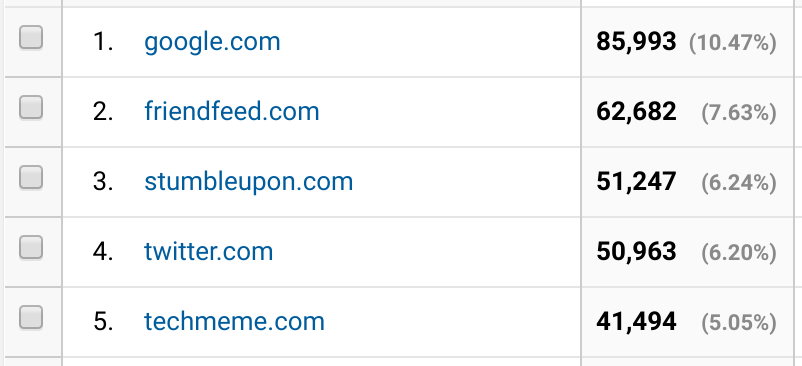
My top referring sites, via Google Analytics, from previous years

As the social streams of Twitter and Facebook took over, and bloggers (me too) got distracted, the share became the canonical mention. Your mentions on Twitter, or your notification of shares on Facebook, were faster delivered and easily quantifiable. And individual profile owners are quite unlike the publishers looking to deep dive into their analytics to discern where traffic came from.

Today, Brent Simmons laments the result of all the mentions going to the streams and leaving the Web. With links decreasing, and blog search being a relic, he yearns for a way to find again how his business is mentioned on the web or when he is being linked to. Joe Gregorio, like me, wistfully remembers analysis of referral logs to find how people found you... all through links.

Simmons' proposal is a limited one, keeping it to the MacOS/iOS community. A small project like that shouldn't be too challenging, but it speaks to a bigger problem, where the connections we once demanded are an afterthought behind the latest viral tweet and trending Facebook share. Streams are ephemeral, but the Web was built to last. It'd be great to see new voices building, informing and connecting again.

Disclosures: I work at Google and am on the Google Analytics product. So I think about publisher tools and visitor stats more than most.

January 01, 2018

Silicon Valley's Lost Year Blends Fake With Future


At the beginning of last year, as the Trump presidency sickeningly took hold, I worried his mere presence and daily volleys against what most of us thought to be good and proper, right and just, would dominate our every thought and conversation. His long shadow of darkness constantly loomed against any chance of progress and invention - taking the luster off usual excitement, demanding an unrelenting distraction, and regular dread.

I pushed pause on the blog because I felt like my comments on the day to day in Silicon Valley carried less weight in a world of crisis, as politics overwhelmed the usual storylines. But I realize silence is not the answer. Instead, we should ask more of ourselves when the wind is not at our back, but against us.

So what if we can make cars to drive themselves, only to find our streets hit by long-range missiles? So what if we could make it easier to connect people together on the Internet, all while seeing people turned away at the entrances to our countries, and see laws enacted that pitted people against each other in ways that we found abhorrently racist fifty years ago? So what if somebody could sprinkle some magical Internet dust on cryptocurrency and make a handful of desk jockeys rich (on paper), when trillions of real world dollars were being extracted out of the lower 90 percent of earners from an egregiously unequal tax bill jammed through congress, with chicken scratches in the margins?

It all seems pretty foolish sometimes, as we banter about over variations in cost per click on banner ads when retail supermarkets are going out of business and laying people off. It seems ridiculous that customers can debate the benefits of the latest food delivery startup when US senators openly debate eliminating food stamps for those who need them. And you can't get all that excited about meal replacements like Soylent and the highest tech juice squeezers in all the land when there are people just miles from the most valuable companies in the world who can't afford to both live and eat.

Remember "Everything's Amazing and Nobody's Happy?" Well, not only is the guy telling that story now tainted with his own awful reality, but not only is nobody truly happy, but there's a lot of crap that isn't amazing.

Nearly 60 percent of children in the city of East Palo Alto, buttressing Facebook headquarters in Menlo Park are homeless, victims of skyrocketing housing prices. Families have stuffed themselves into RVs, only to be told to move along, in Mountain View and Palo Alto, home to $3 million average home prices, bordering Google and Stanford. And yet, the big tech companies keep hiring, while Bay Area cities don't even come close to keeping up with the housing demand.

The Uncloaking of the Alt Right and the Me Too Phenomenon

As for those tech workers who have managed to find a way to live here? 2017 was a mess. Along with an emboldened racist and sexist wing in the Valley, with a new hero in the White House, and a self-promoting ex-Google engineer having penned a hateful screed that cast doubt to his colleagues' abilities solely due to their gender at birth, we also managed to get pummeled by regular news alerts to who the latest scumbags were who mistreated women and thought they could forever get away with it.

What a disaster to see people I considered friends in years past - like Robert Scoble and Dave McClure, to find some of their seedy behavior exposed to the world, and know that's just the tip of the iceberg, as others who have made sport of inappropriate behavior a practical part-time job are legion. While I am very glad to see that it seems, finally, women are being believed, and men are admitting they screwed up, it will take generations to see our workplaces truly be welcoming places for everyone - if it is ever to be.

(Time out: What a f---ing disaster Robert's non-apology post turned out to be. I was stunned at how bad it was, when the easiest thing to do would be to admit guilt, admit to being an ass and promise to work on making things right. I was horrified when I saw it...)

Bitcoin - A Bet or a Con?

So what did our best and brightest minds tend themselves to, instead of taking on hard work and pushing back on the vacuous fact deniers running the place? Many of them took to gambling their life savings on shiny internet tokens and watching prices rise like addicted penny stock chasers - making their own lingo, and debating the basis of specific coins, as if there were any real value in it - besides to get rich, and quick! Thanks for nothing, crypto nerds.

I'm old enough to remember the first dot com boom, with its own fake money games - Beenz and Flooz, that made up their own online currencies, only to go bankrupt at the first sign of weakness. At risk of being the last person on the crypto train, spare me the spam messages and emails and tweets, and please, get back to work. There are too many things you could have done with your time that helped the world, like we are supposed to do.

I apologize for my irregular notes here. When the Valley is really humming, and working on important tools and exciting ways to help us all learn, communicate and share, that's exciting. I see those flashes of brilliance, where I am, at Google, more than I tell you. But I worry many of the trends we've seen that reward bad behavior have become so entrenched, that the real value is being absorbed by the funders and the funded, more than the users. We have to share or the backlash will be stronger than we've already seen.

September 24, 2013

Two Paragraphs, a Link, and a Cloud of Dust

Our platforms, and their limitations, are changing the way we communicate. Rather than accommodating the many ways we as humans like to share and engage with others, most of the online services we use have limits in how much we can share, how items can be staged, and how easily others can discover or respond.

While Twitter's 140 character platform is only the most well-known of these hard limits, there is an easily observable trend away from long-form content, analysis and conversation, and more toward a brief moment with an ephemeral interaction. Blogs are one of the last outlets we have where the container, like liquid, expands to contain all into it which is poured, while most other outlets are often trying to make us something we're not - be it photographers, clever headline writers or meme artists.

We've moved away from thousand-plus word screeds and dozens of debatable comments over a single item, with a permalink discoverable through search, instead to a moment in a stream that is significantly less relevant tomorrow or next week than it is today. We're valuing our content not in real activity, but in microactivities - be it +1s, Likes, Retweets or Favorites. We're trading points and counterpoints for vague notions of follower counts and popularity.

While it can be a challenge to regularly upkeep an outlet like a blog or a news magazine, consider the permanence and discoverability of this content. One can, with a little effort, read an author's life as it changes, by poring through the archives. Authors can link to previous points and positions to make a deeper case for an idea, and show consistency or evolution of thought. And permalinks can serve as the point of engagement for us to talk something into the ground, or its natural conclusion - whatever comes first.

Consider, if you would, the last really important Tweet or Facebook post or LinkedIn update that you either made or saw. Where would that Tweet stand in the halls of history? While real-time is an amazing tool for the right now, it's not usually a great tool for the later or forever. There's no other solution out there for diving into the world's collective thoughts around television, sports and shared experiences, but it lacks for completeness.

Yet that's where practically all our effort is going.

The most visible entrants and quickly adopted mediums in the social sphere over the last few years are not centered around long-form content. Instagram, for the most part, is a photo sharing site with social interaction. Tumblr, despite the option for longer-form content, is usually a collection of photos or short excerpts -- links to links with the content on the other side. WhatsApp and Snapchat are different beasts altogether, focused on the right now, with the content never intended to have any true longevity.

So our thoughts and our communications are being forced into these neatly approved buckets, wrapping around the presentation of the medium. If you know your network looks best with a headline, a few hashtags, and a sentence, that's all you'll do. If you know it's a beautiful photo with three words at the top, that's what you'll do. Maybe you can make an infographic or a meme out of it and be the most shared image of the moment, only to fade into oblivion the next day.

That's why I'm optimistic about the plans for Ev Williams' work on Medium, as outlined in a dedicated piece for TechCrunch two weeks ago. We've also seen interesting attempts from Dustin Curtis' Svbtle network - a very well designed platform with hand-selected authors. I don't yet have accounts with either, as I'm quite loyal to my +Blogger platform and integrated Google+ comments, but both services seem to be fighting against the stream, so to speak, helping people with longer thoughts share in a better looking way.

I believe as social participants, we can and should do better than a picture with a few words, a tweet that summarizes a link, or a post with a headline and a paragraph. It may satisfy the right now, short attention span theater, but if that's all we have, then what do we tell history that we've done? Do we suggest that those in the future looking back on this age download our archived social stream to best understand who we were? Should they grok our automatically filtered photos and understand our taste for art, or see how many likes a post got to determine its impact?

I would hope we're not letting the containers impact our ability to share the entirety of the message. That's why even while I've got plenty of other work to do, the blog continues to be my foundation in a world of streams, which I first wrote more than four years ago and stand by. So if your favorite social outlet starts to reduce the number of ways you can express yourself, take it somewhere else. Don't cut yourself short, and become dust in the wind.

Usual boring disclosures: I work at Google on Developer Relations. Most of my work is on YouTube videos, short and long. This blog runs on Blogger and integrates Google+ comments. The post is not intended as a post in favor of or against our products or competitors' products. I also like writing long disclosures.

July 11, 2013

You Have Your Tech Routine. But It Will End.

In 1995, as a freshman in college attending Cal, I was rapidly trading emails with my friend from UCLA in a heated conversation, hitting “Check Mail” in Eudora, eventually changing my settings to automatically retrieve email every minute. One of my roommates, annoyed at my behavior, suggested I just pick up the phone and call him instead. But I didn’t. 

Obviously, in the near twenty years since, I have expected my messages to come in practically instantly, and to immediately have my attention - so I’m on top of it. But there might come a day in the future, if you can imagine it, where I send my very last email. For just as we’ve “always” done something one way doesn’t mean we always will. The pace of tech, and one’s changing lifestyle, practically commands adaptation.

Switching to a separate firehose of electronic messaging stimulation, we’re nearly a decade deep into the hyperconnected social media phase. We’re long past the time for education and evangelism, for the most part, on blogging, social networking, tweeting, and YouTube - and you’ve got routines.

While not everyone uses every service, and different people have different approaches, there’s a good chunk of you who can’t imagine doing things a different way, and stopping what you’ve always done. You can’t imagine never tweeting again. You can’t imagine never checking in to the office on Foursquare when you arrive at work, and maybe you can’t even remember the last time you had lunch and didn’t take a photo of it to share on Instagram or Foodspotting.

But it will all end.


I often think of that, especially as I’ve reduced pace here... what would my last blog post say? How will I know that I’m done? What will be the reason I would possibly walk away from thousands of posts in the archives? Could I really close down my Twitter account, or delete my Facebook, or even FriendFeed?

And that goes for offline activity too. In my recent adoption of Fitbit, and regular walks to keep my stepcount high, I think about how long I’ll keep the routine. Will this be the last night I’m walking around the block to get a few thousand steps in, for tomorrow, I’ll be back in front of the television instead, having let my Fitbit power down?

On other occasions, the choice is seemingly made for you. In 2009, I once said I wouldn’t stop using Google Reader every day, even if you paid me $25,000. I guess the joke was on me, of course - for it wasn’t really all that long after I joined Google that yes, Reader was closed, and I’ve turned to Feedly to get all my RSS feeds instead. So outside of my control, one day, my routine of opening Google Reader was no longer there. If Reader had remained, I’d probably be in my same routine, as I always had been, consuming content and sharing it, just like I’ve been doing for about six years.

Meanwhile, the removing of Google Reader, and yes, Google Buzz before that even, meant ranking my social content in my6sense no longer was needed, so I found myself deleting that app from my phone last week, despite our history.

Even when it’s not the company or the service shutting down, it could be a simple measurement of priorities for you against what benefits you’ve seen from the app. For the last few months, I’ve thought about this a lot, as I’ve checked in on Foursquare at places big and small, for the important travels and the mundane.

Am I really a Handmade Hero? No. Last Badge...

While my badges and points racked up, the real world benefits were exceptionally rare. I’d met a few people, and saved a few dollars, but today, I deleted my account. No drama. Just decided I was done. That should save a few power bits on my phone, and a few minutes of each day.

As much fun as it has been to play the role of early adopter and use every service to its fullest, I believe we’re well past the mania time of social networking, services and apps. Being on a platform isn’t the same as using the platform well. And if you can’t find measurable or emotional value to participating in a place, there’s no harm in calling it quits - or continuing to have your eyes open for what’s next, so you don’t find yourself entrenched in the way things have always been, while missing new experiences.

Sometimes that means never joining in the first place, analyzing what you’ve seen and deciding if that makes sense for you. Even though I was an early trial user of Burbn, I never got an Instagram account, and I lived. I never got into GetGlue, and won’t. I never liked Turntable.fm, and I’ve never done a Snapchat. Maybe it’s the graying hairs on my head, or being closer to 40 than 30, but I know time is valuable.

Someday all of this will stop, and when I pick up my head from the computer monitor, will I feel as if I’ve missed something, or will I be happy with the results of what I’ve done?

Disclosures and Disclaimers: Yes, I work for Google, in the Developer Relations team. This post is not intended to represent them or favor their services in place of any of those I just mentioned, obviously.

March 11, 2013

Video: Getting the Attention of Influencers and Bloggers


Having been somebody on both sides of the startup and blogger equation, I know how hard it is for new companies, products and ideas to get visbility and break through the noise, grabbing the attention and sustained interest of early adopters, influencers and users. Today on +GDL (Google Developers Live, the program I run at +Google), I sat down with colleague +Don Dodge to share some of my own experiences and talk about this very thing.

In the discussion, about 20 minutes, I talk about working with +Edwin Khodabakchian of +feedly+Iain Dodsworth of TweetDeck and more, as some examples of sharp people who engaged with me in the many thousands of posts that have found home on +louisgray.com. This event is one in a series we're calling Root Access, targeting startups and developers on Google Developers Live. Find many more events, publishing every workday at https://developers.google.com/live.

October 17, 2011

Hey! Didn't You Use to be a Tech Blogger?

If you really care about a craft, you'll want to be consistent about it and maintain high quality. That goes for athletic pursuits, hobbies, careers, family, or whatever provides you with reward for effort well done. For me, after several thousand blog posts poured into this site for more than five years, gaps are noticed. I'd like to make up some story about how I took ten days off from blogging out of respect for Steve Jobs' passing, but that'd be nonsense. So would any belief that I'm overworked and overtired. After all, I'm keeping practically the same hours I always have, and I managed to cram an entire four seasons of Mad Men into two-plus weeks of aggressive Netflix watching this month. But the ten day gap is the longest here since starting in January of 2006, and I'm hyper aware of it. What's changed, at least in the short term, is what I consider valuable.

MG Siegler, now at CrunchFund and a part-time TechCrunch contributor, wrote a pair of posts in the last week or so on what has driven him as a tech blogger. The first, in homage to the Raiders' late owner Al Davis, was titled Just Win, Baby, and the second follow-on was simply Drive. In these posts, MG talks about how he set goals for himself that he could be satisfied with, whether it be creative headlines, analytical longer posts, scoops or whatever... all elements of a game that contribute to "winning", he writes. Having had a front row seat to MG's ascension, at least the last four years, I understand his view, and recognize his need to find value in his effort. Make no mistake - in blogging, one has to find value in what one is doing, especially as for most there is little to no money it, and those who are the exceptions, TechCrunch included, need a strong combination of skill and luck.

With that backdrop, having shifted gears in August and counting Google as my employer, I bump into the occasional person on campus who graces me with a question much like "Hey! Didn't you use to be a tech blogger?" or "I heard you were a pro blogger before joining us." It's almost with some regret that I have to admit I didn't cram my page full of Adsense to make a few bucks, and that I always participated here for the sheer fun of it as a hobby - that I wasn't really a tech blogger, but just one who played one on TV. While it's great the blog created a name, explaining the true backstory, be it through mentioning my6sense or Paladin or BlueArc or something else... you know, real work... takes a bit of time. But as 9 of 10 startups fail, so do 9 of 10 blogs, I'd bet. Many get started and abandoned. Many don't get readership that satiates someone's needs, and obviously, now, participating on social networks is simpler, faster. It's like popping chocolate espresso beans for a quick perk instead of preparing a full multi-course meal.

As someone on the outside looking in to some of the tech giants who make news and have the attention of consumers and tech reporters alike for years, be they Twitter, Facebook, LinkedIn, Apple, Google or others, I could sometimes get weary of seeing new hires or established employees at these firms talk about how wonderful their jobs were. Just like nobody wants to read the social status update that "I have the best friends in the world" or "my boss is so nice", few want to hear silly updates about the nuances of your 9 to 5. So I have made sure not do bore you with that here. You don't need it, and I know it won't add value.

Similarly, I've always believed in having a good sense for when to speak and when to hold back. I recognize that in my new position, rightly or wrongly, how I comment on perceived competition or rumors carries extra weight. So posts that used to make sense on this blog, such as updated hires at Twitter, comments on the news feed from Facebook, positions on Android or Google TV or other products I like, are viewed in a different light. Also, working within Google and having access to future plans for our product line and sister projects throughout the company makes commenting on trends or specifics a fine line best avoided.

Make no mistake - that's certainly not due to any push from the company to have the blog quieted down. As one can see from many other active Googlers online, an open discussion is celebrated and debate is encouraged. In fact, without jumping into specifics, the greatest conflicts with employees at the company is when access to information or locations is in any way unequal. The corporate ethos is to make that information discoverable and for movement on campus fluid. So while there may be some curiosities as to how the blog will morph, nobody would ever expect it to disappear, and the gap is from me - as I'm finding less of a need to talk about what everyone else is doing, and almost no need to overpromote what we are doing. So I watch, I read, and I keep working.

As MG writes, one of the driving elements of a tech blogger is the ability to get scoops - breaking a story before the competition or before the company is ready. For a while, I was doing that, being first to introduce many properties to the tech blogosphere. I felt I had proven I could do that, and didn't push as aggressively later, even as some small startups would provide tips. Some more effort was pushed toward gadgets instead of social services, or more arching analysis. Unlike other authors, I always had the day job providing a foundation, so I didn't need to chase sensational stories and headlines, or post with great frequency to meet a quota.

In time, I knew that I didn't have to post every day, but when I did, I had to make sure it was good. Some of the best posts are more thoughtful, and don't necessarily break the news - but set the stage for more thought and creativity. Now, at the office anyway, I get to work with a service that has a lot of attention, and help prepare our own equivalent of regular scoops, doing much of what you saw me do here on the outside, on the inside. That helps satiate the need to break the story. It helps keep me connected simultaneously to our users, the news media at large, and third party developers. Hence the decreased need to scratch that itch.

Also, as more people are being introduced to me for the first time, through Google+, as a Googler, and not as a tech blogger, I know that I am representing the company when I post, even if not directly, so they may get confused if I profile one startup or another that is unrelated. No amount of disclosures can clear things up for those lacking patience. So that's weighed in as well. Sometimes it's easier just to sit down and watch an episode or four of Mad Men and put it off - that I'll blog tomorrow. It's not that the Drive is gone. It's just on a different course.

July 12, 2011

I Gave Away My Web Identity. All I Got Was a T-Shirt.

With so many places to position your identity on the Web these days, from social networks to blogs, personal profiles, custom pages like About.me, resumes and so on, presenting one's central presence with a domain that bears your own name is increasingly valuable. While at times, I'd considered renaming this blog to not be so eponymous, it's served me well. Having louisgray.com for more than 10 years, and having registered it through the end of this decade, at least, means that when people put my name on the Web, they'll find content that I have created, in the way that I want it presented and ordered. And thanks to it being hosted on Blogger, backed by Google's strong "Takeout" project, which lets me easily export it and move it elsewhere if I need to, I am not bound to a third party network representing who I am. My domain is owned by me, and will be here for years to come.

The recent trend of some high profile folks, who have earned serious respect for their own entrepreneurial efforts already, to point their eponymous domains to Google+ or other networks seems short-sighted to me. While I am obviously a big supporter of Google+ and am voting with my own activity there, at the expense of other networks that are less engaged and rewarding, I do not have any plans to move my domain to redirect to that page, and suggest others don't as well.

If Google+ (or other networks like it) present an engaged audience with high quality content, and so far it does, the best way to reflect that on your own domain is to bring it to your domain, where you control it. With FriendFeed, Facebook, Google Reader, Twitter and even Google Buzz before it, tools have existed to help you share your feeds, your most recent items, and highlights on your own blog. As Google+ matures and tools emerge from the Mountain View mother ship or from the developer community, I will be bringing more than a "Follow Me" button to my site - hopefully my most recent posts and statistics will make it here as well. But when you look for "Louis Gray" on the Web, it should be my own domain that returns - not About.me, Google Profiles, Twitter, Facebook, LinkedIn or anybody else.

When FriendFeed catapulted on to the scene in late 2007 and early 2008, we heard some of the same rumblings of people saying they were going to stop blogging outright in exchange of using the network. Others found Twitter's 140 character style made the best sense for their output, and their blogging decreased or stopped. While I don't really mind people being comfortable with different styles and migrating to what seems fit, I am hesitant to endorse forwarding your identity to a third party domain you do not control. Of course, with Google being Google, Google+ is much more likely to be around and supported strongly in the long haul than was FriendFeed, which was essentially abandoned by Facebook to wither away like a rumpled jacket left on an elementary schoolyard playground.

Kevin Rose is a smart guy and has done some good for the Web and I expect this will continue. So too has Bill Gross. Tom Anderson has catapulted in visibility on Google+ from having almost disappeared after MySpace's fade, and that's fun to see. Google+ has captured the imagination of these top guys and many more who see it as a vibrant alternative to the boring status quo that we've been shovel-fed for the last few years. But I don't think they should give their identities and domains away to the service. Because in 10 years, 20 years, 30... you'll still be you, but services and companies evolve.

June 04, 2011

A Scorched Data Policy Is Bad for Web, Bad for History

In a world where the cost of storage is practically zero, and the incentive to delete data declines, I'm befuddled by the lack of prioritization for some companies to focus on a complete search history, and in parallel, an intentional erasure of information by more prominent content producers, who seem to arbitrarily decide that the long tail of the Web, and the interest of future readers is less important than being seen as participating in the latest hip wave.

Even as I've changed technologies, blog providers and structures, I make extra effort to not lose historical archives and keep comment streams intact, not for ego purposes or for SEO, but because it's the right thing to do.

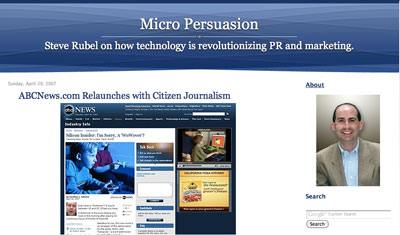
Steve Rubel, an executive vice president of global strategy for Edelman, a longtime blogger who was among the first to espouse the benefits of blogging, social media and was often at the leading edge of tech only a few years ago, has more recently swayed to and fro based on the hot startup of the day, leaving thousands of broken links in the process. After running out of time to update his blog regularly, back in 2009 he ditched the blog to run a lifestream, based on Posterous. (Google cache). Last month, he pivoted again (another hot thing to do in the Valley these days for those with unsuccessful ideas) and now is the proud owner of a Tumblr-powered blog.

Pivot Number One Saw Steve Go to Posterous

Pivot Number Two Saw Steve Go to Tumblr, and Delete Everything

But instead of leaving the older sites open, he deleted everything, proudly stating:
"With just two clicks of a mouse I rid the web of literally thousands of blog posts, some of which I am proud of - others less so - and redirected the URLs to the new site."
While no doubt many of his older posts (like mine) have limited or no value to today's readers or those in the future, they are an insightful historical record of one of the more visible bloggers of a specific period, one who is now in the process of erasing his tracks.

With more than five years of blogging myself here, the blog archives now take on their own role as a personal reference desk. When Kevin Rose left Digg, I was able to go back to my comments on Digg in 2006 to see my thoughts at the time. When TweetDeck was sold to Twitter, I could go back to 2008 and see my first thoughts on the service. With PostRank selling to Google yesterday, I found a post I made two years ago that had comments on it from people who now work at Google. If I didn't manage to keep the posts alive and the comment threads as well, this would not be possible.

Steve's Community Is Very Unhappy With the Deletions, Calling it "Nutty"

Others Say Erasing "A Bit Much", Want Their Comments Out

For those of you who don't consume my blog exclusively by RSS, you might have noticed some recent changes to the look and feel (Go ahead and look). It's not a major change, but an upgrade nonetheless. Part of the reason for my slow migration was the criticality for me to not lose the existing posts, structure, external links and attached discussions. I know some comments from a few years ago are still out of reach, but I'm hoping to bring them back.

Of all the Web content I have produced or managed in the last fifteen years, one of my biggest regrets is the complete void from my time in college, both from my own personal home page, and from the student newspaper where I was the online editor and also wrote hundreds of posts, most on the front page. Current Valleywag editor Ryan Tate, who picked up the online editor job at the paper after I had left, struggled with a series of malicious hacks, and all our collective work was gone, erased from the Web like a bad memory. Whenever we trade emails or talk in person, we both lament this loss.

Steve's Original Micro Persuasion Blog, Pre-Deletion

This data obliteration is something that really is avoidable now, and yet, we let it happen on a near-constant basis. Most newspaper stories from the terrorist attacks in 2001 come up as 404s, beyond the reaches of the Archive.org project, or Google's search engine cache.

What I would like to see is a proposal from Google, or some other well-intended Web entity, such as Amazon, to offer a solution, embedded in today's modern browsers, as an option, that solves for intentional or unintentional content deletion. All those links that I provided back to Steve Rubel's MicroPersuasion blog from 2006 to 2009 should automatically be detected as dead, and then presented, to the best of the tech's ability, as they originally were, using Google cache or S3, Archive.org or something. And yes, I'd love it if somebody like Google or Microsoft would also give Twitter or Facebook a helping hand to get their own search archives into something useful.

Steve Thinks The World Won't Care About His Old Posts.

The issues I have with Steve's approach to pouring gasoline on his past and then lighting it on fire is not one of a choice of platforms. While seeing him join Tumblr is about as hip as your dad trying to snowboard with the cool kids, the more important part is that it eliminates the choice for readers, present and future, to ever get that data, and fill in the blanks. It's not his call to decide what has value for others, even if he sent me a tweet saying "we're foolish if we think the world really cares."

The world should care about walking through the historical record - be it on Steve's blog, or Dave's blog, or Robert's blog, or Mike's blog, or Penelope's, or any of the people who have been chronicling the world they see around them. I wish we had full archives from newspapers for years and decades backward, or the personal journals of people famous and ordinary from centuries past. What they might have found mundane is intriguing to others of us - maybe not massive populations, but to one person, they could contain serious insight. The Web is supposed to cater to the long tail, and the history of what we've produced should be there when they come looking for it.

December 31, 2010

2010 Internal Year In Review (Month by Month)

With almost 400 posts in the year, you no doubt missed some, and January probably seems like ancient history. That's why at the end of each year, I try to summarize the 12 months that just went by on the blog to see if we all can remember the big news and opinion that passed through this place. Interspersed with the day by day updates, the product launches and feature enhancements, I did manage to expand the family and the house and get more embedded in Web startup land with a new role.

Maybe I blogged about all these changes and maybe I didn't. 2010 saw a resurgence in tech startups after a poor economy shelved many ideas in 2008 and 2009, leading some to even claim there was a bubble. To be honest, I don't think there is one, but a few late stage companies that deserve it got funded at big levels. Now let's make sure to recap.

Reviews for the year 2009 and the year 2008 are of course available for those of you who just stopped by this year.

The word of 2008 was "launched". The word of 2009 was "Twitter". The word of 2010 was probably "Android".

January

I started the year saying computing would get thinner, mobile and connected... noted Apple tablet reruns... discussed iPhone owners first considering Android... begged for OS neutral data... checked Technorati's pulse... got a MacBook Air... said the iPad would sell like crazy... and said you should be driven and never compromise.

February

February reported on Apple's growing chip division... saw Siri launch for artificial intelligence... the introduction of Google Buzz... which validated FriendFeed... based on open standards. Cadmus launched for Twitter relevance... and BuzzGain was acquired by Meltwater.

March

In March, TiVo launched the Premiere line of DVRs... SocialToo protected against Twitter phishing attacks... Google Reader hit Play... while Blogger added templates... and Twitter's Ev Williams bombed in a SXSW interview. Qwotebook launched... my6sense launched an Attention API... and my wife and I announced we were pregnant with baby #3.

April

In April, I belatedly started using Foursquare... I was annoyed with my iPad... but noted confusion from developers in terms of focus... Rick Klau left Blogger to head Google Profiles... I joined the MyLikes advisory board... Twazzup launched a Twitter client... Fabulis launched... Steve Jobs became an e-mail machine, and Facebook started pushing "Like" activity to third parties.

May

I mocked Apple's focus on Flash when AT&T was a bigger enemy... Scout Labs was acquired by Lithium... I expanded use of Google Buzz... I grew tired of the echo chamber and attacks and attended Google IO, which saw the introduction of the Chrome Web store... the Google Buzz API... Google TV and argued iPhone users were in for it. I tested Android for the first time... and said mobile choices came down to your focus.

June

By June I reported Android was pretty good and hit 5,000 tweets. Spotify went social... I joined Qwotebook's advisory board... fell in love with Redfin... tried to be pragmatic... heard rumors of Google Me... and saw Brizzly roll out picnics.

July

July saw Blogger add stats, my kids take to the iPads... a call for data independence... I goofed up and thought Foursquare would buy Brizzly... saw Kosmix introduce a cool Twitter extension... I officially switched to Android... saw the launch of Flpboard and Friendly for iPad... and moved across town where I suffered without broadband for a week.

August

August saw me misinterpret internal Twitter accounts as new features.... I had some dingbat fraudulently use my identity... the storage world got hot with acquisition mania... I announced joining my6sense... and Braden was born the next day.

September

In September, Spotify and Sonos teamed up... while I predicted the future of search... my6sense came to Android... people debated the future of RSS, again... and Google Me rumors had us investigating social layers or networks. By end of month, OneTrueFan launched... and AOL purchased Brizzly.

October

By October, I got the new Apple TV... Tweetbeat launched for real-time Twitter events... Yobongo launched for location chat... Marissa Mayer was moved to location... the attention crisis accelerated... I visited the new Google campus store... and rumors about Apple looking to buy Spotify were false.

November

In November, Lazyfeed launched Lazyscope... and Sonos sent me a wireless iPod dock... I predicted the third wave of the Web would be personal... Blekko and Rockmelt launched... I switched to the Samsung Epic... as did Path... and Hotpot... while Cliqset shut down... and new iPad competition from Android emerged.

December

As the year wrapped, Google Reader came to Android... while Facebook expanded friend discovery... I was featured on CNN to discuss privacy, which led to phone calls... Gawker's database was compromised... and Delicious looked to be dying. I bought the NOOKColor... saw the launch of Beluga... argued iPhone fans were discounting Android... summarized Quora's growth... got hooked on the Samsung Galaxy Tab and tried out Google's Chrome OS laptop, the CR-48.

So that was our year. Launches, new gadgets and new operating systems galore. Discussion of openness and data portability, success and failure. If you've just bumped into the blog, now you'll get a solid idea of what we do here. Even with all these links, the hardest part was making sure I caught all the big stuff. On to 2011.

October 29, 2010

Podcast With @hackmanj on Blogging, my6sense, Marketing

Wednesday night, as the Giants and Rangers were battling in game one of the World Series, BlogTalkRadio's Joe Hackman and I sat down to see if we could cancel out the jocks and reaffirm our position as geeks, participating in a podcast to discuss how bloggers can gain visibility through access and insight. We discussed my personal decisions to join my6sense as VP of Marketing, my conversion process from iPhone to Android, and how I try to juggle having three kids under 2 1/2 with all the other tasks that compete with my time.

Among the key discussion points, which might be fun for you to check out:

1) Defending one's turf, rather than being pragmatic & investigating alternatives.
2) Google's innovative moves versus struggles they have had in other areas.
3) A next generation of bloggers in their teens you should start watching now.
4) Microsoft's challenges in mobile a parallel for search.
5) The history of louisgray.com.

For those of you who have read louisgray.com for some time, or heard some of my previous podcasts, some stories may be familiar to you, but there's always something new.

Joe posted the discussion on his site here, and I have embedded it below. You can find Joe on Twitter at @hackmanj.

Listen to internet radio with Joe Hackman on Blog Talk Radio