Showing posts with label Finance. Show all posts

January 02, 2018

Why Silicon Valley's Real Estate Crisis Is a Present Danger

This nice home would probably go for $2 million in some Bay Area cities.

That Silicon Valley housing is very expensive is no surprise to anyone who is paying attention.

Fueled by a bullish tech market for the better part of a decade, with inventory dramatically constrained, each new home entering the market can be flooded with aspiring buyers who are eager to pony up millions of dollars for uninspiring homes, with the desirable promise of reduced commute times to big tech companies or startups, or access to high quality schools.

As a homeowner who bought our place in 2010, I could be doing victory laps about perceived value increases each time I view Zillow or Redfin to see how our long-term investment is doing, but the harsh reality is that the daunting financial demand needed just to find a place to live is having a dramatic impact - not just on the Bay Area as a region, but in markets far from our tech epicenter.

Prices in secondary markets outside the Bay Area are skyrocketing as distressed Californians seek alternatives. Working class families are being priced out of the most desirable cities, forced to endure hours of commute times from far-flung outlying towns, or losing their homes outright. Some small businesses are closing because they can't afford the lease, or can't find enough help to keep their business running. Help wanted ads for service workers are visible practically everywhere, and few answers are clear, aside from pushing for more housing, which in itself finds opposition from the slow to no growth community.


The topic of Silicon Valley real estate is ever present. The high entry point presents a barrier to tech workers looking to start their careers. It presents a challenge to new families in high priced rentals who may once have expected to save for a home, but see that opportunity get further out of reach each month, as savings never catch up with price inflation. Others living outside the Bay Area may turn down career opportunities because the promised salary and benefits can't deliver an expected standard of comfort. It's happening, and it's very likely to get worse.

About two and a half years ago, I read the tea leaves and talked about how I saw Sunnyvale as being in an enviable position, flanked by Google and Apple, both of whom are aggressively growing and are significantly profitable, helping to drive up demand for homes and attracting well-paid tenants. That post, "Tech Company Shifts Position Sunnyvale as Major Hub for Next Decade", helpfully marked some median home prices at the time of the article and allows us to compare what's happened since.

While Bay Area prices have increased, Sunnyvale and Mountain View lead.

As I had expected, not only have home values continued to spike on the San Francisco peninsula, but pressure from Apple's new campus, built on the Sunnyvale border with Cupertino, and increased growth from Google and LinkedIn, etc, have pushed Sunnyvale prices higher at a rate that dwarfed even its pricier neighbors, and driven average home values to nearly $2 million. You also saw a similar rise in Mountain View homes, where Google is based, but Sunnyvale has practically caught up.

What this means in real-world impact is that homes purchased just a few years apart, on the same street, can have wildly different purchase prices, monthly mortgage payments, and property taxes. Our neighbors, two doors down from us, recently paid more than twice the price for their home than we did in 2010, even though theirs is smaller. And they'll get nailed with twice the property tax to boot - their gift from the state of California.
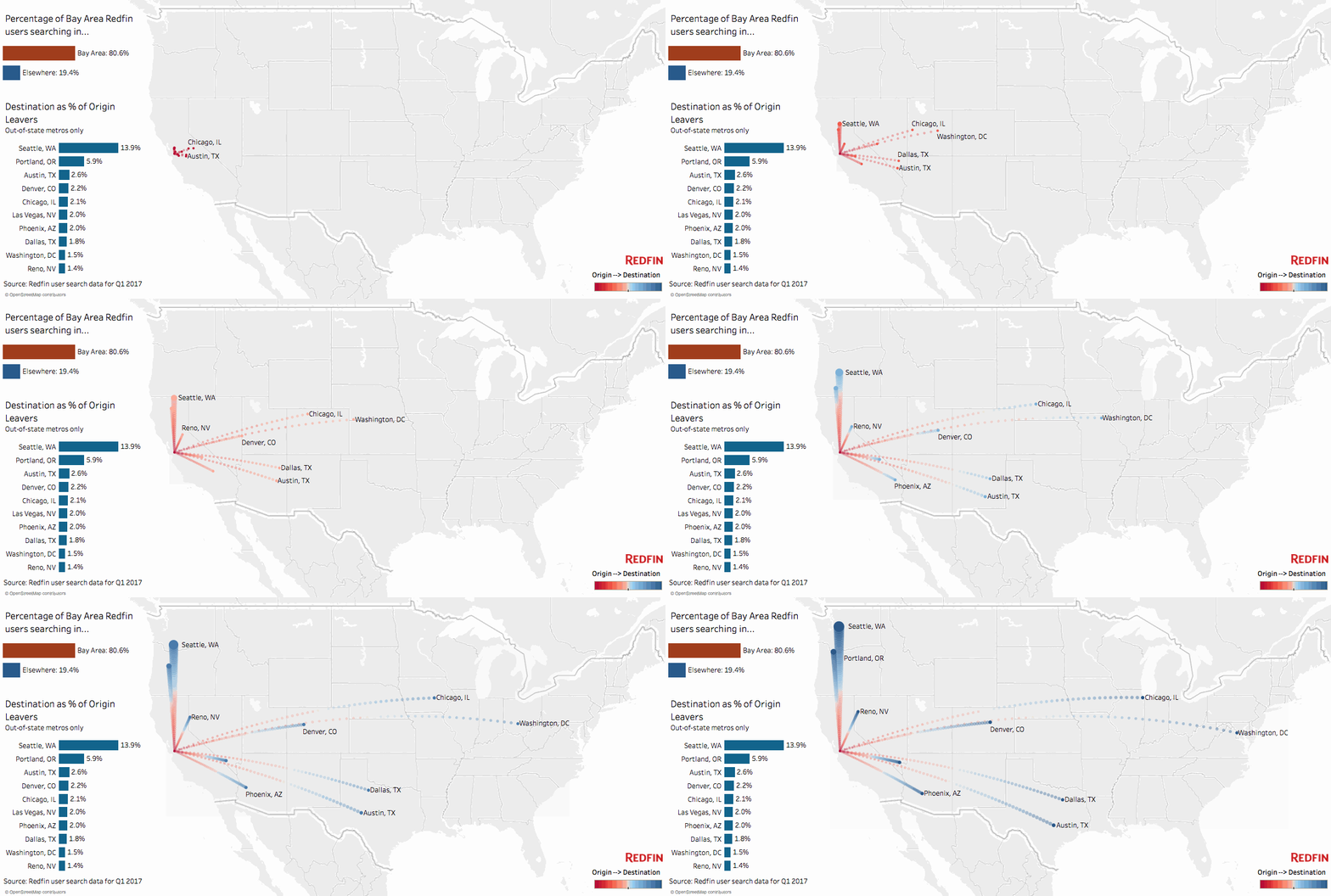
Redfin highlights migration patterns out of California. (Source)

For those who can't stomach a $2 million price or higher (and that includes us, by the way), buyers are looking elsewhere - to Seattle, Boulder, Austin, Portland, or even Washington DC, for alternatives. Seattle's home prices were up 16% in the last year alone, largely driven by migration out of California, which impacted the entire country. And while prices went up, more people were sent to the street - which has led to a spike in homeless deaths in the highest priced cities. (Source)

As I mentioned yesterday, the majority of children in school districts near Facebook headquarters are homeless. This is a new and growing crisis. Low to middle wage earners who can't afford to buy homes here are living in their cars and RVs. I see many of them when I walk the dog at night and recognize familiar faces who are just trying to make it to the next day. Even as Sunnyvale and other cities nearby are raising our minimum wages to $15 an hour, that is not a sustainable wage that can cover high rents that continue to grow. And there is always resistance from NIMBY (Not In My Backyard) neighbors who enjoy the high home values, but want to avoid rising traffic, taller buildings and crowds that come with job demand. Add on to these issues competition from foreign money like China, where many area buyers come from, and you have a recipe for disaster.

Silicon Valley's successes have had incredible impact on the world and the region. Some people have gotten obscenely rich from company successes and acquisitions, and have the option to buy these multi-million dollar homes for cash, or dual income couples with big bank accounts can float enough to solicit high bank loans to get there. But traffic on area streets is consistently thick as people drive further to daily routines. Highways are jammed as badly as Los Angeles - and commutes are worse.

California is where you look to see the future, from our inventions, to our forward thinking governments and social acceptances. The Bay Area is where you look to see what is coming to metropolitan areas throughout the country, and perhaps, the world.

Our high prices today are yours tomorrow, and we're erecting a massive "No Vacancy" sign to those who aren't here yet. Good luck to us all.

February 09, 2016

Running a Social Fantasy Stock Portfolio With Google Finance


It’s no secret the stock market has been more than a little bit rough this year. After years of growth and optimistic enthusiasm about Internet giants, promising biotech pioneers who aimed to change the world, and starry eyed hope for unprofitable unicorns, 2016 has seen record setting declines through January, with the average company losing double digit percentages in value, and less fortunate market caps slashed by more than half in less time than Noah and his family were said to have spent on an ark.

But amid the daily headlines screaming with bold red letters, the overnight alerts about instability in China, and debate over whether the low price of oil will halt the rise of the electric car, a few friends of mine and I have been running a parallel stock game of sorts which makes the daily punishments of whiplash just a little more acceptable, and maybe even fun.


When the leader is down 13%, you know it’s been a rough year already.

The starting rules sounded simple: Start with a virtual $100,000 (any number works, but $100k sounds big) Pick ten stocks or commodities Invest $10k in each one, either short or long. Hold those picks for a full year. No trading. After a full year, the person with the greatest balance wins.


We all started with 100k, but we’d all beg to get there now.

The rules, especially the counterproductive block on any mid-year trading or selling, seem simple. And the twelve month horizon may have you believe it’s a set it and forget it game — just plug in the tickers and come back to see how you did. But the reality is far different. Six different people with different backgrounds, who claim to know what they’re doing and have more than an average level of experience in the market, each delivered widely differing picks, and now we’re keeping an eye on sixty different securities, watching how they move in the face of some pretty strong headwinds.

One portfolio bet 10 for 10 on small cap biotech stocks, crossing fingers for a binary spike on approvals from the FDA, but has had absolutely no luck, down more than 40 percent on the year already — needing a near double to get back to par. Others of us picked large cap tech leaders like Google, Facebook, Netflix, Apple and Amazon, and have also seen declines around 20%. Solar picks like SolarCity, SunEdison and SunRun? Down 33%. One contrarian portfolio is hoping for turnarounds from Yahoo!, HP, Chipotle and Yelp! and faring no better. Pretty much the only things that have kept above water in 2016 are retail picks like Macy’s and Walmart, old media like Time Warner, and a few opportunistic shorts.

(Disclosures: I work at Google and also own SunRun stock in real life. No other biases are assumed or intended.)

The Contrarian Account is Down Too

That none of us predicted a market correction makes us seem more than a little daft, but even though we’ve managed to take $600,000 and turn it into just over $450,000 in about a month’s time, the daily ups and downs and charts created by the automated spreadsheet have turned what should be a tragedy into a thrilling contest that plays out five days a week.

How Google Finance and Google Sheets Run This Game

Stock portfolios are typically a secure and individual endeavor. They’re not made for other people viewing, and they’re not social. But when my dad wagered I couldn’t invest his money better than the 3.5% annual return he expected from a money market account in 2014, I had to find a way to prove I could. And I happened upon Google Finance’s integration with Google Sheets — plugging in my own ten picks that summer, and eventually delivering 10% or so gains on the year. That experience had me getting deeper into Google Finance calls, dabbling with App Script, and setting up the game we have today.

Step 0: Make your picks.

For this game, I set an arbitrary date of January 1st, 2016, and had all participants enter their selections before market trading on the New Year, so that when the market opened, we were good to go.


Start with 10 tickers and then let Google Finance do all the work in Sheets.

Step 1: Get the prices for your picks.

Google Sheets supports calls to Google Finance that request the stock ticker, and then a number of variables, like “Price”, “High”, “EPS”, “low52” for the yearly lows, etc. (see https://support.google.com/docs/answer/3093281) For example: =GOOGLEFINANCE(“AAPL”, “price”) would return the price for Apple stock. Paste that into the cell and change the ticker for your stock.

Step 2: Determine how many shares each player has per ticker.

We determined $10,000 per ticker, and divided the shares by the opening price on January first. A simple spreadsheet call did the math for us.

Step 3: Show the daily change in each ticker and portfolio.

The call of =GOOGLEFINANCE(“GRPN”, “changepct”)/100 would show how much Groupon stock has gone up or down by percent each day. That percentage change, against the total value of your shares at the end of the previous day, would deliver the Daily Impact from that ticker. Add up all ten, and you have the daily change by portfolio.

Step 4: Create background sheets to run a scoreboard.

Now that all the tickers are constantly getting data from Google Finance, and showing the ups and downs each day and over the long term, you can set up three distinct hidden sheets. These sound complicated, but you only have to do it once.

4.1 ) The Master Data sheet. This sheet tracks every ticker in every portfolio and captures their current value. This is done by making calls to each person’s portfolio and the respective cells, like share count, price and gains.


You only have to put these formulas in once, and they’re not really that complicated.

4.2) The All Time script sheet and Daily Script sheets. These are more fancy, as they take data from the Master Data sheet, and auto sort by the most valuable stock pick, displayed it in descending order. This is done using Google Apps Script, with one of these commands: =SORT(‘Master Data’!A2:L41, 8, FALSE) to get all time data =SORT(‘Master Data’!A2:L41, 9, FALSE) to get daily change data That looks crazy, but what you’re doing is making a call to the Master Data sheet, saying you’re looking at all 40 rows from 2 to 41, and all columns from A to L, then ranking by the 8th column, which is the overall gains column, or the 9th, which is today’s change. These sheets make the game more fun.

4.3) The Leaderboard sheet. This small sheet tracks the current values of each players’ portfolios, and how much they’ve gained — both since the beginning of the game, and today.

Step 5: Get As Creative as You Want

Once you have every player’s portfolio being tracked in near real-time through the day, you can do practically anything you like with the data.


The day’s action on a red day shows 10 stocks up and 50 down.

We set up a front page which highlights the current leaderboard, from top to bottom, and shows which stocks have done the best all time or each day. And for those who love to watch the CNBC ticker, we set up another page called “Today”, which captures the day’s action, including our total gains or losses on the day, and an eyeball look at how many tickers are up or down on the session.


Fun charts bring color and tell the story as the market runs.

We also set up a page dedicated for charts, to capture how we’re doing each month on the game — which requires some manual work on the last day of each month, but is trivial, and compares each player to another, showing how much we each need to improve to move up the ladder to the next slot.

And on each portfolio page, we got creative with the Finance API and made calls to 52 week highs, lows and how far each ticker is doing from the annual peak.

What Could Go Wrong?

With Google Finance doing all the calls in the background, and the tickers never changing, the game doesn’t need a lot of maintenance from the project owner — aside from the monthly data captures, and any new features you come up with. But the stock market is a tricky place, and you have to watch for complications.

What if a company gets bought or goes private?

Our answer has been that if a company gets purchased, we would ‘pay out’ the holder as if they owned real stock. An all cash transaction would pay out at the value of the deal, while a stock transaction would get equivalent stock of the acquirer. If a company goes private, the stock value is frozen at the last day it was traded.

What if a stock splits?

That’s a fairly easy one, actually, if you see it. For example, if Amazon is at $500 a share, and you have 20 shares, and it splits 5:1, you’d give the current holder 100 shares at $100 a share, and adjust the acquisition price to a fifth of the original.

What if a ticker changes?

That’s annoying, but we already encountered that with Broadcom getting acquired by Avago Technologies. The calls to $BRCM no longer worked. I tracked down the acquisition details, swapped out the calls to $BRCM in exchange for $AVGO and made sure the dollars matched.

What about dividends?

Look. This is a game, so no dividends for you. Sorry.

What about index funds and options?

Index funds are great if you’re trying to be safe, but games are about risk. And options are too tricky to set up, so no. Sorry.

I did the hard work of getting started. Here’s your template.

Practically all the Google Finance calls from Google Sheets can be found on this help center page: https://support.google.com/docs/answer/3093281. I leaned on Reddit a bit to find out how to pull in data on Bitcoin, and asked my colleague Steven Bazyl some App Script questions when I was getting started. But now I have a template that runs itself. If you want to paper trade by yourself or with some friends, you can absolutely take our template, and put in your own picks. And just maybe the market will turn around and we can talk about gains instead of losses!

Here you go: https://goo.gl/YdTalj Have fun and good luck!

July 30, 2015

Tech Company Shifts Position Sunnyvale as Major Hub for Next Decade

In Silicon Valley, some of the most prosperous cities and most sought after zip codes to live, raise a family and send kids to school, are directly dependent on the proximity to corporate headquarters of the leading technology companies. As some of the biggest companies are running out of room in their headquarter cities, the resulting demand for continued growth is putting pressure on neighboring communities. Sunnyvale looks like ground zero for this next wave.

Cupertino, home to Apple, the most valuable company on the planet, has a median home price north of $1.7 million dollars, up 15% year over year. Mountain View, home to Google, has a median home price above $1.3 million, up 20% year over year. And these high marks significantly trail the more upscale suburban locales such as Palo Alto ($2.44 million average) and Los Altos ($2.65 million average). Quietly sitting wedged between Mountain View and Cupertino, in a state of tug of war between Apple, Google and more companies, like Yahoo!, LinkedIn and NetApp, is Sunnyvale ($1.28 million average). Sunnyvale has not only seen the fastest increase in average home prices over the last 12 months, but is set up to see even more demand as jobs flow to the city. As a biased Sunnyvale homeowner and area employee, this is very interesting to watch.

Bay Area Housing Prices: High and Increasing

As the total land available to new workers entering the area or existing employees looking to leave apartments and find a home near their office stays static, the old rules of supply and demand are taking hold. Sunnyvale home prices are up 23% year over year, at a pace slightly above the surrounding neighborhoods, higher than the aforementioned Cupertino, Palo Alto, Mountain View and Los Altos, but even quicker than Facebook's home, Menlo Park (up 17% y/y), or San Francisco, home to Twitter and many others (up 13% y/y).

Sunnyvale's Average Increase Highest Over the Last 12 Months

So why is this? And who cares? As somebody who has been working in the Valley since the rise and fall of the first dotcom boom in the late 1990s, I've seen ebbs and flows in the economy impact hiring, funding, area traffic and housing prices. Big names that once were major land owners and employers, like Sun Microsystems and SGI, can virtually disappear. But when large companies present stability and prosperity, they can be a magnet for skilled workers. And in the last two years, you have seen major announcements from Valley leaders, like Google, Apple and LinkedIn, announcing new campuses or building into Sunnyvale, as offices in neighboring Mountain View and Cupertino become saturated.

While much press has been spilt over Apple's amazing spaceship campus under construction in Cupertino, what few note is that this work, taking over an older Hewlett Packard lot, is snugly cornered on the border of Sunnyvale city limits, and the company has been snapping up buildings all over the city to manage growth. LinkedIn has been building sparkling new buildings in downtown Sunnyvale and looks poised to move thousands of workers there soon. Google has made headlines as they've taken over buildings from Juniper Networks and even took over nearby Moffet Field.

This expanded pressure from Cupertino on the South border, and Mountain View to the West and North, is pushing Sunnyvale costs and demand upward, much like new mountain ranges are formed under pressure from moving tectonic plates. And this isn't to say that Sunnyvale doesn't already have significant employment hubs of their own. The city's largest employers include Lockheed Martin, Northrop Grumman, Synopsys, Broadcom, Infinera, Nokia, and and many of those I've already mentioned, like NetApp, Juniper and Yahoo!. But the new occupants in the city come armed with significant war chests and momentum, almost certainly strong enough to ward off any turndown in the hot tech economy or an eventual recession.

The stats are Sunnyvale are fairly pedestrian as Bay Area cities go. The last census reported just shy of 150,000 residents, and a workforce of nearly 120,000. The city has adapted to economic shifts, from agriculture to defense to microprocessing through Silicon Valley's first wave, and now, the Internet. With Google bordered to the East by water and marshlands, and Apple by rolling hills of past Highway 280, the growth point is aiming straight at Sunnyvale. Watch this space.

Disclosures: I work at Google, and live in Sunnyvale.

January 01, 2015

10 New Year's Resolutions (for you) for the Year 2015

A new year is a somewhat arbitrary point in time to mark change. But tradition has it that we do two things when the calendar turns from December to January. We look back on the previous year, either with pride over accomplishments, or dismissal of bad experiences, and we optimistically expect the best for the coming twelve months.

In years past I've put forth fun predictions for the world in tech. And trust me, I have some predictions, but I'll hold those close to the vest. Working at Google makes predicting the future like cheating. And I won't bore you with a list of my own resolutions for 2015. Instead, I'll suggest (with bias) ten resolutions each of you (and often us too) should take this year to make our online and offline lives even better.

1. Protect yourself and your data from the bad guys.

Seemingly every week, we are seeing news about security breaches at major retail stores, or finding online databases have been impacted. And outside the headlines, bad actors are out there trying to harvest your online information. I recommend protecting yourself by using two-factor authentication wherever possible, trying to avoid the reuse of passwords, and setting up automatic alerts that tell you if your credit cards are being used anywhere, or over a certain dollar amount.

In 2014, I managed nearly 6 million steps on Fitbit.

2. Use intelligent data to make yourself a better person.

Seemingly everyone's New Year's resolution is to go to the gym more or lose weight. But those resolutions tend to fade out after a strong month or so. Instead, find a fitness tracker or application that makes sense to track what you already do, and find a way to increase those numbers. My adoption of Fitbit two and a half years ago helped me lose more than 20 pounds, encouraged me to buy a treadmill, and find the way to walk just about everywhere.

3. Use intelligent data to make your home a smarter one.

Once you know to count your data with services like Fitbit, running your home without data is kind of dumb. By adopting Nest and Sunrun to handle our energy costs, and Rachio to manage our smart sprinkler system, we've not only set ourselves up to save money each month, but we can better predict our use, and make changes when necessary.

Our Solar powered home saves money and saves the air too.

4. If you have money, put it in places with long term benefits.

In 2010, we bought our home, putting out more money than I've ever done. But with rising Silicon Valley real estate prices, that looks like a good investment. In 2011, we refinanced. In 2012, we paid off our cars and, with the exception of our home, were debt free. In 2013, we bought a treadmill, to keep us active, even if not leaving the house. And in 2014, we made two big expenditures: The first being our Sunrun solar system, which will save us more than $65,000 in the lifetime of the 20 year contract, and the second, paying off a home equity line of credit, which was taking $300 a month, every month. We paid it off 28 years early. This year, we're hoping to get rid of our external storage unit, and continuing to take costs off the top.


5. Reduce clutter, be it of physical things or your time.

One of our 'first world problems' is the accumulation of stuff that takes up space. But many of things that occupy space where we live are for temporary enjoyment. I made a choice to ditch physical items for digital ones years ago, and I don't have books or DVDs following me around. Similarly, it makes sense to cut out activities, networks, people or habits that are a time suck for you and may have stopped adding value long ago. Whether it's closing accounts, unfriending, unsubscribing, or just walking away... if you truly miss it, you can always add those things back.

6. See things from another person's perspective.

It's easy, especially online, to divide into two directly opposing camps. What you like is amazing, and what the other person likes stinks. But it's often very interesting to see why someone has made a choice, be it where they choose to spend their time, what hobbies they enjoy, what apps they use or what mobile or computer operating system they've selected. It can't hurt to ask and understand before overwhelming them with your bias.

7. Recognize a lack of diversity hurts everyone, and work to solve it.

There is bias everywhere, obvious or unconscious. The results of generations of bias have led to dramatically skewed workplaces, city makeups, perceptions and manufactured realities. 2014 saw many tech companies open up about their own diverse makeups. Recognizing the issue is just the first step, and being comfortable with the status quo isn't acceptable.

8. Don't read the comments. And if you do, don't respond.

There's a bell curve when it comes to quality commentary, and the fringes of that curve are in charge of most active conversations, be it on mainstream media sites, popular discussion boards, or video networks. Practically every time, you lose brain cells by reading them, and engaging just makes you part of the mess.

9. Do something good for people who need the help more than you do.

Not everyone feels like they can give money to charity, but practically everyone has time. 2014 saw many of my friends get cancer. Another friend lost his 11 year old son to heart disease. Close friends suffered job losses, divorces and messy breakups. The world got Ebola. Adult problems can be a real pain. Find a cause or lend an ear to a friend that needs the help and always be there. The time you give is better than money.

10. Evaluate what you've always been taught and consider whether its true.

Much like bias can be taught from one generation to the next, so can half-truths and pure make believe, from pseudoscience to religion, political leanings and the latest version of history, depending on the author. Put two people in a room and ask them a direct question on a challenging topic, and you'll get wildly different answers. Find out why you'd state yours, and see if a little research could make you update your story.

Starting here, even if you can't get to them all, will have a big impact on you - online and offline, with health, with finance, and well being. You could give yourself a crazy goal that sets you up for disappointment, or you could just start with these. I'm working on each one and have a lot more to do. Good luck to you in 2015.

September 23, 2014

Zillowionnaires Common As Bay Area Property Prices Boom

While much of the world isn't all that sympathetic to the concerns of a relatively well-off Bay Area population that is home to some of the most successful tech companies on the planet, there's a clear and increasing separation of the exceptionally comfortable (read: rich) group, and those being squeezed by a higher cost of living that is rapidly outpacing any kind of increase in income.

As I wrote just over a year ago (See: DINKs vs SITKOMs and Other Family Finance Disasters), Bay Area housing costs are putting incredible pressure on families who haven't been lucky enough to partake in an IPO or acquisition (or two). Neighborhoods that seem average can be shockingly full of homes valued well over a million dollars, putting mortgages well out of reach, and rents continue to skyrocket. For those who already own a home, this can be a great source of comfort, but for those on the outside looking in, the circumstances aren't getting any better.


This summer, a home with an identical floorplan to our own went on sale, and spent less than two weeks on the market before a bid was accepted. Curious, given the continued balloon in costs in our neighborhood, I awaited the final results. Eventually, Redfin and Zillow updated to show the home had gone for $626 a square foot, 52% higher than the $412 a square foot my wife and I paid when we bought our home just four years ago. The buyers, unsurprisingly, have two working parents - one employed at eBay, and the other at Google. They could afford it. But being a single income parent, it's pretty unlikely that I could afford to move into our own neighborhood today. I'd be priced out. Even a two bedroom, one bathroom home with 1,160 square feet can clear $1.1 million on the asking price, thanks to location, and a sizeable lot.

Zillow Shows Sunnyvale With Million Dollar Homes a Plenty

Having worked in Silicon Valley since 1998, I've seen the rise and fall in the economy following the first dotcom boom, the 2001 recession following the 9/11 terrorist attacks, another recovery and the bank and housing collapse in 2008 and 2009, which saw many people, even in the Bay Area, underwater. But the rise and fall of property prices hasn't kept the trend steady. For example, the two bedroom, two bathroom apartment I shared with a roommate from 2000 to 2002 initially cost $1,350 a month. It rose to $1,950 during our stay there, and just a decade-plus later, is now $3,519 a month. That's a 161% rise from our $1,350 mark, and 80% over our top price, which was a direct reaction to demand from dotcom money chasers.

Zillow Zillow Everywhere, and No Sub $1Ms to See

For those lucky enough to have been in the right place at the right time, the rise in property assets outstripping cash assets can be a funny thing. Why aren't there opportunities out there to sell equity in your home, and take the cash to pay off your mortgage? The buyer would retain percentage ownership, and have the option to sell the share to another buyer, or wait for the entire unit to be sold to cash out. Assuming a continued rise in prices, the partner would make money on the final transaction, and the current owner would save money through eliminating interest payments to the bank. And there's always selling at a perceived high point and high tailing it to a lower cost state or community, in exchange for reduced access to the go-go Silicon Valley network and economy.

It's pretty nuts. I can basically open the Zillow app practically anywhere in Mountain View, Palo Alto, Sunnyvale, Cupertino, Menlo Park and Belmont and not have to confront properties with the dreaded K. But the high price of living comes in exchange for higher chance at bigger success. You have to be in the game to win the game, even if the stakes are incredibly high.

September 16, 2014

Rachio Users Save 10 Million Gallons of Water Amidst Drought

California, and much of the Western United States, is in the midst of an incredible drought. But despite the dire warnings to stop wasting water, most sprinkler systems are still pretty dumb, or are just too obtuse and challenging to operate, putting homeowners on the wrong side of conservation. Rachio, which makes a smart, good-looking system you can schedule with a mobile app, just told early users, myself included, that their combined efforts saved more than 10 million gallons - more than a drop in the bucket.

Rachio's Note to Customers Today Reports 10M+ Gallons Saved

Unfortunately, in our home, we know we're higher on the end of water consumption than we'd like to be. Our three kids need baths far too often, and we do our unfair share of laundry and dishwashing. But through heightened awareness of using less water, and our own switch to Rachio, we've been able to cut down our water usage forty percent year over year, and are down 60 percent from just two years ago.

We've dropped our water consumption 60+% in 2 years, and 40% year over year.

Like our move to Sunrun for solar energy, we'll never be perfect, but we're doing better for the environment, and for our wallet. In our bimonthly statement, by switching from a dumb sprinkler system to Rachio, we've already saved more than $100. Two to three more months of savings like that, and our Rachio has paid for itself, in addition to being easier to schedule and just plain looking better.

The Rachio App In Action for a Quick Drip

If you believe this drought is going to continue, or expect that sunny days are going to greatly exceed rainy ones for the near future, there's really two major moves you could adopt to take advantage of it. First, make energy from the sun that's hitting your house anyway, and second, stop using all that water. If you must use your sprinklers, do so sparingly, and overnight, when it's more likely to have impact and not evaporate. You won't catch ours running during the day and spilling into the gutter - thanks to Rachio.

August 16, 2014

When Priced for Perfection, Startups Not Given Room for Error

While I maintain the meme of a "billion dollar startup" is a myth, there's a clear reality that some early stage and often pre-revenue, companies are quite publicly obtaining historically high valuations. These big bets by angels and venture capitalists are made with the expectation their investments will pay off, and masterfully well.

Sometimes they do, but often, they don't, and the gap between initial expectations and reality can put incredible pressure on the funded company - not just from those who put money in, but from a closely watching press, and users who want to be part of something exciting.

When a private company sees incredible media visibility, and scores a fast-ramping, highly active customer base, it's usually assumed similarly climbing revenue isn't far behind. For game changers like Facebook and Twitter, who commanded sky high valuations privately before earning them publicly, this made sense. But for companies who are seen to have missed expectations, the descent in public perception and media love can be fast and steep - forcing pivots and other odd behavior  that can be somewhat puzzling to the outside world.

Hey, Didn't You Use to Be Cool?


This awkward stage is where you see one time shoo-ins for the next big thing, including names like Foursquare, Path, Fab.com and even Square - who now have many people scratching their heads. Instead of talk of near-term IPOs and exceptional user adoption, you see things like Foursquare taking on debt financing and spinning up new apps that bear little resemblance to the much loved 1.0,  Path taking money from an Indonesian VC most people in the Valley have never heard of, Fab.com enduring many rounds of layoffs and Square also taking on debt financing after a rocky year. None of those moves are what I'd bet their founders were hoping for just two or so years ago - when they were rumored to be turning down acquisition offers and debating preferred ticker symbols.

These mega-hyped startups aren't "too big to fail", but they just might be "too big to pivot", and expectations are so stratospheric, that anything less than perfection is perceived as failure.

My Own Experience With a Priced to Perfection Startup

If you allow for a little self-indulgence, I experienced this very thing at BlueArc early in my career, at the end of the first dot com bubble, when next generation storage companies seemed poised to take advantage of unprecedented data growth, and quite possibly unseat market behemoths like Sun Microsystems, EMC and NetApp. In May of 2001, we raised a stunning $72 million round, for 20% of the company, valuing us at about $360 million. Adjusting for inflation and the sky-high valuations of today, that's probably comparable to being valued above a billion now.


Our $360 million valuation was based largely on promise. We had exceptional technology, smart leadership and a good customer pipeline - or so we thought. But we didn't even have revenue yet. And over the next few years, as things didn't go perfectly, we saw the CEO replaced more than once, and later funding rounds forced employees to accept reverse stock splits - first at a whopping 550 to 1 exchange, and later, at a 40 to one exchange. This made my 15,000 options I'd gained when joining the company essentially worthless, and there wasn't a week that went by when we weren't confronted with press inquiries or rumors on the street that we were about to go out of business. (See: How My Stock Got Reverse Split 22,000 to One)

While the company was eventually sold (and not for pennies) to Hitachi Data Systems in 2011, the decade-long road, executive turnover and significant rounds of layoffs weren't anything like those first investors had hoped. The people behind funding our Series A, B and C rounds were largely absent in later raises, as was practically the entire management team. Our customer base also was radically different, as were the market players, with peers like 3Par and Isilon seeing significant success (and larger exits). While we didn't crash and burn as naysayers thought we might, we were victims of our own predicted fast route to success.

So What's the Solution?

There are multiple views to raising and using venture funds. Some would argue to raise only what you need to get you to the next stage, to reduce dilution, maintain control, and lessen demands from outside influencers. Others would say to get as much funding as you can, to provide a long runway, allowing for tinkering and learning what works best. Others still say to raise about 18 months worth.

By taking the big money at big valuations, you're essentially asking for the spotlight, and if things take longer than expected, or aren't as dramatic a success as expected, people's patience grows thin, and the gap between reality and expectations can take a toll. It seems the biggest complaints about these awkward companies who were once youthful darlings isn't that they don't provide a good service now, but that they're not what we expected. After all, you can still get great tips on Foursquare, buy interesting products on Fab.com, take payments on Square and share your moments with friends on Path. But doing so in 2014 feels a little different than it did in 2011, when you were the start of something new.

In some cases, the startups (if that's what they are) are victims of their own rapid rise to success and visibility. If they had instead raised less money, at lower valuations, and not milked the hype machine for what it was worth, they'd be given the benefit of a longer road to success. What I'm seeing now is that we expect them to grow up fast - and if they don't hit it big, we're on to the next thing. But industry interrupters like Google, Amazon, Twitter, Facebook and their equivalents don't come around all too often, and they have become household names in large part because they are the unicorns - the exception to the rule, and not the rule itself.

Just like individual investors can get caught up in fast-rising markets, and find themselves buying at the peak of the market, their funds trapped as value of their owned stock decreases, so too can company executives and employees, with underwater options, or VC partners holding underperforming funds. After a while, you just want to make something out of that investment, just to see some kind of return. And when that pressure finally reaches a tipping point, it gets really uncomfortable. If priced at perfection, there's really no pleasant alternative to just getting it all right.

Disclosures: I work at Google, which partners with and competes with many of the companies mentioned here. No bias intended. I spent 8 1/2 years at BlueArc, and we also occasionally competed with or partnered with the many storage companies mentioned. I did get a check as a common stock holder of BlueArc shares when HDS finally bought them in 2011, but I certainly wish it had been bigger.

June 29, 2014

50 Top Startups from 2010: Acquired, Pivoted or Still Going?

Editor's Note:

This is one of the longest posts I've made - in length and duration. It's said that one year in the life of a startup is the equivalent of dog years when compared to more established companies. So looking back to a post I made just over four years ago is the equivalent of a generation of startups, and a quick glance at each shows what you'd expect from a generation of change - with some names graduating to the big time, others running in place, and yet a good chunk who've disappeared altogether.
My goal with this June 2010 post was not to highlight the top private companies, as I withheld inclusion of many of the bigger companies, like Facebook and Twitter and Tesla. Instead, it was to show 50 I was following that had promise, leveraging a tool from Symbaloo. I highlighted 50 top startups on the Web. I was reminded of this effort when, at the conclusion of my kids' kindergarten year, many teachers featured computers with Symbaloo organizing their Web.

So let's go back to the list of fifty, and see what's happened. How many are on the verge of hitting the big time, how many are out of business, and how many got acquired?
Walking Down Fifty Top Startups of 2010

#1: Foursquare Status: Independent
At the time of the post, there was no buzzier company than Foursquare. It was the undisputed leader of the checkin. It beat back competition from Facebook Places, and its places database became the backend of even more third party apps. But its Swarm app has seemed to fall flat among users, and nobody's quite sure where the company's headed.

#2: Spotify Status: Independent
At the time of my post, Spotify hadn't even made it to the US. Now it has 1,000+ employees and is the clear market leader in streaming music, with Apple's Beats and others chasing. The company is looking to finish the music business revolution started by Napster more than a decade ago, and remains one of my favorites.

#3: Automattic Status: Independent
Automattic, the company behind WordPress, isn't going anywhere. They've got about 250 employees, and have been acquiring small services like Intense Debate, instead of getting gobbled themselves. They haven't had a big exit like Tumblr, or become a small part of a big company, like Blogger at Google, but they're a lead option for publishing, from blogs to full-featured sites.

#4: Posterous Status: Acquired by Twitter
Posterous was acquired by Twitter in 2012, and while they initially promised their Spaces service for private blogging would remain live, it was quickly killed, becoming yet another acquihire. They'd raised $10 million overall.

#5: Blippy Status: Pivoted beyond recognition
The Blippy I liked didn't turn out how I had hoped. Its initial privacy bump with credit cards being revealed online came at an inconvenient time, right as they raised funding and were poised to come out of the gate strong. That, combined, with an audience skeptical of their focus on oversharing, meant they had to do the dreaded pivot. Phil Kaplan, cofounder of Blippy, left with momentum flagging. Now they're an app for animated GIFs.

#6: SlideShare Status: Acquired by LinkedIn
In 2012, Slideshare was acquired by LinkedIn for a rumored $119 million. That'd probably be around $300 million in today's inflated market.

#7: Tumblr Status: Acquired by Yahoo.
Following incredible traffic growth, Tumblr became the biggest acquisition made by Yahoo CEO Marissa Meyer, who has a tough task to transform a Web pioneer. The $1.1 billion deal in May of 2013 was huge in many ways.

#8 TweetDeck Status: Acquired by Twitter.
The social networking client (which debuted here in 2008) was won by Twitter in a bid above $40 million, after a rumored buy from Ubermedia. TweetDeck founder Iain Dodsworth has since left Twitter, and is working in stealth on Gathers.

#9: Square Status: Independent
The company, headed by Jack Dorsey, cofounder of Twitter, made a stake for itself in an incredibly challenging market, and you can see their payment readers in small businesses or cabs. You could argue they got too big too fast, or margins are tight, but they've neither crashed nor graduated since the first report.

#10: Quora Status: Independent
Quora is an odd duck. They were a Web darling at the end of 2010, founded by early Facebookers, and attracting engagement from a who's who of Silicon Valley. With one founder jetissoned, and the company now being a fifth wheel at Y Combinator, it's not sure whether they're the next Wikipedia or Yahoo! Answers. Nobody really questions the quality of the discussions, but everything else is questioned.

#11: CinchCast Status: Pivoted beyond recognition
The audio Web publishing service I really liked, and used regularly, is vaporized, as was my published content. The shadows of that plan show a site focused on cloud-based conference calls and Web seminars. Meh.

#12: Sports Blog Nation Status: Independent
If you don't remember the name Sports Blog Nation, I'll bet you've seen their content. This one time sports publishing empire expanded to what's now Vox Media, taking on smart writing for tech and much more. I've been lucky enough to see this happen in front of us over the last decade, and consider the founder of SB Nation, Tyler Bleszinski, a fellow A's fan, a good friend. If there are any questions about Vox Media, it's whether the content business can be valued in a world where it's so easy to make it for free.

#13: Bit.ly Status: Independent.
Once Twitter switched to its own t.co URL shortener, bit.ly's perceived value for short link and analytics dropped dramatically. The company refocused on performance tracking and engagement, and is still plugging away, even if you don't hear about them daily, as you used to.

#14: my6sense Status: Independent.
Months after my initial post, I expanded my time helping my6sense from consulting to something closer to full time as VP of Marketing. We launched a lot of cool tools, but there wasn't a big enough market (or funding) to make that dream a reality. So I left to Google, and the team refocused on mobile advertising. Founder Barak Hachamov is now working on Samba.me, a reactive video messaging play.

#15: Thing Labs Status: Acquired by AOL.
Thing Labs, and the Brizzly team, were acquired by AOL after getting an offer in July of 2010, which I had incorrectly hypothesized was from Foursquare. Soon after, Brizzly was shut down, and the team splintered inside of AOL, to take up roost at Avocado, Dropbox and other places.

#16: Plancast Status: Pivoted beyond recognition
Plancast was given a funeral and the post-mortem was written in early 2012. The social events sharing company just didn't take off. The site still exists, focused on planning and event management.

#17: Seesmic Status: Acquired by Hootsuite.
After a bazillion pivots, and clear buddying up with Salesforce and Microsoft, the remnants of Seesmic were sold to Hootsuite in 2012. Founder Loic LeMeur seems to have retrenched into his annual conference, LeWeb.

#18: Lunch.com Status: Independent.
Lunch.com, a community around relevant news and opinion, has been very quiet - but seems to have its diehard users, as many of these sites get. I'd bet it doesn't cost much to run, so there's no urgency to shut it down, but it's hard to predict a rebound.

#19: Gowalla Status: Acquired by Facebook.
After years of chasing Foursquare's fumes, Gowalla's team waved the white flag, and was acquired by Facebook in December 2011.

#20: DropBox Status: Independent.
DropBox is a consumer cloud giant, and has managed a significant position, even when faced with industry competition from practically all the big names: Google, Microsoft, Apple, Salesforce to name a few. The world awaits what will happen once DropBox goes public.

#21: Lazyfeed Status: Dead
The lead developer made many intesting apps, including a Twitter and RSS mashup LazyScope, and Joint.im, but users haven't always followed. So Lazyfeed is gone.

#22: Hunch Status: Acquired by eBay.
The consumer-focused personalization company pivoted to providing services for businesses, and looks like a good fit for the online auction giant.

#23: Ecademy Status: Acquired by Sunzu
Ecademy was acquired by Sunzu in July of 2012, and the open business networking community's content was later vaporized. Most the original Ecademy team is now working on social media tactics with Scredible.

#24: Xobni Status: Acquired by Yahoo!
Initially rumored to join Microsoft in 2008, the address book apps and plugins group was acquired by Yahoo! as part of Marissa Mayer's buying binge in the summer of 2013.

#25: Tweetmeme Status: Dead.
Nik Halstead's smart consumer facing link site that pulled content from Twitter was sunset in 2012 in favor of analytics and more professional work, a move that made sense when Twitter reduced opportunities for consumer-facing developers.

#26: Feedly Status: Independent.
Even if Google Reader is dead (a moment of silence, please), RSS isn't. Feedly was among the most obvious to benefit from the feed reader giant's closure. Nobody really asks how Feedly makes money or what its future plans are… just that it keep working and doing well. It does. As they debuted here, I'm always happy to hear good news from team Feedly.

#27: Klout Status: Acquired by Lithium Technologies
I despise the idea of Klout. Independent arbiters giving you a score is distasteful. But that didn't stop the company from being famous (or infamous) and at least one other company deciding that their stockpile of data and faux reputation was worth paying for. So that happened. Congrats to the team.

#28: Justin.tv Status: Independent
Justin.TV is still around, while most of the team(including Justin himself) now is working on Twitch.tv, a games streaming platform. Justin.TV recently told customers that videos will no longer be archived, since nobody was watching anyway. I have to assume most people at this point are watching YouTube.

#29: Amplify Status: Dead
The Amplify we once knew, which encouraged you to build and share something between a tweet and a blog post, is gone - shutting down in February of 2012. Ironically, they pointed users to web clipping service Clipboard, which itself was shut down after being acquired by Salesforce.com a year or so later.

#30: OneRiot Status: Acquired by Walmart Labs
After pivoting from the unfriendly world of real time search to the world of ad networks, OneRiot was picked up by the active, if not lofty, palace of Walmart Labs in September 2011.

#31: Lijit Status: Acquired by Federated Media
Lijit has had its share of bumps over the last four years. The company was picked up by Federated Media in October 2011, and in early 2014, spun out when Federated Media sold off its content business in the beginning of this year. Now, Lijit claims they're back, under a new name. Lost? Me too.

#32: Echo Status: Independent
Echo may first have been known as a comments competitor to Disqus and others, and was among the first to capture reactions from the real-time stream. They successfully moved to aid enterprise companies with adding social platforms and engagement with their platform. They're quietly executing - even if an endgame isn't obvious.

#33: MyLikes Status: Independent
MyLikes bills itself as the largest content and advertising platform in the world and has a top-notch board. The social advertising platform raised just under $6 million in 2010, and isn't noisy about trumpeting its success. Side note: Robert Scoble and I were introduced as advisors in early 2010 when they raised seed funding, but things are quiet on that front.

#34: Outbrain Status: Independent
Outbrain, like it or hate it, is most well know for its “more like this” or “you might also like this” type of content ads spread across the web. Their goal is more engagement on content, and they do a great job at it. They've raised nearly $100 million, with the last round being in 2013.

#35: DailyBooth Status: Acquired by AirBnB
In a “you didn't see that coming” deal, the photo sharing site team behind DailyBooth ended up as an acquihire for dodgy rental service AirBnB in the summer of 2012. Meanwhile, DailyBooth is dead.

#36: Gist Status: Acquired by Blackberry (RIM)
Gist, the one-time contacts manager, was acquired by Blackberry in early 2011. A little more than a year later, news came that Blackberry would shut down the original site. Oh well.

#37: Soluto Status: Acquired by Asurion
The cloud service for remotely managing devices was acquired for more than $100 million by insurer Asurion in late 2013. Maybe not an exciting ending, but the checks still clear the bank - a good turn for $18 million funding by VCs.

#38: Tungle.me Status: Acquired by Blackberry (RIM)
As with Gist, social calendaring app Tungle was acquired in early 2011 by Blackberry to improve their software suite.

#39: Qwotebook Status: Dead
A fun idea for a quote repository and database, started by my good friend Drew Olanoff (and listing me as an advisor) didn't really get off the ground. Next time.

#40: Regator Status: Independent
Blog and content directory Regator is still tracking blog trends and aggregating news from the Web. But I haven't heard a word from them in some time, and they're not talking.

#41: Untitled Startup Status: Independent (with a new name)
Damon Cortesi's untitled startup ended up being Simply Measured. The social media analytics company now sports 159 employees and says it's used by more than ⅓ of the top 100 global brands. Hats off to you, Damon. I knew this was one to watch.

#42: Twazzup Status: Independent (but mostly dead)
Twitter's battles with developers over web clients and search made some promising ventures less so over time. Founder Cyril Moutran lists his time at Twazzup as ending in 2011 on his LinkedIn profile, spending more time on his role with Feedly.

#43: The Cadmus Status: Dead
The Cadmus is no longer being maintained, but the team behind the Twitter analysis tool is working on a host of new products under the name Anomaly Innovations in San Francisco.

#44: Branchr Status: Dead
The one time text and image-based pay per click advertising company, who once claimed hundreds of millions of ads on tens of thousands of sites, seemingly vaporized. Web site? Gone. Twitter account? Dead. Huh.

#45: Graphic.ly Status: Acquired by Blurb
Graphic.ly, the comic book enthusiasts platform, was integrated into Blurb earlier this year, having raised about $10 million in funding.

#46: BlockChalk Status: Acquired by Klout
BlockChalk, a Twitter-centric community bulletin board, renamed itself BlockBoard, and was later turned into an acquihire by Klout (see above) in February 2012.

#47: FitBit Status: Independent
FitBit, in my view, lit the fire of the wearable gadget revolution. They're the default fitness tracker, competing with Nike, Jawbone and others, and I've been a devout user for the better part of two years - even if I wasn't at time of this post in 2010. So far, they've managed to keep independent. I'd see them being picked up by a big company before seeing them go public, but if they did, I'd invest.

#48: RockMelt Status: Acquired by Yahoo!
Yahoo acquired Rockmelt in 2013 and the products were shut down shortly afterward, despite rock star visibility at launch, and the support of Marc Andreesen.

#49: Live Intent Status: Independent
LiveIntent is focused on email advertising and engagement. They've been at it since 2009. And they're hiring. But if I had to do this list again, they're probably not top of mind.

#50: Fabulis Status: Pivoted beyond recognition
I loved Jason Goldberg's Socialmedian, and launched it here. Fabulis was his next attempt, a social network for gay men. I liked the idea, but wasn't the target market. When Fabulis pivoted into Fab.com, and had a meteoric rise for flash sales and other online commerce, I was again cheering on Jason from the sidelines, and root him on through the subsequent downturn. We'll see what happens with Fab, but Fabulis is most certainly dead.


Summary

I never claimed I was ranking these fifty startups as the most likely to succeed, or ranking them in order, although it's easy to see the first ten named were stronger than the last ten in my list. But when the list was posted and people questioned the longevity of these companies, I knew it would take time to bear it out. With four-plus year hindsight, we have those results.

Of the fifty companies named, 21 are independent, 19 were acquired, four pivoted, and six are dead. I expected more to be dead, outright, but it shows me many companies in search of an out found a willing corporate partner - be it another startup, or a large company, be it Blackberry, LinkedIn, Yahoo! or eBay. Tumblr sold for more than a billion, and Spotify is valued at much more. Others, no doubt, went for nothing except a handshake. Interestingly, none of these 50 were acquired by Google.

If I were to do this again, with hindsight, there'd be less focus on Twitter tools, but in 2010, one thought Twitter's platform was not just an interesting testbed, but potentially a big business. And I didn't even mention Uber.

Meanwhile, Symbaloo, who hosted my original list of fifty… they're still around - and found a niche.