Showing posts with label Mint. Show all posts

June 25, 2011

Zillow Rewrites Home Price History, Invalidates Old Data

Many people look to Zillow for third party estimates of property values, whether homes are on the market or not. One can turn to Zillow to gain property information on homes, including home features, property tax data, and previous sales. The more data-hungry or curious may even watch their own homes or target properties to see fluctuations, due to a number of factors, and get a good idea of whether homes' prices are rising or declining.

Two weeks ago, the company recalibrated its systems, and has pretty much thrown all previous years' data out the window, replacing it with new histories. So if you were using the site to get a good picture of your neighborhood, they're hoping you'll ignore what you already know and start fresh.

Coming up on the one year mark in our home which we purchased last summer, I've kept an eye on the surrounding market, both on Zillow and Redfin, to not only watch our own home's data, but seeing new sales come and go. In an economy which is by no means perfect, the weekly data coming from Zillow from its frequent "Zestimates", and tagged on my weekly Mint.com emails was pretty bad all Spring. My email archive shows eight separate consecutive downward revisions of our own home value, shaving off sixty thousand dollars in equity. While I have no intention of moving again any time soon, it was hardly reassuring.

Zillow Told Us Our Home Price Was Crashing, Then Changed Its Data

Zillow's New Data Is Smoother, Doesn't Show Crash

I even complained about the continued drops and negative feedback I saw through Zillow on one of my less-trafficked Twitter accounts, citing the $67k drop of almost 10 percent in just under three months.

Clearly the Reported Price Drops Were Weighing On Me

But on June 13th, Zillow wiped the slate clean and the year's data doesn't show such a steep decline after all, showing a comparatively straight line with a near-static value and a minimum of variance. Instead of a sharp downfall I had assumed was true this Spring, the gap between highest Zestimate and lowest is only about $20k, less than a third of the bloodbath I was seeing.

Pricing one's home for sale or financing is a delicate one, a dance of recent area sales, market trends, and all manner of comparables. But Zillow's move has me questioning not just our own home's value, and the year's graph, but all estimates I bump into, and of course, their own projections for values in years' past.

In an FAQ on Zillow's site related to "Zestimate Improvements", they mention that you "Possibly" could see changes in history, thanks to algorithm edits going back to 2006, arguing for improved "current accuracy" and "historical accuracy" - adding "We are now working on re-doing all the history."

An Excerpt from Zillow's FAQ

It's likely they know what they are doing, and with more data, they were losing confidence in both their current and historical values. But it sure didn't seem like the company was unsure about its competence before the move, and I'm not sure they're confident about their current data any more.

December 26, 2010

2010 In Web Services: My Top Ten Sites


As with my top gadgets list for 2010, this year's list is personal. It's what I use, and what I found had the most impact for me in 2010, which I found myself using every day. The services themselves are limited to being Web-based, so I am not talking about those which are primarily iOS or Android apps, but if they do have a mobile equivalent it helps. What I've found in the way I use the many Web services and sites that take my time is that I may find things first, and I don't always enjoy those which are most popular, but once I do find real value, I am as loyal as they come.

That said, here are the sites that had significant impact on me and my family in 2010. Your mileage may vary.

1) Redfin

2010 saw the arrival of baby #3 in our family. Braden, who joined us in late August, made his potential known at the beginning of the year, and this forced us to start planning a process to move up and out of our condo. With Bay Area housing prices a volatile, yet always expensive, thing, we had to use the best resources available to help navigate the housing search.

Without any hesitation, I can say Redfin saved us. We set the required criteria for potential homes to fit our growing brood, and started getting alerts in the Spring as we set favorites, getting to learn the trends in each sale and seeing the macroeconomics of the market in a microscope. Needless to say, if a home wasn't listed on Redfin.com, we didn't find it, and it's their loss. Even after buying our home in July and moving across town, I frequently use it to follow home sales in the area, and keep sure that we got the best deal for the best place we could afford.

Redfin quite possibly saved us hundreds to a thousand or more a month, or could even have meant another bedroom afforded or a shorter commute. The value is unmistakable.

2) Mint.com

Planning for both the sale of our condo and purchase of our home simultaneously, while navigating the growth of Paladin and transition to my6sense this year, has required an eagle eye into our finances, seeing how our spending has trended, up and down, and managing money flow. Mint.com has become an essential stop for keeping tabs on our home value, 401k status, bank and credit accounts to show us whether we broke even each month, or if we didn't, what the root causes were.

Planning ahead and our focus on the specifics led to our loan operators' excitement when they found we actually had already paid the 20% down on our new home, and I heavily leveraged Mint.com to balance the process, even as we had to close our purchase before the sale of our condo had closed. Doing it without Mint.com would have been a complete pain.

3) Google Reader

Even with the rise of real-time news, Google Reader's ability to catch all my RSS subscriptions in one place is unmatched. Though I have actively scaled back some of the busier or more redundant sites of late to get more time back, Reader is a cornerstone for my information consumption. It, of course, is also a major player in feeding my6sense. That I had encouraged comments and sharing of content from my Google Reader shares led to an easy transition to Google Buzz when it arrived earlier this year as well.

4) Spotify

Thanks to early tech blogger access, I have enjoyed the mainlining of music Spotify has offered for the entirety of 2010, and I've been enjoying Spotify for about 16 months by this point, without the service making US support official. Spotify is practically a music nirvana, with all the best stuff just a search away, on my Mac, our iPads or any of my Android devices. The tie-in with Sonos doubles down on the brilliance as well, delivering all the world's music anywhere in my house. For anybody in love with Last.fm, Pandora, Napster, Rhapsody, Rdio or the rest, Spotify is like getting called up to the big leagues from the minors. Practically the only time I ever visit iTunes now is to download application updates for our iPads.

When I hear new albums from my favorite artists have debuted, I don't go to Amazon.com like I once did, or iTunes. I just go to Spotify, and it seems they are always there. The fact I can call up any song and choose any point in that song and never suffer buffering or sound quality issues is seemingly magic.

5) Twitter

Twitter became even more useful in 2010 than in early years after I dramatically scaled back who I followed, set up customized lists, and gained the ability to sort the service's many updates by relevance, or show only those with links, in my6sense. Removing the link-free updates from Twitter practically put the service on the same pedestal as Google Reader RSS. On the desktop, I continue to use Tweetie for Mac, with its integrated multi-account support, tracking Paladin clients and my6sense, including keyword searches, @replies and any other discussions that could flare at any time.

To use Twitter in isolation from the rest of the Web would starve you of oxygen. But at this point, using the rest of the Web and avoiding Twitter could be similarly bad. News breaks on Twitter and your brand and products can win or lose 140 characters at a time.

6) OneTrueFan

I am gaga over OneTrueFan, not because of the gamesmanship, or even due to its top news feature just launched, but instead due to the potential for discovery from peers of mine to new sites and sources for news. OneTrueFan helps me find out where established folks who I respect are getting their news, or what services they find critical. OneTrueFan manages to be incredibly useful while also being fun. When on the desktop, I use OneTrueFan's browser bar to share articles to Twitter and Facebook, knowing I'll be rewarded for bringing new readers to the story, and to see just how effective my shares were - much like Bit.ly analytics for the entire Web.

This is the second go-round for this team, who spawned and sold MyBlogLog to Yahoo! years ago, who promptly put it through their "How to Botch an Acquisition 101" course. The band is back together and you should wait for some sweet sweet music as they build a horizontal social network that spans all the sites you visit.

7) Google Buzz

For a long-time FriendFeed devotee, the debut of Google Buzz earlier this year, delivering smart aggregation by a company promising to support it, was like manna from heaven. Pad on linking with Google Reader shares, and you could see serious potential. I wasn't as big a fan of it being locked down into a Gmail experience, but believed in its open standards pedigree and corporate promises for fast innovation. I also was one of the few who heard their caution about not taking Facebook and Twitter head-on, but looking to foster a community within Gmail.

Public bumps stalled the service's potential growth out of the gate, and while I enjoy the community a great deal there, and visit every day, it is not as big as it could be, never having launched a dedicated site, where I would spend much more time, and quietly working on its innovations, not making good news when it was available. Without having any detailed insight, I think it is safe to assume that Buzz and the Buzz experience will play a strong role in whatever Google's future social plans for 2011 will be.

8) Blippy

Speaking of amazing services with public privacy bumps that didn't get the press eating out of their hand, Blippy has evolved to play a much bigger role in my online experience than I had first anticipated. Blippy in my mind is the next step after you've first told us you "like" something, and then "checked in" on Foursquare. Blippy shows you what you did when you got there, with your own money. The company is making a real product graph to help connect consumers and bring intelligent reviews to your purchase streams.

Blippy now has pulled in about $100 million in purchases through its site. That's a good chunk of consumer data. Aren't you intrigued by what brands would want to know about these folks? Don't you want to know how Blippy will leverage this gold mine? I do.

9) Zillow

The companion piece to Redfin, Zillow helps provide value estimates for homes practically anywhere - even if they are not on the market, with trends showing if the prices are rising, falling or stable, with 1 year and 5 year histories being especially useful. As someone who just bought a home, I get a lot of fun out of keeping Zillow open on my phone as we walk the kids around the neighborhood to get an idea of the homes we are passing, and their history, or simply getting incremental updates to see if the value of our home has increased since we bought it five months ago. (It has)

10) IceRocket

Yes, Icerocket. Icerocket is the best blog search and Twitter search tool on the planet, period. That you're not using it every day means you haven't figured out why you should. I check IceRocket to watch for mentions of my activity and content in Facebook, Twitter, Blogs, Video and Photo sites daily, as well as those for companies I interact with.

Missing the Buzz? Check out http://louisgray.icerocket.com/ to see what IceRocket has on me or http://my6sense.icerocket.com/ for my6sense, for example. Technorati has changed its focus. Google Blog Search seems neglected at best. IceRocket may not have the brand pizazz, but it's the best.

So who didn't I mention? Quora? Quora's cool, and maybe in 2011, it will play a bigger role, but it hasn't yet made a major impact for me in how I use the Web. Foursquare? That's a mobile experience for me. In June, I wrote up 50 startups worth watching, and that included many of these as well as others. So for a broader scope of companies I am seeing, that's not bad (from 6 months ago). Why isn't Facebook here and Twitter is? Good question. I do use Facebook a lot, but that's like telling the world I use e-mail. Duh. I didn't feel a need to tell you I use Blogger either. That's obvious. So where are you spending the most time, and am I crazy to put sites like Blippy, IceRocket and OneTrueFan so high?

October 27, 2010

Credit Karma Eliminates Credit Score Mystery

Just as Mint.com greatly simplified people's ability to get their entire financial picture in one page, complete with trends, potential savings, and the option to see how they measured up to people across the country, Credit Karma brings the same level of transparency to one of the more opaque statistics out there - the personal credit score. And, unlike other gimmicky "free credit report" businesses out there, this one has its Karma in the good column, for it truly is free.

One's credit score can impact a person's ability to make purchases with debt, or to achieve a desired interest rate. But the factors that can impact one's score are often seen as something of a black box. Consumers know that it is good to not have late payments, and that having some amount of open credit lines available is better than none, but how one goes up and down the credit score scale can be mysterious.

My Credit Karma Is Great, But Not the Best In the World

This confusion has given rise to multiple "credit report" businesses like FreeCreditReport.com and FreeScore.com. Even the FTC has a dedicated site to the practice, discussing annual credit reports. (See their dedicated site or the official annualcreditreport.com for more) Most of the time, users find they may get an initial score free, and start receiving bills in later months, which can often be hard to cancel. I dealt with this myself, and was pleased to see Credit Karma skip that annoyance.

When you sign up for Credit Karma, it is important they determine it's really you. Answer a few questions about your housing history, who may own your mortgage, or your car payment, and enter your social security number (just once), and they will hit up TransUnion for your score. But the fun doesn't end when you get your three-digit number.

My Credit Karma Is Strong Among Similar Aged Peers

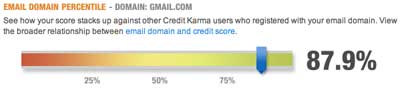
Among Gmail Users, 1 in 8 Has a Better Score Than Do I

The number (mine came in at 767) is just the beginning, not the end result. Credit Karma lets you know how your score places you against your peers by age, by e-mail account domain, or how that compares to the national average. Much has been made about the fact that Yahoo.com e-mail holders have the lowest credit scores on average, so if you want to look great against your supposed peers, then use one of those free e-mail accounts. Could be fun.

Beyond the sizing up, Credit Karma shows you how you got your score. I scored very well on percent of on-time payments with 100%. It's how I was raised, I guess. But I got D's on the age of open credit lines (thanks to the recent purchases of a home and minivan, no doubt) and total number of accounts. Turns out if I had twice the number of open accounts, I would have scored better. Go figure. I also got a C for my 4 "Hard Credit Inquiries".

I Pay On Time! That's Good, Right?

As with many things financial, you can have a disconnect between what you feel is good practice and what others say is actually great use of your credit. Keeping a small number of credit cards and paying off each month sounds great, but a full third of Credit Karma users have more than 20 credit accounts on file (open or closed). 60 percent of users have an average age of credit lines of less than 4 years, with only 10 percent having more than 8 years.

Also like Mint.com, Credit Karma lays on potential savings thick. I have offers to reduce my credit card costs, my mortgage costs, auto loan costs or even bank costs. I haven't yet looked into any of them, and to be honest, probably won't, as these accounts are pretty new with the recent move and upgrades, so I'm a little fatigued by playing financial Tetris. But I am glad Credit Karma is out there to keep tabs for these options on my behalf.

The site is free and open for business at http://www.creditkarma.com.

June 29, 2010

Mint Adds Goals to Help Plan Your Financial Future

Mint.com is quickly turning into a single stop venue to not only capture your current financial picture, and graph how you are doing in terms of spending and savings from your financial history, but it is also helping you set marks for the future - with the launch of Goals, a new tab now available for all users, who can leverage the site's relationships with various financial institutions and intelligent calculators to see how much money they should be saving to achieve one's life targets. And even if you opt not to sign up with new banking institutions immediately, the site's basics help you stomach the tough realities and importance of socking money away even when it seems you can't afford it.

While Mint.com previewed the new Goals feature at the end of April, the tab just went live for all users, between budgets and trends. As you can expect, the site encourages you to choose from a list of preset goals, select an end date or affordable amount, and then, once saved, you can track Mint.com to see how close you are at achieving this goal.

Mint.com Has Many Preset Goals

For example, when looking to buy a home, Mint.com asks your annual income, and prefills with average mortgage rates, 20% downpayment, insurance and property tax data. The more you earn, the more you can afford. It even provides "Aggressive" and "Conservative" options should you be more fiscally responsible or prefer to live dangerously.

You Can Set Criteria In Mint.com To Gauge Home Purchase Planning

Speaking of dangerous, as a parent of twins, simply calculating college costs can be scary indeed. One can set estimated costs per year, the number of years the student plans to attend college, and their current age to start the calculators in motion. In fact, Mint.com says we should be saving more than a thousand dollars per month, every month, per child, to be prepared for a good school, so that is quite daunting. Luckily, they do offer a way to get a 529 plan started to help with that process.

It Could Cost $200k to Save for One Kid's College. Gulp.

Mint Says to Save $1,035 Per Child Per Month for a $25k/year Education

Where I think the Goals function falls a little short is that it first, doesn't tap into your existing data on the site, as it could help you understand how much you make on average, and it also relies on you to choose how much things will cost in the future. Why not suggest prices for specific colleges, cars or geographies for instance, when buying a home? In these simple models, you say whether your child will attend a $10,000 a year university or a $30,000 one, and you decide whether you think you earn $30,000 a year, or $300,000.

Mint.com, now part of Intuit, can make quite a bit of its own revenue through referrals of its customers to financial institutions that offer the very plans that make sense to achieve these goals, so in some recursive way, these goals push Mint.com's goals further forward. I do plan on investigating if it makes sense to get serious about my kids' college plans, and yes, we may even need to plan on getting one of those super cool minivans everyone is talking about once baby #3 shows up, so I'll tap Mint.com for suggestions on saving there as well. It's a goal, right?

If you are a Mint.com user, check out Goals here: https://wwws.mint.com/goal.event

April 25, 2010

Why I Trust Blippy, Mint and Others With My Financial Data

In an up and down week for the startup, Blippy gained a huge amount of unwanted attention on Thursday and Friday as it was discovered that four (and eventually five) of the company's users saw their credit card numbers exposed, in full, through creative Google searches (since removed). As somebody who has registered my credit card and debit card with Blippy, you might think my knee-jerk reaction would be to pull out my data, but it's not, and I am just as supportive of the creative site for sharing transactions as I ever have been. I will continue to encourage people who want to share this activity to use the site, and I am not any more shy about putting my data into their product than I was before. Similarly, I will continue tracking all my data on Mint.com and other sites, because these companies and others like them, have proven themselves to be trustworthy and innovative - delivering me real value.

I joined Blippy in January largely because as I have been participating in and advocating sites that tell people what we like for years, Blippy takes the next step and tells people what we actually purchase, going beyond the "like". I have watched Blippy expand its social capabilities, as you can follow friends, have conversations on transactions, and see groupings of similar behavior, seeing who is buying from specific vendors, or even finding out if other friends are buying the same things you are.

My Credit Cards Go to Blippy Automatically. Zero Concerns.

Unlike some users of the site, I opted to go "All in" with Blippy, sharing not just my soft accounts, like Zappos and iTunes, with the service, but all my purchases. That means you see the boring fillups at Chevron on my debit card, my cash withdrawals from the ATM, and yes, even my wife's Teletubbies DVD rentals on Netflix for my kids to watch. I did this because for much of what I do, I am living life in public. I believe in sharing as much as possible, partly demonstrating that there is little to hide. And while some of my transactions are boring, that's just who I am.

When it was reported this week, by VentureBeat, who, from my understanding, worked on the story for a few days before issuing their initial story, that some cards were exposed, it was quickly shown to have been a limited bug, related to early beta users using a specific card from a specific bank - and was completely out of the ordinary. Blippy quickly responded to the issue, and worked publicly with Google to solve the issue, keeping all of us informed, if we were nervous. (I wasn't)

Mashable's Typical Approach to News Reported by Others

Meanwhile, you saw the typical tech press pile-on from people who had done no original research, flocking to the story like youths at a soccer game chasing a ball, as blood in the water can be exciting. But VentureBeat calmly and professionally kept the story updated, while the Blippy blog did the same, open and with considerate remorse.

There is a huge difference between making a mistake and being untrustworthy - and for me, putting my card data in Blippy is not dissimilar to putting my credit card data into Mint.com, having Intuit find my W-2 data come tax time, or entering my credit card information over and over and over from e-commerce site to e-commerce site. In order for Blippy and Mint.com and these other businesses to succeed, they need to ensure the safety of users' private data, and practically without exception, they have done so. The companies' success will come through their amassing a high number of users, and being able to report trend data based on groups and demographics, not on individuals - and thus, it is in their best interest to keep your data safe and secure.

Google Makes Their Role In Fixing the Issue Clear

ReadWriteWeb chronicled some of Blippy's response to the slip-up today, when they said what to do when a PR disaster strikes your startup. Blippy did the right thing by all accounts, apologizing, making full disclosure, and reporting how the issue was being addressed. Meanwhile, Google's Matt Cutts took to Twitter to explain what that company had done to fix the issue also. That's transparency and a closed loop response.

If I had more options to share even more data with Blippy, I would do it, and getting my e-mailed updates from Mint.com is among the highlights of this data-driven geek's week. It benefits the Web at large to get more real data about our purchases and activities public, and Blippy is one of those making the process interesting. I trust them with my information, and won't be changing a thing. You can find all my data here: http://blippy.com/louisgray.

March 02, 2010

Intuit's Mint and TurboTax Have Your Finances Summed Up

It may only be the beginning of March, but our home's taxes are already done. It's a yearly tradition of sorts to head online, capture all relevant data, and trick Uncle Sam into giving us a refund in time to blow it all on the Final Four (not really). That's due to my leveraging TurboTax online, which gets easier every year, considering how it comes pre-linked to the prior year's data. Now, with Intuit also owning the personal finance site (and awesome iPhone app) Mint.com, the same company keeps my data organized all year round - and with tax time being a good opportunity to look backwards, I thought I would highlight some of Mint's more interesting options.

While much of Mint.com's focus has been on trying to find ways for you to save money, for example, by switching from one credit card to another, or finding a new brokerage firm, I have been watching my Mint activity to help see whether we have been breaking even this month, if our family is within budget, or through getting alerts on high expenditures and deposits. Mint has become one of my most frequently-used iPhone applications and Web sites, especially as I've managed starting the new consultancy in the middle of last year, transitioning from my full-time role with a more stable income.

Mint.com Shows Half My Spend Was from 10 Merchants in 2009

As you know, doing one's taxes helps to bring clarity into the last twelve months. It gives you a sum total of what you earned, what you took home, what you were able to deduct, and how much you gave to the government. But it doesn't show you details on your spending. Mint does.

If you are a Mint user, you can walk through your spending history, and if organized well, you can see where your money is going - to your house, to your groceries, utilities, car, or entertainment, to name a few categories. After logging into Mint, click Trends, and choose Spending By Merchant.

Clicking Mint's "Other" Category Shows Me Merchants 11-20

I selected the 2009 period, and found, unsurprisingly, that 5% of our home's expenditures went to Safeway. What was a surprise is that we had more than 100 transactions at Safeway, which meant either my wife or I was going to the grocery store every 3 or 4 days (some days had multiple charges). The most we ever spent at Safeway was $208.32, and the least was a mere $5.49. In contrast, expenditures at Apple just exceeded 1% of all spending last year, less than 2 percent overall. Meanwhile, no doubt the result of having twin toddlers, and their being invited to other baby showers and friends' birthdays, there were more than 20 expenditures at Toys R Us, good enough to have gotten me a brand new MacBook Pro with all the fixings.

Just like you no doubt do when you look backward at your previous year's investments, there are purchases on my Mint.com history that make me cringe - as I look at air travel to events that proved less than useful, or wonder about whether I should have given so much money to Adobe, or raise my eyebrows at the more than $1,100 spent at Chevron in 32 separate transactions. But the more I look at the data, the smarter a consumer I become, as I use the information to change my behavior, and constantly look at Mint to see if I am on track.

Everything I have heard from my occasional talks with people at Intuit is that Mint.com's being set to replace Quicken Online is that Quicken was seen as a tool for the last generation - the one who balanced their checkbooks to the penny. Mint.com isn't yet integrated with TurboTax, but I would assume having the two properties under the same roof offers plenty of potential. The question is, can you take advantage?

January 15, 2010

Forget Oversharing, Blippy Just Proves I'm Boring

When first introduced to Twitter, I couldn't get over the banality and minutiae people were willing to share. Their food. Their location. Their thoughts. Just mind-numbing half-sentences, LOLspeak and link after link of news I had probably read somewhere else. But over time, the service seems to have evolved, and its success has led to derivatives which provide us new ways to share slices of our lives, even if the revelation proves not to be some dark secret, but instead, the dark truth that we aren't really all that exciting to be following in the first place. Blippy, the service that lets you stream your purchases online, which opened up this week, takes this feeling to a new level.

After first having a mental block on the entire concept of Blippy, I realized it could be interesting to share my iTunes purchases and my Netflix rentals with friends, and see what they were buying online. After all, if we are so willing to share those things that we like (See MyLikes for that) or things we are a fan of (try Facebook), it makes more sense to take a step upward and show what we actually spent money on.

So I joined. You can find me here: http://blippy.com/louisgray


See How Boring My Life Is? Blippy Knows.

With a goal of erring on the side of transparency, I added iTunes and Netflix and Amazon, and even added the family credit card that both my wife and I use. This way, when I have a mundane task like filling up the car with gas, or she gets diapers at Safeway or buys the kids something new from Toys R Us, you will get the opportunity to know about it. You can follow each update, and I can follow you, or others who have joined, seeing my every purchase, and discussing them. Did I buy the right thing? Do you have this product too?

The interface is a lot like Friendfeed than Twitter, to be honest. You can make in-line comments to every purchase, or "Like" items, just as you can in FriendFeed and Facebook. Obviously, this appeals to me, and using the product is self-explanatory.


You Guys Are a Thrill A Minute Too...

But for every so-called "fun" update, where you see I bought an iPhone app that may appeal to you, or a restaurant I visited, or a Netflix movie I rented, you're going to need to sift through my routine updates, like paying Homeowner's Dues on our condo, stopping for fuel at Valero, getting food at Safeway, and on and on. The truth is, it soon becomes as exciting as reading a bank statement. There may be the occasional eyebrow raised as you see someone's update with a big dollar amount, or an amusing venue, but more often than not, at this point, I am simply exposing to you what I've long known to be true. The daily minutiae of my life is not interesting. That's why there aren't blogs dedicated to my comings and goings, and why I am often writing about other people and what they do instead.

Following on to yesterday's post about being "open", am I worried about revealing something I shouldn't? Something that might embarrass me? Not really. It may show that my wife and I go to the dentist or doctor and may have to spend money. And I can always delete individual items at any time if I want them out of my stream, if I remember to. Blippy essentially is a lot like Mint.com, which I also like, but instead of keeping all my data internal to me, it opens it to the world for discussion. The service is actually pretty cool, and can be amusing, if the people you follow are interesting. I just don't anticipate a lot of excitement on my feed.

See also an interview in the Wall Street Journal from today of Philip Kaplan (@pud): Philip Kaplan On Blippy: People Are Loosening Up Online. He's thinking along the same lines I am, adding, "The biggest risk is that their purchases are totally mundane and you’re really super boring." Sorry, Pud.

November 22, 2008

Mint.com Says I'll Be Bankrupt In Sixty Days At This Pace

When Mint.com first integrated the tracking of investments alongside bank records and credit cards this May, I was really excited to have a one-stop destination to see all my activity. But now, my weekly e-mails coming from the site are nothing short of a cross between a thrill ride and horror film, as one line stares me in the face: TOTAL. And peeking at the last three weeks' worth of updates shows that if I were to lose the average amount of money I lost each of the last three updates, my net worth would hit zero sometime in January of 2009. (Not on a percentage basis, but on an absolute value basis)

While I don't believe every stock I own will hit zero, and that I will have emptied all of my accounts, taking on more credit card bills than my actual assets, what was once trivial is eye-opening. While many say the smartest thing to do during this trying time is to not look at all, for me it's like a horrible accident on the highway. You can't help but slow down and take a peek. But unlike most of those accidents, there's actually more blood than expected.


My Holdings Are a Complete Disaster this Year (FriendFeed Discussion)

After a mild Spring and Summer that had my investments slightly trending downward, we all know what happened next - a massive cratering that has seen nearly everybody's financial situation turned upside down. 401ks and mutual funds that used to be stable and trusted are actually performing worse than the very worst individual stocks I've picked. One of the funds I am in dropped 24 percent last week, and another fell by more than 17 percent.

In six months, names that used to have the word "Trusted" next to their name are anything but. Fidelity. Citibank. Washington Mutual? Lehman? And yes, we know other companies in the news were less safe - General Motors, Sirius, eTrade itself... but as my own holdings are plummeting, it seems there is no safe place to turn, no "safe" investment to hold the money until things improve, be it in six months, two years, or more. Forget about Web 2.0 companies being shaky. Everybody's shaky.

For me personally, in years past, in the occasional case where I've needed to spend more money than I've had in my Wells Fargo Account, whether it be to pay year-end tithing for church, or to pay taxes, I've always known I can dip into my eTrade account and move money around as a backup. Now, that safety net has been eroded to the point I don't know that I can do that if I need to. I don't believe I'm going bankrupt, whether Mint.com thinks so or not, but unless something changes soon, we're definitely going to be putting off purchases, getting more frugal and settling for something less than we really want a whole lot more often.

And maybe I won't be logging into Mint.com all that often just to prove how bad things are.

October 20, 2008

Is Lifestreaming a Catalyst for What's Coming After Web 2.0?

By Mark Krynsky of Lifestream Blog (FriendFeed/Twitter)

There has been lots of rumbling lately about what the successor to web 2.0 will look like. Along with that, even more attention has been spent trying to determine what to name it. My post isn't to discuss semantics (pun intended) but more to provide some of my thoughts based on what I've been observing.

I feel lifestreaming, which I evangelize and cover incessantly, has become a catalyst for much of what's coming next. I feel we will see some of the core elements of lifestreaming penetrate other areas and watch many benefits become realized.

Companies are slowly starting to understand social media. They should also start thinking about how to improve communication internally for a well informed workforce. Creating rich workstreams by aggregating real-time data on an internal network can help achieve this. I see a resurgence of rich intranets like this starting to happen soon.

Data aggregation continues to re-invent itself in other useful ways. I was excited when I first started using Mint.com as I saw it as essentially a vertical lifestream. In this case it was aggregating all my financial accounts to provide a real-time "financestream". But that's not all that Mint.com does. It's a very special service and it actually provides the bridge to two areas where I see the web going next, recommendation engines and moving apps to the cloud.

Many services are getting really good at collecting the data and providing ways for us to interact with it. But that will only take us so far. The next phase will be creating intelligence based on the data. The first step to that will be recommendation engines. Strands provides several services including lifestreaming and has recently put up a prize to help them improve this technology. Mint.com provides recommendations on how to save money based on the data. I'm sure we will continue to see these engines applied to many new areas and perfected as they become mature.

By having more and more of my data living online it becomes increasingly difficult for certain apps to be effectively maintained on my local computer, which brings me back to Mint. I was a heavy duty Quicken user, but now it's become cumbersome having to pull in all my data. Add to that how powerful mobile phones are becoming, the pain involved with trying to sync data across multiple devices we own, and the answer seems clear. Many users will start the migration path of moving their apps to the cloud. Tying back to work again, my primary tool for managing website production is the Clocking IT service. So here I have an app hosted in the cloud accessible anywhere on multiple devices that also offers a real-time stream to co-workers.

What have you been observing? What do you think is going to start taking off?

Read more by Mark Krynsky at Lifestream Blog.

May 18, 2008

Mint's Latest Additions Make It My One Stop Financial Hub

For years, I've manually edited a custom portfolio in Yahoo! Finance in an attempt to track all my financial details in a single place. That meant copying and pasting trade details from eTrade and checking in with Fidelity every two weeks to get an update from my 401k. But even then, it wouldn't have bank data from Wells Fargo, or credit card debts, so I haven't had a perfect picture on a single page - until now. With the addition of investment tracking capabilities at the end of April, Mint has now morphed from a simple curiosity to becoming my long sought after single point for financial details.

Mint came to my attention last year, like it did for many people, when it won the best presenting company award at the inaugural TechCrunch40 event.

While some have said storing financial login data on a 3rd party site makes them nervous, I've always erred on the side of trusting the Web, and I registered right away. But site slowness, and Mint's initially not offering support for my investment accounts at eTrade and Fidelity meant it wasn't all that useful for me. I wasn't interested in following their little tips on how to save a few bucks here and there by switching my bank or credit cards, so I largely left my account dormant.

But now, Mint shows me everything in one place. After synchronizing my Checking and Savings accounts, my investments and my credit cards, I now get a perfect picture of available funds. And Mint, having more than 200 days history of my activity since I first signed up, also has some educated guesses on where I spend my money most frequently, trends on whether I'm spending more than others in my geographic area, and even records of which vendors.

Now, according to Mint, I can see I've spent $155 on iTunes since October 1st of last year, in 16 different purchases, I've spent $798 at Safeway in 9 tracked purchases, and $332 at Chevron in the same number of visits. Of course, with more than 1/3 of my spending being marked as "No Category", I have some work to do to get the data even better, and there are some amusing bugs, like the one showing I've spent $6,891 at "Louis Shoe Shop", in four transactions. My guess is that's supposed to be where I've made credit card payments, and I have no idea why it's called "Louis Shoe Shop". Are they confusing me with Imelda Marcos?


One month's financial tracking within Mint.

Regardless of those rare oddities, the simple fact that Mint shows me all my activity in one place means that I don't have to go to each of the individual financial sites to get my data. On occasion in the past, I've gotten hit with late fees on my credit card just because I had forgotten to log in before the bills were due. Now, if I can just log in to Mint instead, I can not only see when money comes in, but when money needs to go out. And I'm done messing around with Yahoo! Finance, manually entering owned shares data and estimated per share costs. Now, Mint does all the hard work for me. It's the way Web finance tracking was supposed to be.