January 10, 2018

Linking Less and Talking More: Disappearing Web Mentions


The World Wide Web was designed to primarily do three things - inform, discover and connect. A globally connected series of documents could instantly bring you to the thoughts and experiences of someone across the world. In the earliest designs of the Web, it was through hyperlinks that you would find those new voices. Links brought you new sources of data, and those downstream documents led you even further to new people and ideas.

As the Web evolved, and incorporated photos, videos, streaming, and all manner of media, discovery expanded to include search. Without an explicit link, you could still find pointers to new content in the results of your query. Destination sites, acting as content hubs, would surface new content, usually within their network, of recommendations you might like. Ads, essentially links with pretty pictures, would offer another exit.

WebCrawler: One of the Web's first search engines
When blogging was the main medium of first person information sharing, prior to the rise and later domination of real time social streams, the way we discovered new voices was through links to others. I'd mention those I agreed with and highlight, with more links, those I didn't. One popular feature in practically everyone's sidebar was a blogroll, to show those with closest ties or just who we liked to read. And there were custom search engines, like Technorati, which when combined with tools like Google Alerts, could let you know when somebody mentioned you on the Web.

Technorati: The original blog and link search engine
But over time, a number of things happened to chop away at this fluffy cloud of friendly discovery.

1. Many Blogs Gravitated Toward Internal Linking, Not External Linking
The big sites realized that keeping visitors on their own site was more profitable and aided their metrics more than sending them away did. And while there is obvious irony in my posting to my own discussions on this from the past, we actually had lengthy discussions about these internal linking practices in 2007 (Part two and part three
Arguments a decade ago in favor of internal linking were that site visitors were familiar with companies and topics discussed, and could see previous coverage by their publication to learn more if they weren't. And any link off site started feeding the ad revenues of a potential competitor.
2. Dedicated Blog Search Sites Didn't Graduate to Quality Businesses
Technorati was a specialized blog search engine that skipped the general Web and went directly to blogs for its content. Its leaderboard of bloggers was closely watched, as were trending topics on the site that led to see what the blogosphere was discussing. But it was seemingly always in financial trouble, and has pivoted beyond recognition to whatever it is now.  
A 2010 interview I had with the company's leadership team claimed a pivot to quality, but their CEO was gone a year later, and so are pretty much all the discovery tools that initially aided me to find some of the best voices of the Web 2.0 era. And yes, Google Blog Search quietly disappeared not too long afterward.
3. Blog Discussions Pivoted to Real Time Streams and Sharing
As I noted in 2009 (yet another internal link, am I right?), linking between communities was declining in favor of retweets on Twitter or sharing into the stream. The microburst of a little site traffic would provide that one time dopamine hit, but not leave a trail for later web spiders to find.
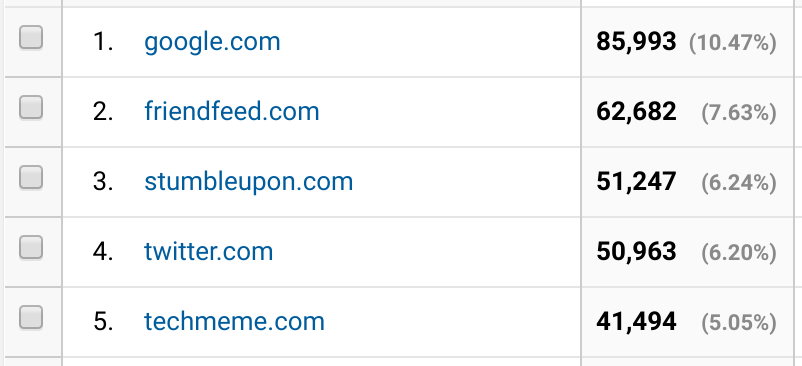
My top referring sites, via Google Analytics, from previous years

As the social streams of Twitter and Facebook took over, and bloggers (me too) got distracted, the share became the canonical mention. Your mentions on Twitter, or your notification of shares on Facebook, were faster delivered and easily quantifiable. And individual profile owners are quite unlike the publishers looking to deep dive into their analytics to discern where traffic came from.

Today, Brent Simmons laments the result of all the mentions going to the streams and leaving the Web. With links decreasing, and blog search being a relic, he yearns for a way to find again how his business is mentioned on the web or when he is being linked to. Joe Gregorio, like me, wistfully remembers analysis of referral logs to find how people found you... all through links.

Simmons' proposal is a limited one, keeping it to the MacOS/iOS community. A small project like that shouldn't be too challenging, but it speaks to a bigger problem, where the connections we once demanded are an afterthought behind the latest viral tweet and trending Facebook share. Streams are ephemeral, but the Web was built to last. It'd be great to see new voices building, informing and connecting again.

Disclosures: I work at Google and am on the Google Analytics product. So I think about publisher tools and visitor stats more than most.

January 09, 2018

Space Fillers and Superstars: Silicon Valley's Divergent Career Arcs


Career Paths Are Often Circuitous Routes

My career in Silicon Valley started before I'd even graduated from college. Rather than plug away at Berkeley and try to get top grades, I split my time my senior year between going to classes and commuting across the Bay Bridge to Burlingame, working for a revenue light startup during the initial dot com boom. By the end of 2018, I will have completed twenty full years in the Valley.

In these twenty years, I've been laid off. I've been promoted. I've fought for raises and rejected stock offers. I've co-founded my own consulting business. I've worked at startups with three people, ten people and two hundred. And for the last six plus years, I've been at Google, which can hardly be called a startup.

In these two decades, I've seen companies lay everyone off firsthand, and had another acquired. I've pitched Sand Hill Road for venture capital funding, been part of corp dev talks about a possible acquisition, and even filed for IPO. I've worked with billionaires, millionaires, neighbors, and colleagues straight out of college, with debts to pay.

And while I've been lucky enough to accumulate 15 years of work at just two jobs, that is fairly unusual for the industry. Some estimate the average software engineer, used as a metric for the average employee in our tech-centric world, is only 1 to 3 years. (Source)

Underneath the headlines and noise of product announcements, and seeming get rich quick ideas, the reality is the overwhelming majority of Silicon Valley employees are role fillers, who just get things done. Some are living month to month, and others are more comfortable. But for each example of wunderkids who get lucky on their first try, you have cubicle dwellers whose LinkedIn history won't have you blinking an eye. And the Valley needs these people. Hundreds of thousands of them.

The Intersection of Skill, Luck and Loyalty

Marissa Mayer famously put together a rubric after completing a Symbolic Systems degree at Stanford to determine where she would take the leap from her 14 job offers, and Google was seen as having the greatest upside. Tough to argue against those results, and hindsight is 20/20. Yet a close friend of mine who graduated from the same school with the same major is as anonymous as they come, with a pedestrian career. There's no discounting Marissa's hard work and ambition, but not everyone gets lucky.


In 2009, I wrote about this magical intersection of skill and luck - where good people work incredibly hard at toxic companies, or doomed dinosaurs. There are tomes to be written about the worker bees of the Valley who come in and work hard for a full day's pay to make all the services go, but aren't job hopping for the latest startup du jour, instead hanging on with loyalty to the company even if the company doesn't return the favor.

Roll the Dice or Buy a Lotto Ticket

For every superstar like Marissa, there are thousands more stories like my friend and others who just missed. A decade plus ago, I had a roommate who passed up being one of the first 25 employees at Google, so he could instead finish his PhD. (He is now a professor at NYU)

The more cynical among us could say that aggressively enterprising workers should quickly hop from job to job and ride the rocket to financial happiness, and yet another group will say that if the current workplace isn't looking like a lottery ticket, you should quit and form your own startup. It certainly looks easy enough, with so many ideas landing venture funding.

Venture capitalists will tell you they are looking for that elite leader, the masterful person with unique product vision and market awareness - a founding team with impeccable credentials. But every decision is a bet. The VCs and companies make bets on the staff, and the staff makes bets on the companies each day they show up. Sometimes you win the jackpot, sometimes you push, and other times, you could lose it all and have to start over.

Among a world of aspiring superstars, a much more common, but also important, role played out daily amidst the rows of cubicles and open office spaces in the Silicon Valley is an army of people making it all run, quietly.

Disclosures: I briefly overlapped at Google with Marissa from 2011 to 2012. Also, if you must know, I attended UC Berkeley, a natural rival of Stanford. But that's not really super relevant.

January 04, 2018

A Decade of Silos Has Throttled Open Content Distribution

The 2018 Social Media Flow is Driven by Content Silos

In the ten-plus years since I started this blog, one of the clearest trends on the Web has been for destination sites to want to control the user session and experience. In parallel, sites focused on aggregating content from external sites or highlighting the best of the web - serving as a filtered pass through, have struggled. Many are gone.

While significant efforts were made during the forging of Web 2.0 to drive open standards and allow for data to flow from one site to another, through RSS, Pubsubhubbub, Atom, XMPP, or whatever your preference, 2018 on the social web is a much more challenging place to write once and publish everywhere.

As I view the publishing space, I often turn to four big challenges that have to be solved for a platform to be a success to both authors and readers:

1. Creation

A platform, be it for photos (Instagram, Flickr, Google Photos, etc.), short updates (Twitter), long form (Medium, Blogger, WordPress, etc.), video (YouTube) or a mishmash of all (Facebook, Google+, etc.), needs to make it easy for the content creator to share what they want, in the form they want, and have the output be what they intended. This is true whether we are talking about desktop or mobile creation.

2. Distribution

Once the content is created, it has to be sent somewhere. If you write a post and hit publish, how do people find it? Is it sent to a third party network where they are hanging out? Is it sent by email? Do they get a notification on their phone? Does it flow down their timeline, as they have new items to consume? Or is it just another flat file, waiting to be indexed by Google and other search engines?


3. Discovery

Readers want to find new content. They seek relevance, freshness, and community. This mirrors the three pillars of social sites I highlighted back in 2009, and echoes that readers want intriguing views that mirror their own preferences. Like I'd predicted in 2006, the Web has become a divided place, where we all flock to our groups of like minded people, and disavow opposing views, but we still are eager to find more who reinforce our position. We still crave new friends and stories and we want to find them quickly.

So how good a job do these apps and sites do of surfacing new people and ideas? Do they have an aggregated site with highlights and popular people or posts? Is there a place to find more obscure viewpoints and new voices?

4. Consumption

Since the smartphone revolution, kicked off by Blackberry and the iPhone and now led by Android, more people are constantly connected and reading news from their mobile devices. In many countries, the mobile device is the only window to the Web. Does the content flow well for mobile consumption and new ways to navigate from screen to screen, update to update? Or is it best suited for a leanback tablet experience or for the desktop?

What typically happens with content platforms is the content fills the available container. Twitter is a clear 140 or 280 characters. Social hubs like Facebook and Google+ favor large photos and a short introduction. Instagram is all about the photo with a small description. Blogger and WordPress and Medium are as long as you want to go. One has to consider if users and screens keep up.

2009's promise of sharing everywhere wasn't meant to be.

We've Come a Long Way from Aggregating Streams and Sharing the Web

As content started to be created in a wide array of social sites, aggregation services like FriendFeed helped bring people's streams together. Bookmark services like Delicious helped people save the highlights from the Web and amplify the world's favorites. Users voted up posts from Digg and passed them along with StumbleUpon. The most voracious consumers lived in Google Reader and didn't miss a single post from the RSS feeds they were subscribed to.

It was too good to last.

The largest social platforms were not content in simply being links to external sites. Facebook focused more on original content shared on the platform, with less priority given to send traffic off site. Google Reader shut down, and while Feedly and others stepped up, the world of RSS never recovered. Delicious died. Digg is a shadow of itself. FriendFeed was obliterated. LinkRiver closed. Socialmedian closed.

In the wake of all these gateways' demise, taking content from the open Web and getting it in front of new viewers is more challenging. While I've always said you need to be where the users are and can't force them to come to you, what could be automated is now requiring manual intervention at practically every step.

Just What Am I Talking About?

The alpha and omega, yin and yang of social outlets (for text, anyway) are Facebook and Twitter. Facebook is much bigger and much more profitable, but don't get distracted. People creating content for the Web also need to make sure that content fares well downstream on Facebook and Twitter. You can write it for the open Web, but you then have to take explicit action to share the content downstream - or set up automation to either site, usually backed by RSS. At that point, whether you get discovered or not is up to each site's algorithm, which has leaned more in favor of implied interest rather than chronology of late - meaning you can see viral content from hours or days ago before you get the newest stuff.

On a mobile phone, notifications are the holy grail of getting someone's attention. (See: Life by Numbers and Notifications from 2014) It's not uncommon to get notified when someone tweets, but it's very uncommon to ask for a notification when a site makes a post.

In parallel, the feedback loop from such networks, as well as Instagram or others, is near instant and acts as an incentive for the author to initiate their content on that silo natively. Post a 20-tweet storm to Twitter, and immediately start seeing those likes and retweets roll in. Post a story to Facebook and wait for the Likes and comments. Post a news story or a blog post, and ... wait. Wait for visitors in Google Analytics? Wait for the post to be shared downstream? Wait for the story to be indexed in Google News and search?

The elimination of Google Reader, FriendFeed, and Digg as amplifiers of Web content, alongside the attention absorption by Facebook and Twitter makes it harder for Web authors to get visibility - and they they aren't dropping their content into the real time stream.

So What Does the New Flow Look Like?


In 2009, it seemed pretty easy to me. Post on the blog. RSS would take it to FriendFeed and Google Reader. FriendFeed would post to Twitter. Twitter would post to Facebook. Then I'd run around and answer comments wherever they were distributed. (More on distributed conversations from 2009)

Now, I can still post on the blog. And the RSS link is the same. I even get the small bump of engagement on Google+ from the blog's page automatically adding my content there. But then, to make sure I cover all my bases, I then make another share of the same content to Medium, for those who love their site, and I've even found good engagement on LinkedIn, by making a third post of the same content on their channel. It's a different audience, but, if on topic, they share and engage.

So that's three posts. Meanwhile, I still have to share the story on Facebook and Twitter separately, hoping that someone will break their consumption flow and engage on my content downstream.

It feels like more work to get less return. And yes, I recognize that some may not miss FriendFeed because they never used it. Maybe others think Digg got replaced outright by Reddit, and gains similar traffic. Others prefer Hacker News. So aggregators do exist, obviously, but hubs aimed at surfacing new content, as opposed to highlight content on the site and keeping readers there, have declined.

To properly make the Web as desirable and viable a platform for publishing, we need to work together to fix the distribution and discovery gaps, make content fantastic on mobile for creation and consumption, and allow for engagement that is as simple as a Like. I applaud (there's the joke) Medium's approach to reward users with claps, for at least they're trying something. We should all be trying.

Disclosures: Yes, I work at Google. Sometimes, I help the Blogger team. I used to work on Google+ and have many friends on those teams still. I miss Google Reader every day. FriendFeed too.

January 03, 2018

How a Google Home in Every Room Gives My Kids Answers All Day


Some time last year, we installed five Google Home units in our house. One was placed in the master bedroom. One each went in both our kids' rooms, as well as one in the office, and one downstairs in the kitchen. Knowing that asking Google any question was just a simple request away, I was eager to see how the family would adjust to having a friendly assistant ready at any time to go fetch answers. What I've seen is that the devices are used throughout the day, and, often, the kids talk to Google before they talk to me.

OK Google, tell me a joke.

The morning starts with Google Homes sounding the alarm to wake up.

As the kids mumble "OK Google, stop", we have momentary quiet, until they shuffle out of bed and ask Google what the weather is going to be that morning. Obviously, depending on Google's answer, this can mean wearing shorts or jeans, long sleeve shirts or short sleeves. If the answer isn't detailed enough, I've heard the kids ask a second time, asking for the high of the day, which could impact how they prepare for PE at school, or if it's going to rain, and they need to pack an umbrella.

One example from our Assistant history.

As the morning routine begins, the first person downstairs gets to be the DJ, asking Google to play a song, which serves as the background music for breakfast. If the song isn't what they wanted, they simply say, "OK Google. Next song." until one they would prefer comes on.


If it's a weekday, we're most likely off to school and work, and we're all out the door. But if not, we probably have another query to Google Home to see how bad traffic is wherever we are going, how long will it take to get there - or sometimes, how the weather will be at our destination.


When the kids get home from school, Google does more than just act as background music device. My 9 year old twins use the Google Homes to confirm math homework answers to see if they are right, or ask it to sub in if an equation is too hard, or if they are unsure of spelling. The Google Assistant is the parent who is always willing to give an answer and never gets tired. 

With the expectation that Google has all the answers, the type of questions can be fast and furious. "What is hypoglycemia?" "Are hedgehogs nocturnal?" "What state is Boston in?" "What time is it in Sydney, Australia?" "What does salutation mean?" "What day is Black Friday?" "What time is it sunset?"

If Google doesn't know, or says, "Sorry. I can't help with that yet. But I'm still learning!", it's usually followed with sighs of exasperation and amusement, as they follow on with a different query more likely to get an answer.

The most popular question asked of Google Home this last year? By far, a simple one. "What time is it?", followed by "how much time is left on the timer?" for those ever important assigned times when they need to be reading, or when kids are taking turns with a game or a device, and need to hand it off to another child.

How many more minutes are left on my timer?

As homework time wraps up, and the kids find themselves on leisure, as dinner is eaten, and things are tidied up, I can hear them play music in each room as they have access to the world's artists on demand. "OK Google, turn your volume to 50 percent." "OK Google, play Katy Perry."

Do they always get the question perfectly right? No. But the device tries its best to guess and provide the answer - or pushes for another try. "Sorry. I don't understand?" or "Try again in a few seconds."

As bedtime approaches, everyone asks Google to set an alarm for the next day to start the process anew. And yes, if you're wondering, we do disable the devices in the kids' rooms by 9 p.m., so they don't end up rocking out in the wee hours. If they want something so badly they need to ask that late, they can ask me.

Set an alarm and call it a day.

The Google Home devices were such a benefit to our house that they were the go-to gift this last Christmas. Given they were only $29 apiece on the Google Store, I maxed out the order of ten, and shipped them in many directions - to family, to friends and even to neighbors, as they too could see the benefit of a smart assistant that takes the kids' tough homework questions on without complaint, and is more than happy to let you know if it's going to rain.

Just like touchscreens and tablets were so easily made a part of our family's life, from the very first iPads, and through the Nexus line, adding voice-activated devices has been simple and the children don't find them daunting at all. After all, who wants to get a laptop out and type in a query?

Disclosures: I work at Google, obviously. I paid full retail for my devices.