Showing posts with label Cliqset. Show all posts

August 30, 2011

Path.To Debuts for Meaningful Career Endorsements


With LinkedIn having established its central role for online business networkers, a flurry of startups have emerged to let people present a new, and often prettier, face to their work profiles - including About.me, Zerply (who I covered back in May), and starting today, Path.to, a network that aims to let you customize your business profile and tap into the power of your network for meaningful endorsements that will help you stand out from the crowd.

Like Zerply, Path.to starts with the new user pulling in their data from an previously-created profile elsewhere on the Web, and then prompts you to fill out the missing gaps in your profile to better tell the story in the way that you want it to be told, with as much information or as little as you like. Rather than simply listing the places you've worked and the titles you've held at various points in your career, Path.to gains value when you list particular skills that you have used at each stop, setting up the opportunity for your network to endorse you based on your shared experience.

My Path.To Profile: http://path.to/louisgray

But there's a little touch of magic behind the scenes at Path.to, which makes the endorsement game more than just a vote counter. Darren Bounds, who you also know from projects like Cliqset and Glow.io, writes, "In Path.To all endorsements are not created equal. We’ve built an algorithm that constantly reevaluates and scores each individual in the system. This scoring helps drive the weight of your endorsement within the system."

Endorsing Darren on Path.to

The Project Management Leaderboard on Path.to

Without diving to deep into that, which sounds a lot like how Klout assumes a certain value to each individual, Path.to hopes that its endorsement structure and leaderboards will surface the best and most qualified people at every skill, from product management to blogging. The site continually pushes users to get endorsed, saying, "Skill endorsements are the currency of Path.To. They help distinguish you from the crowd by increasing your weighting in and around the site."

Connections on Path.To

For beautiful looking glamor photos and a short personal description, About.me works well. But Zerply and Path.to are all about endorsements and an attractive UI that puts your resume in a friendly light. You can find my Path.to profile here: http://path.to/louisgray

June 08, 2011

Cliqset Cofounder Preps Distributed Social Platform Glow


For those who believe strongly in a future of federated social networking, not owned by the large Web brands, the perceived lack of success from existing social projects, including Diaspora, Status.net and others has been extremely frustrating. Darren Bounds, cofounder of the ahead of its time social Web pioneer Cliqset, aims to do something about it, working hard on his second act, called Glow, a distributed social infrastructure aimed at closing the usability and feature gaps in today's federated systems. The launch of this new system is only a few weeks away.

As he describes it, federated protocols and standards often get in the way of building a pleasant user experience, which makes supporting important features like global people discovery, global content search and anti-spam practically impossible, as no information exists in a single place that's easily analyzed. The goal of Glow is to deliver a distributed alternative to Twitter or Facebook, while still delivering full support of their feature set, with no sacrifice to the user experience, while still keeping data ownership in their hands.

An Early Glow Instance With Sharing, Photos, Comments

Glow looks much like existing platforms, from FriendFeed to Facebook and Twitter, consisting of aggregate network activity, status updates, and nested comments. When creating content, users are able to organize their followers into a number of predefined groups, and you can dictate which group will receive it, keeping the content private to only those on the intended recipient list, unlike Twitter's all public or all private approach, and more similar to Facebook's select distribution and lists, which have proven difficult for most users.

A Private Group Message on Glow With 3 People

At launch, Glow will offer a centralized option, as well as the opportunity for you to launch your own dedicated node, the equivalent of running your own single user copy of Twitter that looked and felt just like it does on Twitter.com, with the same users and experience.

From a feature perspective, Glow will support all the features of a modern social network, with the usual status updates, photo and video sharing, implementing the "follow" model, along with likes, mentions and comments. Additionally, the service is location-aware, which brings forward its own opportunities. What it does not do is aggregate content, a hallmark of Cliqset and other sites, like FriendFeed.

"Glow is an attempt get us a few steps closer by created a system that behaves as users have come to expect while increasing privacy and user control in the process," Darren wrote me in an e-mail. "Glow itself is not a federated system, it is a hybrid architecture combining aspects of centralization with that of decentralization."

True to Darren's background, which featured early implementation of Web standards like Pubsubhubbub and Salmon with his Cliqset effort, Glow will come with a robust API for developers to create applications on to, assuming user authorization. One example Darren gives is the option for users to provide access to their data in exchange for more personalized advertisements (which we've discussed often).

While Darren says Glow itself is not a federated system, those looking to set up their own Glow nodes can do so - much like Status.net, giving them full and complete control over the content. Glow is heavily tied to the Amazon cloud, helping keep costs free to users and low to Darren.

"Basically, if Twitter and Facebook had a great looking and highly intelligent child together who grew up to solve world hunger, it would be Glow," jokes Darren, who says that the product is still in the realm of personal experiment, more than an actual business. The project is being completely self-built, and Bounds hasn't yet taken any funding.

While Status.net and Diaspora have made new in the past for their approach, most federated systems have put technology ahead of the user experience, and have suffered in adoption. Glow is hoping to achieve the benefits of federation without sacrifice of technology features or user experience.

"I've taken many of the best features of Facebook and Twitter and combined them with some of my own special sauce," Darren says, "The result is a reinvention of social network architecture with none of the user complexity of systems that have come before."

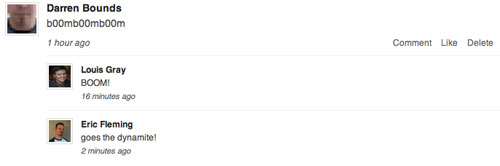
A Simple Nested Comment Stream With Option to Like or Delete

In future enhancements, after initial launch, Glow content will be organized into two types - user content and publisher content. Its architecture ensures that user content is created by people and not bots, and a publisher marketplace is being designed so organizations can push content and build community. Publishers will be organized much like Apple's App store, with categories and featured communities.

Darren is nothing if not ambitious. Cliqset, while it didn't attract massive the massive user base it deserved for all the work put into it and pioneering of leading-edge technologies, was always well respected for its forward thinking. Glow, marinating at http://glow.io, should be just as forward thinking, but instead of pushing people into a single domain, it's allows people to create their own instance, run it anywhere and own their own data. It's all about putting the power of social networking back in the users' hands, with real privacy controls and simplicity.

November 22, 2010

Founders Moving On from Social Aggregator Cliqset

Taking on Facebook, Twitter and Google in the fiercely competitive world of social networking and community building is a tremendous challenge that can be practically impossible to overcome, even with superior technology leadership and adherence to federated open standards. Cliqset, the wildly innovative social networking aggregator that was among the first pioneers to adopt Pubsubhubbub for real-time updates, and Salmon for cross-network comment posting, faces a murky future with news today that the company's founders, Darren Bounds and Charlie Cauthen, are going to be leaving the company, following an unsuccessful round of funding.

Despite a number of smart moves to make the site increasingly useful, such as the launch of social search in September, and the addition of Groups and Activity Streams in January, the site struggled to grow a consistent and growing community of users, with a short-lived Turkish invasion drawing a traffic bump and some amusement.

Speaking with Darren today, he said that he and Charlie are not moving on to a new project, nor have they sold the company, saying as founders of the company, it didn't seem appropriate to seek out other opportunities while simultaneously growing the site. But there are no regrets about the adherence to cutting-edge open standards with the site, which were ahead of practically any other service on the Web.

"A federated social Web agenda at Cliqset is something we chose to promote," he said. "The open standards aspect is something I believe is still the future. The roadmap to getting there is going to be a little longer than we would have liked. But where these standards can be implemented and improve efficiencies, they deliver real value."


As I wrote a year ago in a post on the 3 social pillars needed for any successful network, one needs to find leading technology, community and relevancy to make a site a must-visit each day. For Cliqset, their technology was never in question, but scrapping for users was a challenge that didn't find a great deal of traction. Darren agreed.

"In order to build a community, you need massive differentiation today," he said. "It's fairly obvious in hindsight. Projects I would be working on in the future would be leveraging the existing social graph, and the need for success wouldn't be contingent on relationships and community within itself. In no means do I think Facebook is impenetrable and somebody can't build something to compete with it, but it's not an easy task."

There are no plans to shut down Cliqset.com immediately, as the company's investors have opted to keep it up and running, despite a lack of engineering and operational support. In the event the service were to be acquired, Charlie and Darren could theoretically be pulled back in, but that scenario is unlikely. As I have been saying for a year aggregation is great in theory, but sites like FriendFeed, Cliqset and Arktan haven't been able to find a unique voice that makes people go their way instead of the original sources of content - Twitter and Facebook. I am eager to learn about the team's next move - they're very sharp and were focused on pushing open standards forward. In an ideal world, their work will not have been in vain.

September 26, 2010

Social Layers or Networks... Is There Room for More?


Sometimes, it seems the phenomenal success and user growth seen by Facebook and Twitter in the last few years has boxed in what we accept as a bonafide social network - as we early adopters and tech press absorb potential challengers like chum and digest them quickly, mocking their attempts as feeble, and their traction as futile. For some, Facebook and Twitter, despite their faults, are the end all and be all - and it matters not if other products have more features or innovation, because in the end, he with the numbers wins, and it seems they've got all the numbers.

In the meantime, recent comments from CEO Eric Schmidt of Google to social layers being part of whatever the company has planned for what's largely been dubbed as Google Me have people saying a thin layer of social spread like a veneer over the company's many products just won't be enough to challenge a behemoth like Facebook - yet we see social elements being added to just about everything, from our e-mail clients to our music players, our photo editors and our video games.

The world is going social, whether it's little bit by little bit or in an all-in gamble to change the world. It's simply a matter of perception as to what is a feature and what is a network, and if users are willing to give the old college try to networks that aren't from Palo Alto and San Francisco proper.

Just take a look at Apple's Ping, within iTunes. Is that a network, or a social layer grafted on an existing service? What about Spotify Social? Is that the same thing as Ping, or is that simply a service that integrated with Facebook - not a network on its own? Does a social network require a unique user name and password and its own social graph to be a network?

What about Google Buzz? Is that a social network, or a social layer inside of Gmail? And if that's a network, certainly one must consider the social elements of Google Reader as a layer and not a new network on its own, right?

And just where does this leave other innovative social services (that's a safe word), including Amplify, Cliqset, Quora, GetGlue, Plancast? Boxee? Is Foursquare a social network? And let's not forget the classics that have been here for a while, even if you're not talking about them... like MySpace. LinkedIn. FriendFeed. Orkut. The list could go on for a while.

As I mentioned in a somewhat off the cuff "timeline of new social networks not named Facebook or Twitter" post I put on Buzz earlier this month, it seems our rush to judgment rapidly dismisses any challengers to the throne. All we are doing, in many cases, is signing up, following the same old folks, kicking the tires, and then walking away. But services, if they are any good, aren't about the first week or first month of services, and not about the first 10,000 customers. They continue to build. While many were quick to judge Google Buzz and Apple Ping, usually not in the best of light, both services have added many features since their debut and both see strong engagement from a loyal core of users - even if not in the hundreds of millions. (If they did, trust me, they would tell us)

Additionally, it is interesting to see how the services themselves perceive their place in the world - if they are networks, layers, or features.

From the Google Buzz announcement in February, they said:
"If you think about it, there's always been a big social network underlying Gmail. Buzz brings this network to the surface by automatically setting you up to follow the people you email and chat with the most."
So it sounds like, to Google, Gmail is the social network, and Buzz is the presentation of that network. Note this is not how they presented social features in Google Reader, when they added comments in March 2009 or when they added friend management in August of 2008. Neither blog post even mentioned the word social. So the ability to make friends, to add likes and comments, that was not a new network, but instead new features on an existing service - albeit one that integrates very well with Buzz, which came afterward.

In contrast, Apple Ping describes itself directly as "A Social Network for Music", while just last week, Twitter says it is not a social network at all, but instead a media company.

In May, I said to make a choice to your mobile phone platform, you should look to the core. For Blackberry, that's e-mail, for Apple it is iTunes, and for Google, it is the Internet. Not surprisingly, the latter pair's social networking aspirations are starting there. Apple has shoehorned a social layer into iTunes and called it a social network, much like Google did with Buzz and Gmail. Both companies are rallying users to spend more time in their assumed strengths. It makes good sense. Now, with the thought of Google adding social elements to everything, be it through layers, or widgets... or something, you can see the idea. Share everything. Like things. Link things. Facebook wants to own the "like-o-sphere" and capture what pages you like everywhere on the Web. Why would Google want them to have that alone? Of course they wouldn't.

The tech rumor mill is seemingly in wait and see mode over what they hope would be a full-on assault against Facebook from Google. Is it because they want an alternative to Facebook, and would literally leave the site for something else? I doubt it. I think it is as much because they want to see a fight. They want to cover a fight, and to declare somebody the winner and somebody a loser. It's clear, at least to me, most people aren't even spending the time to establish serious use on secondary platforms - platforms with elements similar to Facebook and Twitter that offer sharing and connections and liking and discussion - like Amplify, who wants to break through the 140 character barrier to have real communications, or like Cliqset, who wants to enable discussions to flow in and out of the network, no matter the origin, or still again, like Cinchcast, which is the easiest way to make a social network around audio podcasts on the go.

There's a like button in my iTunes now. I didn't ask for it. I don't even use iTunes much any more, now that I'm addicted to Spotify. There's a like button in my Google Reader. There are like buttons in my Facebook and my FriendFeed, and my LinkedIn too. These are social elements to existing networks. But think about who could turn this all upside down - the operating system guys and the browser guys. Guess what? They're one and the same now. Google has an OS and a browser. Apple has an OS and a browser. Microsoft has an OS and a browser. Only Firefox seems a little out of luck. Why wouldn't Google or Apple find a way to make the browser social, through a social layer, and make the entire Web their oyster? You wouldn't even have to make one more login with yet one more password to remember.

Let's not get too caught up on what's a network and what's not... what's a layer and what's not.... what's a feature and what's not. The real question is if the big guys are going to deliver tools that bring us real tangible benefits, or if there will ever be a small challenger that gets our attention so strongly that we really take the time to use it and get it right. For now, I think the alternatives to Facebook and Twitter are in the small niches. They are in Fabulis for the gay community, in SportsBlogNation for the jocks and fans, and in Reddit or Digg or Slashdot or Hacker News for the nerds.

Being social doesn't have to be in a network. It's everywhere. It is already a feature, layered into all we do.

September 09, 2010

Cliqset Social Search Discovers Pulse of Real-Time Web

Cliqset is the most feature-rich site aggregator on the planet, pulling in content from more than 80 separate Web services, going way beyond Twitter, Facebook and Google Buzz, and acting as an unsung pioneer of open standards, especially around data portability, identity and speed. The amount of data flowing into Cliqset has now reached a tipping point whereby creator Darren Bounds is opening up a searchable database that finds trends and information across the entire system, not just one service at a time. The idea? A broad social search that any brand or curator can tap into to see what is happening across the real-time Web.

The new Cliqset Social Search is similar to that long offered by FriendFeed, which, once the deepest and most broad real-time search engine, has now atrophied since its acquisition by Facebook, not only not getting new features, but seeing sporadic uptime. But the service goes a step further in having a dedicated site focused on searching deep into content shared on these separate networks, rather than just burying it inside Cliqset itself. Now, should you choose, you can skip right on past Twitter Search and do so on Cliqset instead, seeing a true real-time flow of mentions, keywords, brands and whatever else is happening on the Web.

Searching for Google Maps on Cliqset Social Search

As with Twitter's well-known "trending topics", Cliqset Social Search displays "popular terms" that are trending in the different social networks. And you can search across any of the individual networks, or more than one, by choosing the checkboxes. This way, you can search just Facebook or Google Buzz, if you like, and skip Twitter altogether, should you be looking for more signal and less noise.

Searching for my6sense on Cliqset Social Search

If there are holes in the new Cliqset Social Search, I found that the recency of the item being discovered didn't always correspond to the time the item was shared. For example, a TechCrunch article posted in March came up as "2 minutes ago", presumably because that's when Cliqset found it. But it's better to find content than not find anything at all!

Searching for Cliqset on Cliqset Social Search

The opportunity for data mining social networks is obvious. That we haven't gotten a perfect solution for searching Facebook outside of the network, and Google Buzz hasn't made external searches easy is unfortunate. But we know the world online is much bigger than just Twitter, and Cliqset gives us a start to dive deep into these multiple content repositories to find just what people are saying everywhere.

Additionally, for Cliqset users, when logged in, you can interact with the content, including commenting, curation, replies and shares, said Darren. This is clearly another way to get more users into the site, which recently found itself hit with an invasion of signups from Turkey, and remains popular outside the United States - even if most people are having a hard time seeing beyond Twitter and Facebook, to try new social networks with interesting capability.

Of note, you don't have to search to find my account on Cliqset. I am here: http://cliqset.com/louisgray.

August 19, 2010

Social Aggregator Cliqset Undergoing Turkish Invasion

While the Silicon Valley seems to largely have turned a blind eye to any social network not named Facebook or Twitter, one country's citizens have flocked to alternative sites more than practically any other. Turkey, well-known for being the #1 country driving traffic to the Facebook property FriendFeed, appears to be having a similar impact to the well-designed, if not fully embraced by the masses, Cliqset. Partly due to the uncertainty around FriendFeed's domain, thanks to recent downtime, a year after the product was acquired, Turkish users of the network are seeking out alternatives, and have seemingly found Cliqset as the best alternative.

Cliqset, which supports integration with more than 80 networks, has closely integrated with other sites, including Twitter and Google Buzz, to highlight mentions and migrate comments between networks, is now seeing the results of this migration, be it temporary and permanent, as the site's public feed (highlighted as Community) sports a great deal of Turkish posts and updates from the FriendFeed refugees. The sheer volume from the new arrivals, either testing the site or setting up their profiles, drowns out all other languages, amusingly.

FriendFeed's Turkish Fans are Flowing to Cliqset

The New Voice of Cliqset - Via Turkey

The Turkish invasion aside, Cliqset has quietly developed a fantastic tool for discussions, letting you easily discover your friends from other networks, search across the site for topics and tags, join groups, and see direct messages from Twitter from their centralized interface. In fact, the ties between Cliqset and other networks are so strong that you can see items you have favorited in Twitter, and should you follow a person on Cliqset who has registered their Twitter account, you may end up following them on that network as well.

Cliqset Offers 80+ social integrations and a solid conversation platform

CEO Darren and I Trade Turkish Barbs

Earlier this month, TheNextWeb highlighted the tie-ins between Cliqset and Buzz, arguing the former was trying to save the latter, by offering an extremely clean interface to Google's network. And whether you agree with the author's premise, his comment that "Both Buzz and Cliqset have a similar struggle: strong technology that is not quite matched with equivalent user activity," rings true in light of the more-discussed and more utilized alternatives, especially Facebook and Twitter.

As somebody has always investigated edge case social networks, from FriendFeed to Strands, MergeLab, Socialmedian and others, the new generation, including Cliqset, Amplify and Google Buzz are innovators I am rooting for in the battle for attention and activity. While I don't speak a lick of Turkish outside of Google Translate, it's always good to see entire groups find community in a new place and have ties so strong that they can all migrate at once. As for FriendFeed, I am sure the site will do just fine if their Turkish fans are now congregating in multiple places.

You can find me on Cliqset at http://cliqset.com/louisgray. Your language choice is up to you.

March 29, 2010

Cliqset, Status.net Support Salmon for Comments Migration


As Marshall Kirkpatrick noted in a post on ReadWriteWeb this morning, the Salmon Protocol project we first introduced back in October of 2009 looks like it is progressing beyond the planning stages, as it has been integrated in two small, but influential, social networking sites, Status.net and Cliqset - both of whom are strong open standards advocates laboring away in the shadows of larger communities.

The Salmon Protocol, which aims to define a standard protocol for comments and gestures (such as likes) to swim upstream to the originating blog, hopes to unify conversations across diverse locations. It's planned for adoption by Google Buzz (See: Designing Buzz for a Google-Free World) and solves the problem that first blew up back in 2008 around fractured conversations.

While many people, including myself, have adapted to a new world whereby conversations take place in a wide array of communities, it would be nice for the content originator to have one centralized location to see all downstream activity.

Evan Prodromou of StatusNet mentions integration of Salmon's digital signatures in a blog post from Sunday, where he also notes support for Activity Streams encoded in RSS 2.0 and Atom. The move, paralleled by deployment at Cliqset, should be what I hope is the start of a lot more announcements, from small and big companies alike, to make Salmon a reality. The next big target, which I am biased in favor of, obviously, would be for Disqus to integrate with Salmon and pull comments upstream to this blog.

I managed to find time to talk with Darren Bounds of Cliqset at SXSW earlier this month. In our quick discussion, recorded on CinchCast, you can find his comments on their support of open standards, and that network's direction - which could hint at why they're an early adopter of Salmon.

February 09, 2010

How Google Buzz Validates but Marginalizes FriendFeed


When FriendFeed debuted on the scene in late 2007, it was one of the simplest ways to aggregate all of my updates from the social outposts I have all over the Web, see friends' updates and have a discussion around their shared items. Now part of Facebook, the product continues to have an extremely loyal, albeit relatively small, community, who embraced the technology and made it a platform for social interaction. The site, which was among the pioneers of real-time streams and the surfacing of popular items, has seen its technology mimicked and imitated by many, but its complexity helped to reduce its total impact, contrasted with single-purpose sites like Twitter. Today's Buzz announcement from Google brings many of the things that made FriendFeed great to a new, more mainstream, audience.

At the beginning of 2009, I wrote a provocative list of things I hoped FriendFeed could do to grow and keep new users. Chief among these hopes was the first point: "FriendFeed Must Have a Lite Version for New Users". While FriendFeed's support of fifty-plus social services was great for a power user like me, the sheer noise on the service, exacerbated by constant updates from likes and comments, could be a serious challenge. At the time, I suggested this "Lite" version should feature "blog postings, Flickr photos, and native FriendFeed entries", with additional services being opt-in, not opt out. It didn't happen.

Fast forward a year, and you see Google launching Buzz, in combination with Gmail and other services, with integrated support for a few services, namely: Flickr, Picasa, Twitter and Google Reader. You can share YouTube videos and direct links as well, but gone is the wide array of one-off services. And the immediacy of sharing in Buzz couldn't be more simple, with integrated high quality photos and video in line. Buzz, in effect, is what I hoped FriendFeed Lite would have been to a large degree, even if it means using that service will require my rebuilding the social network in a new place.

In this new world, as I mentioned when I talked about how aggregation sites are not becoming the traffic leaders, contrasted with single-use social networks, the need for a dedicated aggregation site, like a FriendFeed, Cliqset or Arktan, is largely being eroded by the adoption of similar functionality by companies including Facebook and Google.

While I may have turned to a site like FriendFeed previously to aggregate all my data in one place, and find updates from others, Google Buzz brings the same benefits to a centralized location where people are already engaging - their GMail, on Google.com, and in their mobile handsets.

As I was more than happy to share frequently through this blog and on other networks, FriendFeed made sense to me and continues to be among the most polished and versatile networks on the Web. I have even said I would use the site if I were the last one to do so. But I believe people are looking to consolidate the number of properties in which they engage online with friends, and they may flock to Google Buzz in the same way they have flocked to other sites like Facebook and Twitter.

If FriendFeed were to debut in a world where Google Buzz and Facebook already existed in their current incarnations, there would not have been much hope or need. FriendFeed, alongside other products, helped pioneer many of the features that you see today in Buzz, including the aggregation of content from social sites, and integrated likes and comments. There is no question the Google team had a high level of respect for what FriendFeed was doing, and Google employees, current and former, were among the most visible, active, users. Now, they have brought the best elements of FriendFeed into Google, validating the promise of what FriendFeed was and could be, but further reducing the need for a site like FriendFeed.com.

In April of 2009, MG Siegler of TechCrunch said that you would be using FriendFeed in the future, only it might be called Facebook. Now, in 2010, it again is true. You could be using FriendFeed in the future, but it will be called Buzz.

Google's Buzz Brings Social Sharing, Aggregation to GMail

Google's growth from its roots as a spartan, but highly effective, search engine has been as transformative as the changes the Web itself has seen over the last decade-plus. As the Web has evolved to include more rich media and social connectors, so too has Google evolved, as the company now operates not just the most popular data discovery engine but also some of the Web's most popular data creation and sharing engines, including Gmail and YouTube. But the company, so far, has struggled a bit in connecting its wide array of properties and making them feel personal and social. Today, with the launch of Google Buzz, the company aims to change that, making Gmail, and its sister sites, including Google.com and Google Maps, new places to share information of all types, with your friends.

Google Buzz is more than just another status updater. The world has seen plenty of those already. What Buzz aims to do is help Gmail users share content with connected friends, extending the popular messaging platform further from its roots, to a high quality multi-media social experience. And lest anybody fear that Buzz has Twitter in its sights, Twitter is supported from day one, so your updates can feed into Buzz and be part of the conversation.

Google Buzz Connects You to Friends and Followers


Starting today, all Gmail users can see the Buzz icon just below their Inbox. Clicking the Buzz icon places you in a familiar-looking aggregator, where you are immediately connected to those people you e-mail and chat with the most frequently in Gmail, giving you an instant start to a new social network. Within Buzz, you can share text, or more importantly, videos, photos and links - taking the product beyond Twitter and into FriendFeed territory. (Now also Facebook territory)

Add Social Services to Buzz


For veteran FriendFeeders, the look and feel of Buzz is an extremely familiar one. Every Buzz entry features the option to comment or like it, and shared items can be toggled from public to private, meaning Google can start indexing the shares into its search engine, or ignore them outright.

At launch, Buzz supports a few major services, including Google Reader, Flickr, Picasa and Twitter. Unlike many other aggregators we have covered in the last few years, Buzz isn't looking to pull in all links from dozens of different social sites, but instead, aims to make the act of sharing more commonplace for the mainstream.

Photos Shared On Buzz With Likes, Comments


Some of Buzz's main attributes include the product's attention to detail. Photos shared in Buzz are very high quality and can be viewed quickly. YouTube video shares play in line, and interestingly, links that are shared as status updates give the option to share any images from the page, much like FriendFeed's bookmarklet - only without the need for the user to install any JavaScript code on the browser.

Recommended Content from Buzz From a Friend of a Friend


Additionally, thanks to Buzz being partnered with Gmail, the e-mail in box is hardly the second cousin to the social experience, as it is with many other networks. Rather than simply being a repository for follower notifications and daily summaries, Buzz messages in your in box are live conversations, which are updated in real time with comments from friends as they flow in. You can get notifications to your in box when there are comments on your items, when others comment in conversations where you have been active, and when people send conversations to you through an @Reply feature, which autocompletes in Gmail.

In a conversation I had with the team behind Buzz on Monday at Google's headquarters, the developers said they focused on five major elements of Buzz:

1. Auto following, which prevents you from starting a network by scratch.
2. A rich and fast sharing experience.
3. Public and private sharing to mark individual posts or global settings.
4. Inbox integration.
5. Just the good stuff.

So what is the good stuff? Google wants to avoid the problems that have befallen other networks, which can be overrun with irrelevant, nonsensical updates, often from people you don't know. Buzz looks to surface content from those best connected to you, and will lower the visibility of inactive items. More active items, receiving comments, will bump to the top while others sink.
Embedded YouTube In Google Buzz Plays In Line


At the end of 2009, I aired my thoughts about how aggregation has thus far failed to set the world ablaze, with sites like FriendFeed, Cliqset, Arktan and others yielding comparatively lower user numbers than more simplified offerings. One of the major reasons for this, in my opinion, has been the need for a dedicated, or new, social network to follow. An advantage Buzz has in this case is that many millions of people are already using Gmail for their e-mail and many more use the company's contacts, maps, RSS reader and search software.

Buzz is a first major step in making Google more social, and setting up ways for users to share their external content with friends. It's not looking to kill other services, but to make these services available in a new place.

January 06, 2010

Cliqset Upgrades Aggregator With Groups, Activity Streams

Despite my comments last week on the mainstream's reticence to adopt aggregation sites on a wide scale, there remains a desire by many in the technology community to build a site that pools all one's activity from around the Web while setting a foundation for discussion. Today, Cliqset, which is chomping on the heels of FriendFeed in the features department, if not the activity department just yet, added several new capabilities that make the site very compelling - including my personal favorite, highly customizable streams by service and individual.

Today's announcements include major revisions and a redesign of the product's user interface, the ability to share files natively to the site, a new (for them) groups functionality that lets people talk on specific topics, and the aforementioned activity stream filters.

I talked with Darren Bounds, Cliqset CEO, yesterday, and he said "the biggest problem with aggregation is handling the firehose and being able to manage it in a good way."


Setting Up an Activity Stream Filter on Cliqset

As many users of aggregation sites can find the overall activity intimindating, the new activity stream filters let you granularly create personalized sections of the site which can display specific types of updates, specific services, or even selected users. For example, I could decide to see all blog posts from all Cliqset users in one stream, or make a dedicated stream just for the busy Twitter streams from Chris Brogan and Robert Scoble.


A Filtered Stream of Blog Updates on Cliqset

The additions of file sharing and groups match those from FriendFeed, who similarly lets you share office files, MP3s and PDFs with the community - an interesting but not often used capability. The addition of Groups similarly matches FriendFeed's Groups functionality, once called Rooms.

Like FriendFeed, Cliqset is also making the rapid discovery of data and real-time streaming of content a priority. Last month I highlighted the service's adoption of PubSubHubbub, and Darren reiterated that focus yesterday.

"Every activity that is generated for groups or users gets pushed to the Google Hub," Darren said. "For subscribers, we look at every feed and API we integrate with and look for PubSubHubbub information and look for those feeds."

Today, Cliqset has a relatively small population of users, but as with many sites like these, the potential for more activity through growth provides serious potential. The company is focused on become a highly functional swiss army knife for Web service updates from around the Web, and now, native on the site. You can find me at http://cliqset.com/user/louisgray

December 30, 2009

Like Convergence, Aggregation Is Better In Theory

There always seems to be a tug of war in technology between those who want a converged, multi-purpose device that does everything, or those who want a dedicated device that does one thing (or just a few things) extremely well. For every successful hulking converged printer/copier/scanner/fax machine device, there are utilities like toasters or microwaves that just do one specific function. The truth is that when differing technologies converge, it usually leads to a single unsatisfying experience where none of the functions are high quality. More common is the practice of product diversification, where one device turns into a family of devices, with differing features for differing price points.

On the Internet, many of us are creating a ton of content in a ton of different places, and in most cases, this content differs by the site. I may use Flickr or Smugmug for photos, and use Twitter or Identica for microupdates. I may use last.fm or Pandora for music streaming, and Blogger or Wordpress for more lengthy pieces. The solution, which I've long championed, has been the development of an aggregator, which takes all this disparate activity and presents it in a single place. This aggregation is what is at the heart of sites like FriendFeed, and more recently, Cliqset, Arktan and, increasingly, Facebook. In parallel, there has been this development of personal lifestreams, which can capture all our content in one place, and be hosted on our site or on a third party URL.

It sounds great. But despite my excitement and evangelism around such tools, for the most part, they have not flourished. It seems that, instead, people want to enjoy the content in its native environment, or keep things simple. I look at the developments behind Arktan and Cliqset, and wonder, does the world need to develop a perfect aggregator, again?

It's possible that the disappointing answer is no. It's possible that while an aggregator is among the fastest ways to get caught up on individuals' activity from around the Web in once place, that getting the downstream data at the aggregator instead of at the source somehow reduces the quality or impact of that message, in the same way that the iPhone isn't the best cell phone on the planet, or the best Web browser, thanks to it being a converged device and not a specialized device.

Hardware specialization enables products to be refined and refined until they cannot be completely virtualized or emulated by software. A good example of this is the DVD player. The DVD player on your computer, and its associated software, is good, but it's not as good as the dedicated device in your entertainment center. And that convergence of your media player and your TV hasn't really been a success either. The VCR/TV combos were never a good idea, and WebTV wasn't exactly considered the quality leader. Convergence always sounds wonderful, but ends up coming up short.

For the past two years plus, I have been among the loudest proponents of aggregation. For me, an odd person at one end of a data consumption curve, it solves a need that I have to concentrate my activity and discover my friends' updates from around the Web. But for the more common user, they just want a few things to work well. They have chosen Facebook as their social network. They have chosen Twitter as their micromessaging platform. They have chosen LinkedIn for their business platform. Even those who have chosen all three aren't crawling the Web looking for a single site solution the way some of us early adopters have.

In his 2009 wrap-up post, Lifestreaming advocate Mark Krynsky confirmed that he "didn’t see many things this year that took Lifestreaming to the next level," adding "Lifestreaming was pretty stagnant." 2007 and 2008 saw a lot of new services come to the fore, and 2008 was the year that FriendFeed looked like it could change the game, threatening sites like Twitter and Facebook. But as polished and professional as the site was, it just wasn't capable of converting those away from the original, refined, source of the data.

I have to believe that aggregation tools are interesting, and useful to a small minority of people. Lifestreaming tools are fun for individuals to highlight their activity. Sites are out there that do a good job, and more are coming, but I am thinking that "aggregation" is the new "convergence". It looks great on paper, and some people will carry a Swiss Army Knife with them everywhere, but most won't.

December 09, 2009

Cliqset Clicks With Pubsubhubbub for Real-Time Updates

Social networking aggregation, taking in all your content from around the Web to a central service, as well as seeing updates from around the Web by all your friends, was among one of the biggest trends in 2008, with services like Socialmedian, FriendFeed, Profilactic and others. In 2009, this process has been embraced by another trend - realtime - the goal being that one's updates from around the Web would flow into these sites practically instantaneously. Many of those services, including FriendFeed, are turning to Pubsubhubbub to make this happen. This week, Cliqset, a growing site for social conversation, threw its name in the ring, and its feeds, both in and out, are Pubsubhubbub-enabled.

In a quick note to the Pubsubhubbub Google group, Darren Bounds, creator of Cliqset, said that "all Cliqset user activity feeds are now publishing to the Google hub." In addition, services feeding Cliqset that are Pubsubhubbub-enabled, such as Google Reader and Blogger, are also accelerated.


My Updates Hit Cliqset In Real Time Now

Now, if you go to any user profile, such as that for Chris Brogan, Holden Page or Robert Scoble, their updates are pulled in from the Web in real time. Also, if you are following any of them on Cliqset, your main page will flow in real time, just like FriendFeed's similarly-accelerated platform does today. With Facebook also moving to real-time, users are getting more and more comfortable with new updates flowing from the top of their site downward, and they aren't tolerating delays.

As Superfeedr recently demonstrated, Pubsubhubbub is gaining traction. That Cliqset added support is the right direction, and I hope to see more and more networks making similar announcements soon.