Showing posts with label VC. Show all posts

February 12, 2011

The Story of TweetDeck's Rise from Obscurity to a Rumored Sale for ~$30 Million In Less than 1,000 Days

The launch and resulting success of TweetDeck starting in the summer of 2008 surprised everyone, including the application's founder, Iain Dodsworth, who is reported tonight to be selling the product to Ubermedia for as much as $30 million - culminating a two and a half year journey from complete obscurity to a position where his product is recognized as one of the most innovative social and communication dashboards on the Web - the standard tool used from casual users to businesses and newsrooms alike. Time from the product reaching the public consciousness on July 4, 2008 and getting close to a sale on February 11, 2011 is 952 days - nearly 1,000 days of dedicated development, with practically one-fifth of the world's tweets flowing through his application, from the desktop to mobile devices to the Chrome Web browser.

Iain, in an interview with me back in 2009 referred to the first day, launch day, as "one of shock and extreme excitement," the result of his finding Twitter "a bit overwhelming" after following about 50 people. Unsatisfied with the current offerings, he set about making his own client.

As long-time blog readers know (and may remember), our paths crossed when Iain neared release of the first version, and the first product, something new the world had never seen, was covered here. I remember Iain's real fear that the first beta version would not be good enough, combined with a hope that initial press would make it visible. On July 3, 2008, he sent me an e-mail, saying:
"I am furiously coding away getting the next version out there (a real improvement on the current version). Since you are the highest profile person who has seen TweetDeck it would be great to capitalize on your visibility (if that's ok with you) so please DO blog on it with the URL possibly making the point that its very early beta and a new version is due very soon..." adding "Really appreciate any push you can give it."
The next day after trying to summarize this new product in a way that clearly described its potential, I put up a post covering it as a new AIR app with integrated search and groups. From there, the word spread like wildfire. By mid-day on July 4th, TweetDeck had managed the 6th highest Trending Topic on Summize (prior to Twitter's acquisition), behind Obama. I e-mailed Iain, and he responded quickly, "Oh cool! I've taken a screen grab :-)".

My Short e-mail to Iain with a Screenshot on 7/4/08

Seemingly innocent times. There's no question he probably didn't foresee what was to eventually happen, even after continued excitement around the app made it clear he'd hit a nerve just under two weeks later, when the spike in activity was highlighted by a since-defunct Tumblr site called Tweetip. Only a few weeks later, Iain wrote me to say he wanted to "make TweetDeck something quite spectacular," suggesting while looking for Angel investment, he was considering a "Pro" version of the app to sell for "a nominal amount." I am sure my answers weren't too helpful, but he forged forward.

TweetDeck's Jump As Noted by Tweetip on 7/14/08

Then came the hard work of adding more features, scaling to meet demand and finding a way to work within what at the time was a flaky service, Twitter, which struggled with API issues, downtime and frequent inconsistencies. Iain forged forward, responsible for about 4-6% of all tweets within 5 months and gaining funding in January of 2009 and becoming the desktop standard against Twitter's Web client.


I speak with Iain in December of 2009 at LeWeb


By February of 2009, TweetDeck went global, adding translations, tweets by e-mail and integrated StockTwits. As Iain's product was still relatively small, he was kind enough to offer an exclusive video demo featured in this post where he showed the new features to the blog's readers. I still remember sitting in an airport coming back from a trade show, sending him a note, and getting this video back, where he answered my questions personally in less than an hour. Even to a real-time geek like me, that was very cool. Later, TweetDeck expanded beyond Twitter, with support for Facebook and MySpace later in 2009, promising the addition of Twitter lists integration, and later expanding the vision to become the client for all streams from any source, which led to a B round of $3 million.

By this time, TweetDeck was clearly a big deal. Despite serious competition from Seesmic and others, and a parallel acquisition of Tweetie by Twitter, TweetDeck had become a serious company with big aspirations - beyond the scrappy individual who could lob e-mails to me overnight and work with my little eponymous blog to get coverage. This I welcome, of course. For all the fun of owning a story, I'd rather see the little guys graduate to be household names, and TweetDeck seemingly pulled it off. It's probable that an exit to UberMedia isn't something that kids dream about, but an 8 to 10x return on investment for VCs is a win, and Iain went from being a single guy staring excitedly at his laptop on a big first day to someone who has his finger on the pulse of the real-time Web, the move to a world of pages to a world of streams, and no doubt can afford some luxuries today that he couldn't yesterday.

For those entrepreneurs looking to get rich quick, you had better believe this is hard work. Iain once e-mailed me to say he was doing 16 hour days, 7 days a week, coding. And nearly three years is a long time to do that. It's not a 20-year career pushing papers in an anonymous cubicle, but it's attention to detail, differentiation and quality that made TweetDeck the best at what they do. I haven't asked Iain for a hint to the future, and didn't approach UberMedia for their plans either, but let's put TweetDeck next to SocialMedian and others who got their start here, and whose founders are now quite financially well off. Very exciting. Can't wait to see who is next.

January 31, 2011

This Valley Bubble is Not of Valuation, but Optimism

Having worked at startups practically my entire adult life, with more than 12 years in Silicon Valley, I distinctly remember the hallmark elements of the dotcom rise and fall, the rise of Web 2.0 companies and the fizzle of most, and I am seeing people talk again in similar ways about whatever state we are in now - with an almost giddy eagerness of people to claim that a world with skyrocketing valuations for companies like Twitter, Facebook, Groupon, Foursquare and Quora is one that is a bubble. I don't think that this is the case. These elite private companies are possibly fairly valued, much more so than the vapor dreams of years past, and the very real disconnect is in fact, more closely related to the Valley's separation from the outside world, one more fraught with concern and continued pessimism following exposure to the world's most dire economic crisis in generations.

In the late 1990s, as most of us know, companies with almost zero business plan were going public on pageviews alone. Companies that measured Web statistics, like Media Metrix, were turned into rockstars, vying for time on CNBC. Even Media Metrix itself filed to go public in early 1999, raising $51 million in an IPO, eventually trading under the ticker symbol of MMXI. There were stories in the press of companies that filed to go public on the very day their Web sites were announced. Many companies were public entities despite never having turned a profit at all.

In parallel, companies that had plans of going public could easily command double digit million dollar raises. The company I joined in January 2001 raised $72 million at a valuation of more than $350 million, on the hopes of a strong beta plan at customer sites. The company eventually raised more than a quarter billion dollars, including subsequent $47 million and $29 million chunks during tougher times, and is still out there, not having gone public or having been acquired, despite a false-start $100+M IPO filing ourselves back in 2007.

That world is much different than what we have now. Facebook and Twitter and Groupon, all valued in the billions of dollars, are the exception, not the rule. Facebook and Groupon are both suggested to be potentially in the billions of revenue already, and Twitter has established itself as a household name with a morphing business model. Meanwhile, even my wife has seen value with Foursquare coupons and loyalty programs, and Quora is getting incredible visibility with early adopters, becoming a potential top property for the future.

Below this lofty echelon of companies, I am not seeing the bubble-like activities that have marked years past. Funding rounds are usually being announced in the single digit millions, or less. For every big investment from Digital Sky Technologies (DST), startups are fighting for their first $150k at Y! Combinator. I have spoken to many small companies who are finding today's angel investor climate challenging - where good ideas are competing with other good ideas, and wallets are tentative. But the optimism remains. Maybe rounds that took weeks to months to close in the past can take six months or more now, and maybe valuations are lower and total amounts raised are less high, with real revenue and profits being required.

Meanwhile, as we debate valuations and revenue, world news is still difficult. On a recent drive home, the hourly news talked about record high gas prices, and potential inflation - offset only by continued high unemployment, which helped to keep costs down, with demand being down as well. This news was followed by comments that unemployment numbers were making progress, only because many long-time job seekers had given up. Next, we heard from continued depressed home prices, and high foreclosure rates, with the state of California possibly needing to file bankruptcy, assuming drastic measures would not be taken to get back into the black after years of overspending versus tax receipts.

The dramatic disconnect between our debates of rockstar founders and infighting for designers and developers versus doubling class sizes, tax hikes, unemployment and home losses is a much bigger issue in my mind than that of assumed valuation issues and any "bubble." I don't think there is a bubble. Not like before and not out of control at all. Facebook is growing a tremendous business, as is Groupon. Twitter is just behind. LinkedIn was patient, and now has revenue of greater than $160 million a year, before filing to go public. This is no bubble. It's a new tougher reality. But we can't be blind to the world outside us which continues to struggle.

August 16, 2010

In Storage & Networking, Big Numbers In Dollars and Data

Today, at least for those of us who watch the enterprise space closely, the big news is that Dell Computer has offered to acquire Fremont-based 3Par for $1.15 billion, a premium of more than 80 percent over the company's stock price. In a world where much of the tech news is dominated by small companies taking money from angels, it's interesting to see the gulf between what it takes to grow a successful hardware company and the more ephemeral Web-based or application based companies that play significant roles on practically everyone's smartphone. And while I haven't talked about it too much on the blog, trying to keep a black and white separation between my day job for much of the last decade and my more hobby-oriented interests here, I've lived it, participating in one venture backed storage startup for more than 8 years, from 2001 to 2009, seeing companies raise, rise, fall and fail. In storage, the big winners, with few exceptions, can raise hundreds of millions of dollars before reaching break-even, and may be worth billions on the other side. Others may never find traction at all. 3Par, which took on tech titans like EMC and IBM, proved to have a winning formula.

There are three major truisms in technology. The first, and most well known, is that of Moore's Law, which while it has slowed in recent years, dictates that CPU processing speed increases at a regular clip while reducing in price. The second is that data storage capacities and densities are doubling at practically the same rate. Just look at the gigabytes or terabytes on your desktop or laptop hard drive and compare that with 5 or ten years ago. And the third is the speed of the network, both wired and wireless, increases - from the Kbps-rated modems of yesteryear to the fast-flowing networks of today, including 10 gigabit Ethernet on the client side and high speed Fibre Channel on the back end of many data centers.

These three advances mean simply this - more data can be created, shared, transmitted and stored more quickly than ever. Entire industries have been spawned around managing the data flow and storage, enabling branch office access to centralized data, deduplication and compression, load balancing and virtualizing the resulting complexity. If you watch consumer companies, such as Twitter, Facebook and Google, you probably see each of those companies creating new standards for global file systems and redundancy. You see them eschewing traditional storage companies and building their own devices in an effort to keep costs down as usage spirals upward. The trends are both amazing and incredible.

Back in January 2001, as Web 1.0 was crashing, I left a Web services company (eventually sold to Oracle) and joined a small company called Synaxia Networks, which later launched publicly to the world in March as BlueArc. At the time, comparable network attached storage devices from EMC and NetApp were capable of scaling to a then-massive 7 terabytes, and performance was not a metric either of them dominated. Our approach was simple - by converting aspects of the file system from software to hardware, we could dramatically accelerate storage. We scaled not to 7 terabytes, but to 225. We promised five nines (99.999% uptime) of reliability, and performance that was ten times the competition. And if we were less than that, everybody knows that two to five times the speed of the incumbent is still pretty darn good.

As we debuted, the press attention at the time was incredible - as our launch, backed by $30+ million in funding and our CEO being a former top guy at Compaq computer, gained massive attention. We had headlines in the Wall Street Journal and New York Times. George Gilder proclaimed that our product "imperiled" all software based storage devices, and after a successful debut at PC Forum, one reporter at TheStreet.com said it was like offering crack to CIOs. Pretty heady stuff, and not unlike other dramatic booms seen from companies that captured the tech press's attention, including the currently hot Twitter and Foursquare, to those less successful, like Handspring and Transmeta.

But building a storage company takes a lot of real money. BlueArc, which raised another $20 million just last month, has raised $200+ million over its lifespan. 3Par, purchased today by Dell, similarly raised $100 million in 2001 (as we were raising $72 million) and others raised similar amounts. Cereva Networks, whose assets were later purchased by EMC, had raised $137 million and laid off 140 employees back in 2002 after not getting off the ground. Zambeel closed in 2003, having raised $66 million, but selling only a single system. Panasas raised $25 million in 2008, one of multiple rounds for the firm. Maxiscale raised $12 million before coming out of stealth. Pillar Data, funded largely by Oracle's Larry Ellison, is expected to have raised between $300 and $400 million alone. So when I hear tech reporters hem and haw about Web startups raising $10 or $20 million, it doesn't make me blink, considering the world of big dollars I've operated in for a decade.

So why the big dollars? Why are venture capitalists so willing to put such big bets into spinning disk and faster networks? Because when things go well, the customer benefits are very real, and the returns could be even better. Customers will pay top dollar to reduce the amount of time it takes to build special effects or bring pharmaceuticals to market. Fast network storage devices are key in mapping out the earth's terrain from satellites, and combing its ocean floor for potential oil deposits. Fast network storage is being used to collect mountains of data by the government, to simulate nuclear weapons' testing, and build next generation vehicles. And those companies that won't compromise on the speed of execution will buy from new storage startups not named IBM, EMC and HP.

That's why Isilon, a competitor to BlueArc during my time there, is worth more than $1.1 billion today, even after its own public struggles. 3Par earned its way to the discussion and is now cresting above $1 billion. Ocarina Networks, a client of Paladin, was purchased by Dell last month, for an undisclosed sum. Ocarina's competitor, Data Domain, was caught in a bidding war between EMC and NetApp, eventually going to EMC for more than $2 billion last year - simply with the promise of reducing storage capacity!

Today, some of the biggest debates in the Silicon Valley are around angels versus venture capitalists, and whether a $500k round can tip you from one side to another. Some of the best known Web startups today are begging for a $25 million acquisition by Google, or so it seems. FriendFeed, one of the biggest acquisitions by Facebook, was rumored to be "only" $50 million. But on the other side of the datacenter, it is an entirely new ballgame, where hundreds of millions of dollars go in one side, and you could get billions out the other end, or you could get nothing. Companies like 3Par, BlueArc, Isilon, DataDirect Networks, Panasas and others have put pressure on EMC, NetApp and IBM to innovate, and expand their product portfolios. Companies like Data Domain, Ocarina Networks and Permabit are working to optimize storage throughout the datacenter. Emulex, Qlogic, Brocade and Cisco are working on faster networks, cards, adapters and protocols to make sure data can go between client and server and back again at rates previously impossible, and everybody is betting on standards they hope will put them in the best spot.

So congratulations to 3Par for their fantastic exit and sale to Dell. Congratulations to Isilon for fighting a tough battle and living the life of a public company, worth $1 billion and up. It's fun to see companies and people I once saw as competitors, partners and allies, who I rubbed shoulders with at trade shows, and with whom I traded taunts on Twitter, taking things to the next level. There is no doubt in my mind that others will be good stories, and some will go the other way with spectacular flameouts, equally incredible to watch, but for much different reasons. It's a very different ballgame over here.

Disclosures: As a former BlueArc employee and investor, I own private equity stock in the company. In addition, Emulex is a current client of Paladin Advisors Group. Prior to their sale to Dell, Ocarina Networks was also a client of Paladin Advisors Group. Maxiscale was also a Paladin Advisors Group client in 2010. At times, I may seek to do business with or engage with many companies in this list, or their competitors.

April 13, 2010

Advisory News: MyLikes Announces Funding, Advisory Board


Today, MyLikes, formerly Likaholix, announced they have raised more than $600,000 in funding from former Googlers, and the addition of a few names to their advisory board, myself included. As you know, I've been watching Likaholix (and now MyLikes) since their launch in March of 2009, and outside of the blog, I have had numerous conversations, by phone, e-mail and in person, with co-founder Bindu Reddy on the company's progress, morphing from a social recommendation engine, to one focused on word of mouth advertising for the Web. It will be a fun challenge to have a helping hand in the company's move to the next stage.

As I have said many times here, I am not a fan of unfocused advertising or low-quality ads and for the most part, I am not a fan of advertising for advertising's sake. But I am a big fan of relevancy, and leveraging one's social graph to discover what people are not just liking, but recommending, and actually buying. Those are reasons I have been working with my6sense on relevancy, and what attracted me to sites like FriendFeed and Likaholix in the first place - as well as Blippy, where I am a happy oversharer of my actual purchasing history.

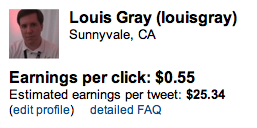
MyLikes Lets Me Select Available Advertisers And See Potential Revenue

MyLikes' attraction to me is the platform's ability to have people act as influencers in their community, promoting items and services that make the most sense for them, to their friends, and getting rewarded for spreading the word. It's something I do informally all the time as I praise some products and ignore others, and while I may not be the perfect target for this kind of affiliate model, others are finding the approach to be significantly improved, in terms of click-through rates and payouts, than standard keyword advertising.

Creating an Ad in MyLikes for Google Apps

The Ad, via MyLikes, Posted to Twitter

Ads on influencers' blogs or tweets or other social activity, which are hand-selected by the individual, carry much more weight than those selected by a generic ad network. And as Twitter has made a lot of noise around their own approach to revenue, enabling big companies to promote their services in the tweet stream, MyLikes lets the users benefit from similarly promoting exactly what they like and signing their name to it - extending beyond Twitter, but to blogs and other sites as well.

Given my history of not embracing off-topic advertising, I am looking forward to working with MyLikes to drive quality through the system. You can be sure I will be one of their more interactive advisors, and they will hear from me often.

DISCLOSURES: I am an unpaid advisor to MyLikes. I hold a small equity stake in the company. In addition, my6sense is a client of Paladin Advisors Group, where I am Managing Editor of New Media. My comments on the company's product are always independent, and do not pass their way in advance.

March 29, 2010

TheCadmus Hits Bay Area for Y Combinator, Twitter Boost

Since November, I've been talking to you about TheCadmus, a new tool that taps into your social streams to remove duplicates, find relevant topics and group discussions - one of many different services that is looking to improve the ability to find signal in today's noisy networks. TheCadmus is looking to make a name for itself in reducing clutter, and personalizing trending topics, including drill-down by lists. Now, the company is looking to take its personalization engine even further with a trip to Silicon Valley to talk with Y Combinator, the much-respected angel investment group, and a presentation later this week at Twitter headquarters to showcase what they have accomplished with the service's API.

The very acts of meeting with Y Combinator and Twitter are of course no direct correlation with success. TheCadmus is but one of 80 companies looking to impress the YC team with their story this week. A poor showing could send the two-person team back to Toronto empty-handed, with nothing but the experience to show for it.

I had the opportunity to meet with the company's two founders, Jay Air and Frank Wang, this evening, as we discussed the product's direction and its place in an online world where most of us are encountering too much noise. They told me the product's first direction, simply to group similar social updates and remove duplicates, led directly to more and more efforts around personalization. They told me that yes, it is a problem that many services are targeting now, but they believe they are approaching the problems in a new way.

Today, TheCadmus lets you consume updates from your social graph, but not communicate from them. For example, they're not a Twitter client. It's not outside the realms of thought that TheCadmus' API could be part of other Twitter clients looking to add new forms of personalization. I got the chance to take a few minutes with Jay Air to record a CinchCast explaining the company's plans for their short trip in Silicon Valley and what they would do with any potential funds gained from a Y Combinator investment. The discussion is embedded below:

January 29, 2010

Fabulis Scores $625k In Funding for Gay Community Site


Jason Goldberg's new startup, Fabulis, a new service targeting the lucrative, but potentially underserved, gay male market, announced the raise of $625,000 in seed funding today, the majority of which will be used to "build product". Fabulis' launch comes on the heels of Goldberg's success in building and selling Socialmedian to XING in 2008, which itself followed his work at Jobster, one of the more visible jobs and recruiting sites on the Web. The first round of funding came from the same supporters who invested in Socialmedian, clearly happy with their returns from the 2008 deal.

Following success with Socialmedian and Jobster, Goldberg sees Fabulis as a personal venture, about him and his friends. As he wrote me in an e-mail today, "If we can't get this right, we should just hang it up."

Fabulis' goal, in Goldberg's words, is to establish the site as the "definitive service that gay men around the world rely on to help them connect with amazing experiences." The company is planning to launch its Web site and mobile applications, for iPhone and other platforms, in the Spring, which will help site members to get tailored suggestions on "where to go, what to do and who to meet".

As has been well covered in demographic studies, gay men have a disproportionate amount of disposable income and discretionary time when contrasted to the general population. Goldberg and team look to tap into the $400 billion spent annually in the US alone by this group, and leverage the high amount of activity the demographic participates in for travel, online commerce, and early adoption. Goldberg's stats said that gay men are more than twice as likely to own an iPhone as their straight equivalents, and were also more likely to own laptops or digital video recorders.

Despite all this, Fabulis doesn't believe that there are adequate solutions online that help this market. Traditional travel sites do not target the gay male demographic, nor do restaurant listings, or other marketplaces, making the gay community rely more on word of mouth than any centralized directory.

Fabulis' focus may seem somewhat exclusionary to straight visitors or same sex female couples, but Goldberg thinks this focus will really give the site an advantage.

"Fabulis is intended for gay men and their friends. We are very focused on our target market," Goldberg said. That's not to be exclusionary, rather just to make sure that the site appeals well to our target user. This site is unapologetically for gay men," he added.

With such a massive growth in niche social networking sites focused on specific tasks, be that for credit card sharing, calendar broadcasting or location checkins, the opportunity to focus all the major social elements into a recommendation service for a lucrative demographic looks extremely promising, if it is done well. And unlike many Web services, Fabulis appears to already have a business model in mind that will make money - one that is "not just a straight ad model (pun intended)", Goldberg said.

After the successful launch to sale of Socialmedian, Goldberg is also doubling down on seeing how social relationships form and evolve in a community. He wrote me, explaining one aspect to the social graph that differs between gay men and the rest of the population:

"One really interesting aspect of gay male relationships that we're also spending a lot of time on is how the gay male social graph functions differently than that of the typical straight person," Goldberg said. "For instance, for most straight people, the social graph of who you know is enough. Facebook is really good at helping you share and discover things with your friends. But with gay men, it is often as useful to know what friends-of-friends are doing or recommending or where they are going. And, for gay men, even just knowing what everyone in your city is doing or gravitating towards is very interesting. So, that's an interesting problem to solve, how to make the big gay world seem a whole lot smaller."

And if you think the name is "Fabulis", you can tell the company is looking to have a good time building a "fabulis" product. You can get a "Fabulis shirt" just by explaining how you are Fabulis. The Fabulis blog explains.

December 09, 2009

Gowalla Raises $8.4 Million for Location Check-in Service

Much of the talk from LeWeb and other Silicon Valley get-togethers of late has centered around geolocation and the future of how geolocation is going to be integrated in social activity, search, advertising and communication. To date, the most visible company centered on geolocation has been Foursquare. But Gowalla, based in Austin, Texas, has gained significant traction over the last three months, and today, announced the completion of a Series B funding round for more than $8 million, bringing their total funding to date to more than $10 million.

According to the company's press release, Greylock Partners led the round, which will be used to accelerate the company's growth and enable future development.

Despite Foursquare's share of voice, Gowalla has managed to attract 50,000 active users, who have checked in at 150,000 locations in nearly 100 countries. Unlike Foursquare, which requires the service to support specific cities, Gowalla users can participate anywhere they are connected. Gowalla is available for both Apple's iPhone and the Android platform, and all this growth has taken place in only ten weeks.

In contrast, Foursquare raised $1.35 million in September of 2009.

November 16, 2009

Inefficiency of Interaction Driving Need for Social Leverage

"It is a complete joke how we interact with people on the computer right now," believes Brad Feld of the Foundry Group. With multiple devices and scads of Web services needed to consume information and engage with others on the Web effectively, Feld and other venture capitalists are looking for ways to fund the next generation of companies and products designed to leverage social connections, reducing information overload and enabling simpler collaboration in the enterprise. In a keynote panel at the Defrag conference last week, five venture capitalists explained how they thought they could help companies take advantage of social experiences that are being forged, which, if successful, could supplant the way we discover information today.

Today's Web is one that is largely search driven, leading to Google's position as both king and king maker. But Union Square Ventures VC and principal Fred Wilson said that much of the information we discover and the links we click on are coming through social experiences, instead of from search or navigation. Taking advantage of this activity woul be a logical extension for companies, and therefore, for VCs looking to enable it to happen.

Roger Ehrenberg of IA Capital Partners, whose fund is behind BlogTalkRadio, Mashery, TweetDeck, Bit.ly and many other services, said that despite advances, the Web continues to have a problem of finding relevant information, and identifying people who would be potential connections. Social leverage should enable you to tap into the knowledge of your peers to bring the information to you, at your own pace.

"It's an opt-in world, and you can let people in as they deliver information," Ehrenberg said. "When you look at all this information you are receiving, you need to build in filtering."

As I have often stated, I believe "there is no information overload", or at least, there can't be without your explicit permissions. Feld argued that the perception of information overload is due to individuals' approach to how they consume data, more so than an increase in total data.

"We are stuck with a rigid set of distribution models," Feld said. "You can be rigid or disciplined about one type of information, or you can let whatever comes at you come at you. The computer has to get a lot smarter about what to do with all that stuff, and it needs more adaptability. We are in an era over the next decade where there will be a fundamental shift."

Over the last 20 years, Fred Wilson has said he has already seen two major shifts in communication. In the 1980s, as he started in the venture capital business, events would lead to business cards, which led to hours on the phone chasing deals. The 90s brought e-mail and the ability to hit an estimated 10 times as many people. Blogging then let him reach more than 10,000 people a day, which he called "a different interaction model."

"I still see the deals I want to see and I can see better deals because of it," he said. "E-mail is a heavy interaction model, which is a lot of work, but a blog post is easy for me... I don't even use the phone any more."

Feld and Wilson have found ways to adapt to the changing dynamic to continue their efforts in business, but with so many others feeling an information onslaught, lacking proper filters to reduce the noise, this too sets up the potential for new solutions and new services.

"The biggest opportunity is the opportunity in the enterprise for social leverage," said Jim Tybur of Trinity Ventures, "There are tons of opportunities for that to permeate throughout business. There is a place where e-mail and social streams can coexist effectively."

October 08, 2009

Benchmark Capital's Twitter Gets Hacked to Hawk Plasma TVs

Benchmark Capital had a string of profitable exits earlier this summer, culminating in a big day that saw FriendFeed sold to Facebook and SpringSource acquired by VMware on the same day this August. The firm is among the most respected in Silicon Valley, and a leading name on Sand Hill Road.

That's why I was more than a little surprised tonight to see Benchmark's official Twitter account start to spout promotions for flat-screen TVs. Not only did it look fishy, but it was done "from API", while all updates on the account to date have been "from Web", which indicates that the activity took place automatically, and not by hand.


VCs Typically Promote Their Funds and Portfolio, Not TVs...

Whether one of Benchmark's multiple Twitter users accidentally clicked through to some phishing scam, or if some bot just managed to get lucky, is unknown, but it looks like the damage was undone relatively quickly. That there are malicious characters out there trying to hack into Twitter is no surprise, but it's always eye-opening when a big name gets caught. Maybe it's time they change their password.


To be fair, many other accounts look to also have been compromised by this "Free Plasma" bot. See Twitter Search for many more affected.

September 28, 2009

On Raising Money: Goals, Valuations and Pressure

For the most part, starting a successful business in Silicon Valley and having to raise money from venture capitalists (VCs) practically go hand in hand. Like most things here in the Valley, there are no guarantees. Raising $100 million doesn't guarantee success. Raising funding from specific venture firms with solid track records doesn't guarantee success. And, depending on the stage of a company's lifespan, raising money can be viewed negatively as much as it can be a positive thing. Meanwhile, if you're curious as to how much attention should be paid to valuations of private companies, well, trust me, that too can vary widely, depending on market conditions, momentum, founders' goals, and individual firm's enthusiasm.

Since starting my career in the Valley back in 1998, I've seen much of this process up close. I've worked at a company that once raised a $1 million seed round of funding, but I've also worked at one that raised $72 million in a single round - part of more than $200 million raised, thus far. I once saw a company I worked at close down because investors stopped funding outright, worked at another that found itself acquired by a big name tech firm months after I left, and also worked at one that filed, and later withdrew, its IPO bid. And while I wasn't sitting across the table from the VCs asking for their funds, in most cases, I certainly helped position each company in advance, and saw the effects each round played in the company's lifecycle. I mention this to add some level of background for why I thought to add my two cents to some of the discussion has been teetering in the blogosphere of late, especially following the news of Twitter's latest round of funding, rumored to be as much as $100 million.

Why would investors put money into a company to begin with? There are a few most-common outcomes:
  1. The company could later merge with another firm, or be purchased outright (M&A)
  2. The company could eventually go public and have an IPO.
  3. The company could remain private and be self-sustaining.
  4. The company could eventually close down, through bankruptcy or other means.
Of these scenarios, investors are most interested in potential M&A opportunities or the potential for going public. Obviously, investing in a company that will shut down is not a good way to use one's funds, and a company that has no real "exit strategy" but plans to meander forward, private and independent, will not provide the big returns hoped for by venture capitalists. In the reverse scenario, why would a company raise money?
  1. To gain initial capital to start the business.
  2. To gain capital necessary to expand the business, be it through marketing, human capital, new product lines, through geographical expansion, or even through acquiring other companies.
  3. To avoid running out of money and needing to close its doors.
  4. To obtain a level of valuation that sets a mark for potential acquirers.
As tempting as it can be for a company to raise the largest amount of funds possible, to have this cash available in the bank, the greater the amount raised typically also means the greater the reduction in control - as the company's initial founders see third party VCs take a higher percentage stake in the company. They may gain multiple seats on the board of directors, and gain influence that can be used to push the company toward one direction or another. Should they gain enough of a stake, it can be possible they end up pushing out the company's CEO or management team altogether, especially if expectations are not being met.

Thus, many entrepreneurs suggest a company raise as little money as is necessary to run the core business - and no more. In many cases, as soon as venture capitalists are involved, the pressure to reach stages one or two (M&A or an IPO) increases, and as time goes forward, or more capital is invested, the heat can intensify.

In parallel, if a company has determined it should raise a specific amount of capital, and has been fortunate enough to gain access to it, the preference would be to give away as little of the company as possible, essentially valuing the company at a higher rate than if more were sold for less. This valuation can be set based on the company's current sales numbers, its projections for the future, market competition, market dynamics and often, a combination of all factors.

Given this, if you examine the news around Twitter from last week, it has been written that Twitter sold ten percent of the company for $100 million, which valued the company at $1 billion. It has been said that Twitter raised the $100 million despite having a significant amount of money in the bank (up to $30 million) from its previous funds. So why would they raise now, and why this amount? Without having asked Ev, Biz and the team myself, you can see above just why now would be the time. First, the company, despite having little to no revenue to speak of, is in an incredible position. The service's growth over the last two years has been nothing short of phenomenal. Second, the company's internal projections, as we understand them, are aggressive - and third, many different news stories have shown practically all the large players in the Valley, from Microsoft to Facebook to Google, as having been interested in acquiring the microblogging company.

Similarly, we saw Facebook raise a massive $200 million in May of 2009 at a $10 billion valuation, following a $240 million round raised from Microsoft in 2007 that valued the social networking giant at $15 billion. Huge numbers on all counts, from the amount raised to the total valuation - again meaning how much would be needed to buy the entire company at that price.

For Twitter, raising the $100 million sets the company up to expand their business in terms of human capital and its technology infrastructure in a big way. While $100 million is not a bottomless trough of cash, it certainly helps. It puts the idea of the company running out of cash far out of the picture, and absolutely succeeds in driving the price higher for potential acquirers, should the service not be aiming to go public in the near future.

For Twitter's leadership, raising money now is a fantastic move. It's improbable that the company could find remarkably better terms in the coming months, and it sets in stone now where potential suitors would need to begin to even entertain discussions. Meanwhile, those investors who just ponied up the $100 million would want to see a positive return on their investment, and thus, would expect Twitter to hold out for an even greater number.

But once the money is in the bank, so begins the pressure. It may not be visible in three months or six months, but outside observers, and no doubt, internal participants are going to want to see plans for that cash, not just in how it is being spent, but in terms of how it will be converted, either into a large acquisition, be it to Google or another player, or if the company finds its way into reaching the public markets.

So what could go wrong? If neither of the above were to happen, and in parallel, Twitter were incapable of growing revenues to approach its level of expenses, the company would remain private, and see its cash balance decrease. Over time, as pressure grew inside the firm, they would be forced to raise money again - likely at a lower valuation, given reduced prospects, meaning the company would have to give up more to get less. You can see this often as you watch companies in the Valley go from the euphoria of their seed and A rounds, followed by less-enthusiastic B, C, D rounds and beyond. And if you hear about a "mezzanine" round, that's the one that truly, finally, should bring the company to break even, or catapult it into position for a near-term public offering. And if it doesn't, let's just say that's not good - as the "burn rate", the monthly expenses that draw down the company's finances, force action, and it won't be at a level the company had hoped for, especially after such lofty beginnings.

In the wake of 37 Signals' tongue in cheek press release that they were valued at $100 billion (with a B) following a brazen 1 dollar investment, one can scoff at revenue-light companies like Twitter saying they should be measured on par with public companies that have real revenues and real growth. But part of being a venture capitalist is that first word, "venture". It's an adventure. It's a risk, and a gamble, and one that relies on promises and potential. Twitter is worth $1 billion dollars, according to these investors, not because of what it is today, as strong as it is, but because of what it is in the future. Had Twitter chosen to sit on its laurels and not raise the money it did, at the valuation it did, the company could not expand to the level it has planned, and it would be at a much higher risk for potential acquisition, something they look disinterested in doing.

Ev Williams and Biz Stone, as well as the other Twitter employees and investors, know they are on to something. Be it vapor or be it real, the company has seized the minds of the Valley in a way unseen probably since the debut of Google on the stock market earlier this decade. Not even Facebook, who is larger and better funded, seems to be as visible as the scrappy San Francisco startup best known for its limitations - 140 characters. With $100 million in tow, the company is set to continue its growth independently, set to work on reducing its burn rate, with a much longer runway.

Meanwhile, don't let the nine-figure number fool you into thinking this is now a slam dunk. The valley is littered with companies that have gone this route. Procket Networks, which raised $272 million from VCs, sold to Cisco for $89 million in 2004. Caspian Networks raised more than $300 million and closed its doors in 2006. And that doesn't even get into the $800 million raised for WebVan or the $250 million for Kozmo.com in the headier Web 1.0 days. (See also: The 20 Worst Venture Capital Investments of All Time)

While we have seen the internal strategy of Twitter "laid bare" earlier this year, we won't be the ones spending Twitter's money, or staving off their burn rate. That's up to them, and up to their board. Gaining the $100 million on top of their preexisting cash horde was the right thing to do to potentially reward some of their founders, who may have sold stock in this round, and also to prop the company up and make it stronger against formidable competition. This Valley is more than just a hub for innovative technology. It's also home for some of the greatest wealth creation the world has ever seen. Now, we get to see, in public, how this particular investment plays out.

For more reading on this, please see:

July 15, 2009

Venture Capitalists, But In Text Form

On Monday night, during a blogger briefing, I struck up a conversation with Dave McClure (he being the Master of 500 Hats) around the process of blogging, and participating in those social networks where we have put our energy. And during this exchange I said something that I have long held as a driver for me, but hadn't yet quite articulated in this way - that as a blogger and technology enthusiast, be it for hardware gadgets, software or Web services, I sometimes take on the role of a venture capitalist, investing not my own money, as I have little, but instead, my focus, my words, and my time.

Venture capitalists are wooed constantly by companies looking to get off the ground, or to gain a push to the next level, be it greater visibility, higher market share, or profitability. And the VCs have to make a choice. Not having unlimited funds, they need to determine which companies, markets and individuals can get access to those dollars. The VCs, based on their own expertise, their analysis of the products' future, the potential market and the products' uniqueness, invest a percentage of their available portfolio, and then push to help make those investments a success - often helping to connect the founders with partners, customers, or providing guidance through board positions and personnel.

Similarly, whether as bloggers, social media participants or technology acquirers, we too are bombarded with choices. With limited funds ourselves, and limited hours in each day, and limited opportunity for attention, we have to make choices as to which products we will buy, which social networks we will embrace, and which companies' services we will use or cover. And while many bloggers aim to be as impartial as possible, keeping a journalistic line to avoid 'favorites', we all have a bias. And some of us wear our hearts on our sleeve, clearly choosing this route, as I told Dave, of being "venture capitalists in text form".

On Monday, Dave and I talked about the array of social networks vying for our time, and he told me that he had once tried to evenly split his time between a handful, but eventually focused on Facebook, LinkedIn and Twitter. While not shutting off his data flow to other networks, he simply stopped using them, picking up his chips and moving elsewhere. Meanwhile, in my role more as an angel investor (in text form) than a late-stage investor, I am more willing to make more aggressive investments in a wider array of smaller services just getting off the ground. And I will make those investments of my time, not always because I think they are going to be the most popular products of all time, but because I see they have the potential to be the best - even if I know that this potential means my bet is of higher risk, for my chosen solutions have a higher chance of closing and washing my investment away.

If you have read this blog for long, you will know that there are some services I really believe in - ones that I have selected based on their merits, and ones that I choose to invest my own time in to use personally, and to cover often. And should they 'pop' and become successful, leaving my little realm and moving on to the larger stages, like we saw with Socialmedian and TweetDeck last year, I won't get rewarded monetarily in any way, but am rewarded to know that I had some impact, and that I saw a real return on the investment to see people and products I invested time in have their success come to fruition. It's likely the same reason that Mike Arrington, at TechCrunch's 4th birthday party, which I attended, highlighted the fact that many in the room had gone on to make a lot of money since debuting on his blog, more than he focused on his own success. Even if he didn't gain monetarily directly from their success, as a VC (in text form), he had a member of the family graduate.

Not every investment will be a winner. Some of the products I've really liked (on paper anyway) have already closed. Some have flatlined or not gained the momentum I had hoped they would. But just like in the world of VCs, it only takes a few home runs to make the whole thing profitable. I'll keep writing and you watch where I invest my time and my words.

March 15, 2009

Is the Valley Too Expensive for Normal People to Launch Startups?

At a morning panel today at the SXSW Interactive conference, titled "Ditch the Valley, Run for the Hills", a great debate was struck between Penelope Trunk of Brazen Careerist and others on the panel, as she argued the high cost of living demanded by Silicon Valley and San Francisco pretty much excluded anybody from starting companies, unless they were 20-something single males. She argued the Valley's "coolness" and access to capital might not deliver enough benefits for shoestring startups trying to get off the ground. The issue of Valley costs was compounded by comments from Mike Maples of Hyper 9, who added his concerns that the state's financial struggles could see dramatic impact the standard of living many of us have taken for granted.

There is no question that over the last few decades, the Valley has gotten a disproportionate share of venture capital. In fact, Maples quoted a recent study that showed 90 percent of venture returns in the last 30 years went to companies founded within 10 miles of either Stanford University or MIT in Massachusetts. And panelist Robert Scoble, now of Rackspace, said the contributing reasons that the Valley attracted startups were three major factors, namely:
  1. Access to Capital (Drive Sandhill Road, see 10 VC firms and get your money)
  2. Scalability of Web sites (Access to people who have done it before)
  3. Tech press (From Mike Arrington and TechCrunch to other tech blogs)
But with the economy changing, and initial rounds for startups dropping from the tens of millions to only two or three million each, the panel said day to day challenges for start-ups could be even more acute, given the reduced access to capital.

Trunk, who is based in the Un-Valley, in Wisconsin, most directly said the process simply isn't doable for people who can't accept risk to their foundation, be it food or rent:
"There is an elephant in the room, about startups," she said. "You are starving and it is super scary, unless you have a trust fund or a previous successful company. In this economy it is very scary. We would have gone under in Silicon Valley because rents are high and there is no safety net in the Valley. Thunk how you can sustain yourself with food and rent before getting your business model."
She later added that only eight percent of companies seeking venture funding are from women, but most are from 20-something men who are single.

Maples, based in Austin, said he recently has been investing in local startups nearby Austin, partly because he would prefer not to travel, but he also voiced concerns about the viability of the Valley, given state budget problems.
"There is also the growing problem of local government," he said. There's a good chance the California government will go bankrupt. The services you take for granted now may not be there two to three years from now, be it education for kids, highways, police and fire support. The nice things you want could progressively change, and that's not true in Texas."
Issues in the Valley don't mean that the San Francisco Bay Area isn't attractive to new companies, of course. The Valley, offering access to capital, people, press and experience, can be an incredible pull. Scoble mentioned Loic LeMeur's Seesmic as one example of a company that moved from Europe to San Francisco and embraced the culture that enabled you to take risks, and fail. Noting that he himself had participated in three startups that have experienced failure, Scoble said Europe entrepreneurs aren't celebrated for their attempted success, but only for their actual success. And many of the panelists cited statistics showing that the venture capital-funded startup was a rarity, and the exception.
"In the valley, failure is accepted, and almost celebrated," Scoble said.
As with most topics here at the conference, the conversation also turned to Twitter. Could Twitter have been started or funded if it hadn't started in San Francisco? Almost universally, the answer was no. Maples even reminded us, "Twitter was a mistake."

February 11, 2009

Outbrain Gets Five Stars (And $12 Million) in Round B

While venture capital is said to be very expensive these days, hard to obtain, and with questionable potential returns given a closed market for public offerings and multiples for mergers and acquisitions, companies on the periphery of blogging appear to still be hot. We saw Auttomatic acquire Intense Debate late last year. You also remember strong funding rounds for my personal favorites, Lijit and Disqus, who are adding strong search and commenting functionality to sites like mine. Now, you can add Outbrain to the list, following this morning's announcement the company scored a $12 million round to expand its blog rating and recommendation platform.

Now, before you cry foul and ask where the money is in such a little widget, as is tempting, you can read between the lines in today's release to see that Outbrain has bigger plans - ones they no doubt shared with their VC partners, and not necessarily with me.

Outbrain is talking less about a widget, and more about finding great content across the Web. As one VC partner said, "Finding great content is getting both more difficult and more important... Outbrain's personalized recommended links offer great value to readers by combining their collective wisdom..."

If you think about it, Lijit and Outbrain are solving similar issues, from different angles. Lijit scours your personal blog and your social network of approved sites to find content you are searching for. Outbrain analyzes your individual posts, your previous blog entries and other blogs in their network to provide recommendations of what to read next. Both are useful, and both are getting traction. And it's good to see that good ideas are going to be rewarded, even when times are more difficult.

August 16, 2008

Is There Less Funding Or Are Startups Just Cheaper?

By Rob Diana of Regular Geek (Twitter/FriendFeed)


As an early adopter, I have an interest in startups. As a software developer and a developer of Web sites and services, I have additional interest in funding and the whole entrepreneur idea. Because of this, I tend to read a few "business" blogs as well as the usual technical fare. One of these blogs is A VC. Recently, Fred Wilson started writing a series of posts on the venture fund economics that is amazing. If you are trying your hand at a startup, I highly recommend you start looking at these posts. Just getting a fundamental understanding of the VC process is helpful in determining whether VC funding is worthwhile to your startup. In his Venture Fund Economics post he concludes with a very interesting point:
Some will read this and suggest that our business is all about swinging for the fences. But I don't think so. There are hitters in baseball, the best hitters in fact, that hit balls out of the park when they are just trying to make good contact. That's how you have to do it in the venture business. You try to make 20 great investments and you work with them closely in hopes that four years in you have six or seven that have home run potential, and after ten years, you maybe hit one or two out of the park. If you try to hit every one out of the park day one, you'll strike out way too much and the fund won't work out very well.
I think this logic can also be applied to startups in general. If you always try to do something that will turn out to be a home run, you will strike out too much. In the technology world, a home run would be a Google competitor, an iPhone competitor or even a Facebook competitor.

So, what if you are just trying to make contact? We have already heard in various places that venture funding is hard to get in general, and even harder in today's economy. Is this discouraging startups? Or are the startups focusing on the "major" technical hub cities? Paul Kedrosky must have been thinking this recently when he found that California is not a big entrepreneur state. Granted this is just an analysis using Google Insights for Search, but it does yield some interesting information. I was not enamored with the search terms that Paul used, so I tried a different set (entrepreneur, startup, venture capital and funding) and found some really interesting results.


Google Insight: Entrepreneur, Startup, Venture Capital and Funding

Interestingly enough, entrepreneur is not a big search term compare to startup or funding. Initially I thought this could be due to the generic nature of these terms, but the locations tend to match up with significant technical presences. As you can see from the chart, there is an obvious downward trend for all of the search terms. We can assume that this is due to the economy because if you read TechCrunch, Mashable or ReadWriteWeb, you will see plenty of Web sites getting initial startup coverage. In any economy like the one we are in currently, investments suffer and people invest less. Therefore it is likely that venture capitalists are being much more careful regarding what they invest in. Many people wanting to be an entrepreneur are probably taking less risks as well. So, we could be seeing a rise in startups being a weekend job until revenue or major funding becomes a reality.

However, some of these startups do require some significant money in order to operate on a daily basis because cloud computing is not free. Are people getting more angel funding? Following the same logic as the entrepreneur search, I compared the search terms angel investor and angel funding.


Google Insight: Angel Investor and Angel Funding

Here you can see that angel investor and funding have flat or slightly rising trends. Again there is a definite relation to the major technical locations and the "interest" of searches. Given the trend lines for the "angel" search terms and the comparison to the previously explained trends, it does look like there is more interest in angel funding.

Why would we be seeing this difference in trends, besides the economy? Well, many of the newer web services do not require major hardware infrastructure in order to get started. Cloud computing and even cheap hosting make the hardware investment something that can be put off until there is a true need. Using the cloud is also very cost effective initially because you do not need to hire a server or network administrator. This is all handled for you by the cloud provider. The cloud also gives you the ability to handle spikes in traffic signifcantly better than with a traditional hosting provider. Given these reduced costs, a good round of $100,000 of angel financing could fund a startup for two years. At that point, there could be real revenue being generated or even a venture captial funding round. Money is easier to raise when you are a somewhat proven startup compared to when you first start and only have a few thousand page views per month.

It looks like the combination of the economy, cloud computing and the generally lower technical barrier for new services is creating a new environment for startups. People are finding cheaper ways to get started. Startups are also using the existing information on the web to define more interesting services. So, what is coming next and where do we go from here?