Showing posts with label Quora. Show all posts

March 30, 2012

Writing for Social, Defending for Court


Earlier this month, I had an interesting experience, being asked to participate in a deposition, taking questions from a legal team as part of an ongoing case. While I’ll skip the details out of deference for confidentiality, there were aspects of the morning that serve as a reminder for those of us who participate online that often, content we post is permanent, and it can be discovered and used for means far beyond those we originally intended.

For those unfamiliar with the process of a deposition, it’s essentially when an individual is called as part of a fact-finding mission, to bring information deemed relevant to a lawsuit or other legal matter, outside of court. The individual being deposed, in this case, me, fields questions from an attorney, and those answers are recorded as on the record, as they would be in court. The questions can draw from one’s memory and experience, or can come in response to exhibits entered into evidence.

In my example, beyond questions about my knowledge and experience, I was presented with four exhibits entered into evidence. As is procedure, I was first asked if I recognized the exhibits, and after acknowledging I was familiar, I fielded questions about their content. The source of these exhibits was intriguing, consisting of:

1. The main documents related to the case, as one would expect.
2. My own LinkedIn resume.
3. A Google+ post I made in 2011.
4. Multiple Quora posts I made in 2010 on a single topic.

Seeing my own words come back to me, in a new and unexpected setting, was initially unnerving. No doubt when I set up my LinkedIn resume and ongoing work history, I didn’t anticipate it forming the background for how I would be qualified in the legal process. When I posted to Google+ last year, I didn’t anticipate mining a few of the paragraphs to confirm what I had stated was accurate. I certainly didn’t expect posts I made on Quora two years ago would later be entered into the legal record.

As I revisited my own words, I was comforted to see they were not only accurate, but mirrored my testimony and helped answer the questions. I was intrigued to see the mix of content coming from LinkedIn, Google+ and Quora as forming the exhibit summary for the case, and glad that my honest and direct approach to social networking meant I didn’t have to explain away any hyperbole, sarcasm or misdirection.

The morning’s events wrapped and I was left thinking about the mountain of content I’ve brought to various social networking sites in the last several years - from the blog to Twitter, Facebook, Google+, LinkedIn, Quora and so many other places, as well as the activity many of my peers are consistently producing. We’ve all heard stories about how posting pictures from a party or slandering your boss online can have real world impact. But as social networking content becomes the grounds for evidence in law, it brings up new considerations for seriousness on the web.

As one friend of mine, who has also gone through the deposition process before, noted when I replayed the events, “People who work for a large company, yet insist on saying crazy things, probably haven't been through a deposition already.” I would have to agree. That doesn’t mean lose your sense of humor and personality, but it does mean that if you do participate online, consider where the words could eventually fall. You might be surprised.

June 10, 2011

Quora Hits the Shuffle Button for Q&A Randomness

The stickiness of Quora for engaged users has been the ability to rapidly find discussions of interest on topics you've selected to follow, or from people you've connected with on the network. But while that alone can provide you with plenty of both information and entertainment, the question and answer service took a queue from services like iTunes, Tumblr and StumbleUpon by adding a Shuffle function tonight, which brings you to random pages within the site. Let the hilarity ensue.

The Shuffle button, which appears at the bottom of any question and answer page, has three options, including showing both questions and answers, showing only open questions which lack answers, or just showing answers. You can also get to a random Quora page by going to the dedicated URL: http://quora.com/shuffle. Quora cofounder Charlie Cheever credited the new feature to two Quora employees, Shu Uesugi and Tracy Chou.

Quora's New Shuffle Button In Action

You Can Select What to See When You Shuffle On Quora

Using the Shuffle feature brings you to a random page on Quora, on any topic, be they posted by friends of yours or not, in topics you may follow or those you don't. Like StumbleUpon, there's certain to be a high bounce rate of people scanning quickly and hitting the "Next" button to get the next Shuffle. But it does have the option to spring people out of a self-reinforcing echo chamber and being exposed to more serendipity. No doubt Marc Bodnick loves it. Start shuffling at http://quora.com/shuffle.

May 30, 2011

Quora Makes It Harder to Hurt People's Feelings

While Wikipedia is well-known for its edict against self-aggrandizement and editing one's own biography, question and answer collective Quora looks to be going quite a bit in the other direction, not just permitting people to manage their own reputation on the site, but to outright push for deletion of topics or questions they don't like. In a new policy issued late last week, the service says not only do they want people under discussion to automatically gain moderation of such topics, but any question that is "hurtful or mean-spirited" simply isn't allowed. So no more questions about why specific people are such jerks, you mean Quora-ites.

The policy outlines that it is intended to protect individuals fairly and equally, regardless of their public stature, so Mark Zuckerberg and Ron Conway have equal access as John Smith. Don't know John Smith? Well, he has as much a chance to defend himself on rude comments on the site directed his way as the next guy.

So why is Quora making this move? Is it to whitewash the site of any negativity? They don't seem to believe so, but they do recognize that some high profile users will use the increased ability to moderate, to "remove questions that other users would be interested in learning about," as Marc Bodnick adds, "We believe that this risk is worth taking in return for the benefits we achieve..." in line with the company's mission to create the "best database of human knowledge on the Internet."

While running from the world of libel and slander is laudable, one has to assume that negativity exists in both the real and virtual world, and it's possible that negative feedback related to individuals could be valuable, especially as the word "best" is so subjective. But their goal is to keep the content on the site relevant and valuable.

Oddly, despite focusing on equal protection under the rules, the change is clearly targeting the famous and semi-famous alike, closing with a hope that "Quora will remain a site where there is not much gossip about the personal lives of well-known individuals," as Bodnick adds, "Internet users have many other alternatives for this kind of content."

The move follows another controversial move earlier this month, when the site disavowed its initial position against self-promotion.

May 25, 2011

Quora Extends Mobile Reach With SMS Question Posting

Quora, the nascent question and answer site founded by a small team of former Facebookers, has expanded its mobile capabilities in the last week with the addition of posting questions by SMS, letting you interact with the service via text message, starting initially with US support. While remaining primarily desktop Web centric, this addition opens the door for mobile question posting for impulse queries, and mirrors the heavy reliance on SMS from another Valley high-flier, Twitter, who continues to count its texting users among the most active and most loyal.

Quora, true to form, has made the process of posting questions relatively simple, with single keystroke responses interacting with the system.

   
Once Confirmed, I Posted a Question to Quora on SMS


As with the standard product, Quora abhors duplicate questions. Ask a question via SMS, by texting your question to the Quora service (having first added your mobile phone via the site and confirming it on the handset), and Quora will ask you whether you want to follow a similar, existing question, or post the question net new. Not sure if your question has already been submitted? Just enter "M" for More, or click any of the numbers to toggle through (and follow) similar queries.

   
Quora Prompted Me to Follow Other Questions or Add It


I tested the service tonight, opting to start with a simple question.

I texted "What is the average lifespan of a beagle"?

Quora whirred into action, suggesting instead "What is the average lifespan of a blog?" and "What is the average lifespan of a race horse"? Opting for more got me "What is the average lifespan of a cell phone?" So there's some work to do. I changed the topic to be more tech-centric, where Quora has thrived, asking instead, "What is it like to be the CEO of a public company?". Unsatisfied with some of the preexisting questions, I just entered "A" to add my question, and it was posted.

   
Posting a Question about Being CEO of a Public Company Via SMS


Assuming you do post your question on Quora via SMS, they promise to extend the conversation in the same way. In a post introducing the feature, Shreyes Seshasai wrote, "When you select a question, we'll send you a summary of the top answer on the page, along with a link to the full question page so you can view it in your mobile browser. It's a quick and lightweight way to check answers on the site."

The Question Gets Posted to Quora As Any Other One Would


Quora has lofty aspirations. Making the product more mobile and pervasive, including this introduction of SMS support, will absolutely help. While I didn't find beagle to be the equal to blog or race horse, that's something the service will likely improve on with growth and more data being added to the system.

To find out more on Quora and SMS, check the initial post from last Thursday.

May 07, 2011

Quora Opens Doors to Self Promoters, Bias and Marketeers

Quora's differentiation from more established but less respected question and answer forums has typically centered around the quality of the discussions and those participating. It's not too infrequent that one finds the perfect person situated to answer a question pops up in Quora to take on challenging queries, from how companies started, to strategy and history. But as the site's grown in visibility, attracting more a wider swatch of early adopters, including social media marketers, there has been something of a tug of war between those looking to keep the site pristine, lacking self-promotion, and those who are hoping to leverage the site as yet another outlet for branding and positioning.

On Thursday, Quora's Marc Bodnick, famous for leaving Elevation Partners, where he is a cofounder, to focus on the site after gaining addiction as a user, posted that users are "encouraged to contribute helpful content about topics where they have relevant personal experience", which deviated from one original mission of the site to prohibit content that was considered "primarily self-promotional." As he put it, the old rules were too restrictive, that the quality of the answer trumps the objective the answerer may have had for posting, and that users with direct knowledge are invited to contribute. The ban on self-promotion could have potentially led those with direct knowledge, but continued vested interest, to avoid participating.

Marc Bodnick's Announcement of the Policy Change

While the floodgates are now open for any brand to insert a representative to start answering questions directly or tangentially related to their products, Bodnick reiterated that disclosure of affiliations (and therefore potential bias) was still required, such as whether you work for the company, are an investor, an school alumnus, etc.

While there is some debate about Quora's ability to cross the chasm to more mainstream users, it's clear there is significant potential in a high quality alternative to today's collaborative knowledge bases, without the relative anonymity and dryness of Wikipedia. Meanwhile, many people are extremely bullish on the company, given its objectives and its founding from well-respected early Facebookers, Charlie Cheever and Adam D'Angelo. See Wired: Does Quora Really Have All the Answers? for one particularly recent effusive take.

As Twitter, Facebook and LinkedIn all crossed the chasm from early adopter plaything to mainstream acceptance, brand advocates and marketers followed. Similarly, Foursquare has gained tie-ins with marketers and advertisers, while other recent tech hits like Groupon and Zynga have always been all about the money. With Quora becoming a magnet for high quality discussions, and the shackles being taken off self-promoters and marketers, there's a chance that one person's insight could be seen as another person's spam. The good news is that with Quora, the community's upvote and downvote capabilities might be able to keep the sleaziest of the gladhanders away and let the quality float to the top.

If you've represented a brand and to date, Quora's ban on self-promotion had you slinging your wares elsewhere, the game is now afoot.

April 01, 2011

Quora Tweaks Follower Emails to Include Avatars, Topics

Following in the footsteps of Twitter, Facebook, FriendFeed and other social networks, Quora updated its new follower notifications overnight to now include user avatars, the number of topics the users are following, and the topics themselves. Combined with the service's new approach of aggregating daily follows and posting them in a single email at 2 am Pacific time, one can quickly get a summary of user activity on the network and click to view new follower profiles.

There are other small changes to the follower notifications email. Instead of being labeled as "XX New People Are Following You", the connections are posted as "XX More People Are Following You", which probably is more accurate as it's not guaranteed that new followers are new to the system. Also, links to user profiles are not represented by machine-generated profile URLs containing random alphanumeric strings, but the more human-friendly "Click here to view User Name's profile".

The Old Notifications Email from Quora

The New Notifications Email from Quora

Minor changes to be sure, but much more useful than names disassociated with their photos and interests. It also could serve to help avoid people aiming to drive up their follower numbers through odd user behavior. It's possible Quora will start to show follower/following data and mutual connections as Twitter and others have done to deliver more social signals in the future. To show up in my email tomorrow, you can follow me here: http://www.quora.com/Louis-Gray

March 06, 2011

Quora Reduces Inbox Impact With Daily Follow Notifications

It's probable that a good number of the most-followed users on Quora have disabled or filtered many of the notifications from the site, including new followers and replies to posted content. With the site activity spiking in the last 60 days or so, follower notifications were fast and furious into the in box. Today, Quora appears to have reduced their tax on both users' in box and on their servers, in terms of delivering the messages, by capping the update at a single roundup per day.

Minor update you say? Not worth a blog post? Fine. Skip this one. But it's a trend I'd like to see other services adopt or offer as an option.

Most social networks, including LinkedIn, Facebook, Twitter, Foursquare and practically everyone, send you individual notices when a single user connects to you. In theory, you should have the time to scan the user's information and choose to follow them back - or just to ignore them. Quora's daily summary is welcome, and is very similar to the SocialToo daily follow/unfollow notifications that Jesse Stay has been offering paid users for the last few years. (Of note, I am an advisor to SocialToo)

My daily followers update from Quora

For me, after 3,000 or so follower notifications on Quora, it was nice to have absolutely zero updates between the morning of March 4th, and the wrap-up in the evening of March 5th. Now, if I get a minute or two, I can scan the incoming message for interesting people and dedicate time to this, rather than multiple interruptions per day.

If you've previously turned off notifications from Quora, or want to tweak the settings you have now, they've got extremely granular options you can access on your settings page. And if you want to be added to my following list in tomorrow's message, we can get connected here: http://www.quora.com/Louis-Gray.

February 25, 2011

Quora Promotes Rating Answers To Improve Responses

One of the biggest steps for Quora as it gains increased use and visibility outside of the Silicon Valley niche is to try and maintain high quality answers to questions despite massive scale. With traffic spiking after a few months of intense visibility, there's no question the site's team and assigned moderators can't be expected to separate the wheat from the chaff for every question.

For the service to succeed through scale, the Quora community will need to pull more of the weight, starting with providing explicit feedback for answers to questions, as those without any upvotes or downvotes don't deliver feedback to the system, and are orphaned.

A New Button Awaits You In Quora

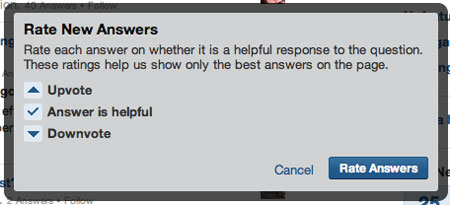
Quora recently added the option to "Rate New Answers" in a prominent place on the service's front page, to the right of the Q&A feed. When I visited this evening, I found 25 answers, which had not yet been rated by the community, waiting for an upvote or downvote from me.

Quora Reminds Me Why Rating Answers Is Good for Us All

If you do click to rate new answers, Quora says you are doing your part to help the best answers be discovered. When one is rated, click Next to rate another, until your batch (my 25) are completed. Assuming a good amount of the population rates a solid number of answers, the likelihood that answers will lay fallow without any feedback will be dramatically reduced. If the quality of the upvoting and downvoting remains strong, it's another explicit signal that will help Quora maintain high value.

Getting Started With My Rating Process (and a Guide to Choose)

Keep in mind that while it may feel like community service, those you do upvote will be listed in your Quora site activity, so it's not exactly invisible. If you're someone who wants to keep your activity feed pristine, on topics you've sought out yourself, you might want to not participate, but that'd be a little OCD now, wouldn't it?

January 31, 2011

This Valley Bubble is Not of Valuation, but Optimism

Having worked at startups practically my entire adult life, with more than 12 years in Silicon Valley, I distinctly remember the hallmark elements of the dotcom rise and fall, the rise of Web 2.0 companies and the fizzle of most, and I am seeing people talk again in similar ways about whatever state we are in now - with an almost giddy eagerness of people to claim that a world with skyrocketing valuations for companies like Twitter, Facebook, Groupon, Foursquare and Quora is one that is a bubble. I don't think that this is the case. These elite private companies are possibly fairly valued, much more so than the vapor dreams of years past, and the very real disconnect is in fact, more closely related to the Valley's separation from the outside world, one more fraught with concern and continued pessimism following exposure to the world's most dire economic crisis in generations.

In the late 1990s, as most of us know, companies with almost zero business plan were going public on pageviews alone. Companies that measured Web statistics, like Media Metrix, were turned into rockstars, vying for time on CNBC. Even Media Metrix itself filed to go public in early 1999, raising $51 million in an IPO, eventually trading under the ticker symbol of MMXI. There were stories in the press of companies that filed to go public on the very day their Web sites were announced. Many companies were public entities despite never having turned a profit at all.

In parallel, companies that had plans of going public could easily command double digit million dollar raises. The company I joined in January 2001 raised $72 million at a valuation of more than $350 million, on the hopes of a strong beta plan at customer sites. The company eventually raised more than a quarter billion dollars, including subsequent $47 million and $29 million chunks during tougher times, and is still out there, not having gone public or having been acquired, despite a false-start $100+M IPO filing ourselves back in 2007.

That world is much different than what we have now. Facebook and Twitter and Groupon, all valued in the billions of dollars, are the exception, not the rule. Facebook and Groupon are both suggested to be potentially in the billions of revenue already, and Twitter has established itself as a household name with a morphing business model. Meanwhile, even my wife has seen value with Foursquare coupons and loyalty programs, and Quora is getting incredible visibility with early adopters, becoming a potential top property for the future.

Below this lofty echelon of companies, I am not seeing the bubble-like activities that have marked years past. Funding rounds are usually being announced in the single digit millions, or less. For every big investment from Digital Sky Technologies (DST), startups are fighting for their first $150k at Y! Combinator. I have spoken to many small companies who are finding today's angel investor climate challenging - where good ideas are competing with other good ideas, and wallets are tentative. But the optimism remains. Maybe rounds that took weeks to months to close in the past can take six months or more now, and maybe valuations are lower and total amounts raised are less high, with real revenue and profits being required.

Meanwhile, as we debate valuations and revenue, world news is still difficult. On a recent drive home, the hourly news talked about record high gas prices, and potential inflation - offset only by continued high unemployment, which helped to keep costs down, with demand being down as well. This news was followed by comments that unemployment numbers were making progress, only because many long-time job seekers had given up. Next, we heard from continued depressed home prices, and high foreclosure rates, with the state of California possibly needing to file bankruptcy, assuming drastic measures would not be taken to get back into the black after years of overspending versus tax receipts.

The dramatic disconnect between our debates of rockstar founders and infighting for designers and developers versus doubling class sizes, tax hikes, unemployment and home losses is a much bigger issue in my mind than that of assumed valuation issues and any "bubble." I don't think there is a bubble. Not like before and not out of control at all. Facebook is growing a tremendous business, as is Groupon. Twitter is just behind. LinkedIn was patient, and now has revenue of greater than $160 million a year, before filing to go public. This is no bubble. It's a new tougher reality. But we can't be blind to the world outside us which continues to struggle.

January 24, 2011

QuoraTop Ranks the Most Followed Quora Accounts

The second-most popular activity on the Internet (ego stroking) just got yet another site. Silicon Valley's latest flame, Quora, the increasingly popular question and answer site founded by a team of former Facebookers, deliciously displays every user's follower counts, as well as the number of times they are mentioned, on each profile. With such numbers flowing freely on the site, it was only a matter of time before a smart coder found a way to rank the top users and post a leaderboard. First to the game is QuoraTop, authored by Gri.pe's Matt Mastracci, which polls Quora daily for users' following counts and shows who's garnered the greatest following.

Spawned from the popular Quora thread "Which Quora users have the most followers?", which to date has been tweaked manually, often by the same people being included in the list, eager to climb the Q&A social ladder, QuoraTop shows few surprises among the top followed people - which often correlates more closely to their visibility from other networks and previous job history than their supposed activity within the network itself.

The Top 3 Non-Banned Quora Accounts

Top users, as shown by QuoraTop, have names well-known to the Silicon Valley digerati, from Robert Scoble, Ev Williams, Kevin Rose, Tim O'Reilly and Jason Calacanis to Mike Arrington, Leo Laporte, Loic LeMeur, Biz Stone, and Daring Fireball's John Gruber to round out the top ten, with just under 7,000 followers. Scoble tops the list tonight with 16,686 followers, about a 10% conversion rate from his follower count on Twitter. Quora cofounder Adam D'Angelo enters at position #20 with 4,433 users, just ahead of the first woman on the list, Laura Fitton, who hits the #21 position. Tara Hunt is #26 overall and Gina Trapani is #37, three women outnumbered by men more than 10 to 1.

Quora's top followed users include popular founder CEOs including Ev Williams, Loic Le Meur, and Dave Morin, fomer CEOs like Steve Case and Craig Newmark, and of course, VCs like Marc Andreessen and Dave McClure.

If you look closely, you can see the aftereffects of Twitter's suggested user list bringing many followers to less-active users of the site. It's widely assumed that once celebrities with their millions of fans on Twitter start to also use Quora, the digerati could be swamped by Hollywood, but it's early days.

Dare to stare at the numbers and see if you're on the Quora leaderboard, or if you've missed anyone? Check it out at http://www.quoratop.com/.

January 17, 2011

Quora's Momentum Continues, Driving Intrigue, Curiosity

Quora, the red-hot question and answer service sprung from the minds and keyboards of a small group of early Facebook employees, continues to see dramatic growth, sustaining a near-fever pitch that was kindled just prior to the new year. While off its all-time traffic peak, with subscription notifications ebbing for most folks, but remaining high, people are still trying to find out what role Quora fits in their Web consumption ecosystem, and what role they may want to play.

Last week, I gained the opportunity to sit down with Brian Remmel of Social Media Club Silicon Valley to talk about what has made Quora intriguing for tech-focused early adopters, who have generally shied away from mainstream question and answer sites. For me, the site has been most intriguing to take a passive view, watching primary sources share their unique insight. Not aiming to draw attention to myself, my answers have been sporadic, aiming to add value.

While there have been some concerns about the site's quality decreasing with the influx of traffic, for me Quora will provide solid value so long as the top-ranked answer is exceptional. The rest of the answers, from the casual to humorous to incorrect, should be taken care of by the community or moderators themselves. You can follow me on Quora at http://www.quora.com/Louis-Gray.

To read the great summary from Brian, see: Social Media Club: Will Quora find its place among the stars? or my previous comments on Quora: The Quora Phenomenon - Peaking on Value & Authenticity.

The full interview (in audio) is embedded below:


Louis Gray on Quora 1-11-11 by bremmel

December 31, 2010

The Quora Phenomenon - Peaking on Value & Authenticity

Unless you've been completely logged out of all social networks, taking the post-Christmas week off as part of a tech detox, you have no doubt bumped into discussion of Quora, the red-hot question and answer site that has taken Silicon Valley by storm. Already an intriguing site that has seen well-respected people who do not typically participate on Q&A sites answer probing and provocative questions about their current or former businesses, the site has seen an explosion of new users, spawning an ever-growing array of discussions on practically any topic. And unlike the more mainstream Q&A sites, which have decayed into primary sources for jokes exposing the vacuousness of the below-average American, quality so far has remained strong on Quora, spawning hopes that this time, the formula is done right.

The mission of Quora is a simple one, theoretically, stated as a continually improving collection of questions and answers created, edited and organized by its users. This makes it share some commonalities with Wikipedia, with the community self-policing what answers are correct or incorrect, through voting them up or down, be it due to the users' identity or the value of the answer itself. The more accurate and transparent the answer, the more likely to be accepted by the community, of course.

Some of the Answers I Voted up on Quora

The site has been especially interesting for Silicon Valley insiders, who have used it as a forum to ask advice on fundraising, how to operate in a startup, or ask investigative questions about companies' origins. The seeming exclusivity of the site, where top bloggers, entrepreneurs, VCs and business people are interacting with the same people who enjoy their products has been extremely attractive - especially when they truthfully answer burning questions we've all had.

More than a year ago, I said that any successful social site needed to nail three points, namely: Technology, Community and Relevancy. Quora has delivered on all three, rapidly tying people to relevant topics, connecting them with people from other networks or just within the site, and providing an intelligent platform that helps surface quality.

One of my Answers on Quora

The attention to quality is especially critical for Quora. The community's ability to edit questions or answers manages to keep discussion accurate, while logs are kept for each edit, so one can see if responses are being redirected. Answers can be voted up by the community, and it's clear who is doing the voting, providing another layer of authenticity to the service.

Another big value for Quora is the return to long-form discussions. In a world of Twitter and Facebook, where discussions are measured in character counts, Quora's rich question and answers, complete with nested replies, seem much more fulfilling. Robert Scoble called this an ingredient of major blogging innovation, which helped kick off the spike in users, but even if it's not revolutionary, it's great to see more in depth discussion than abbreviations, hashtags and @replies.

Where I have heard people express concern about Quora is what could happen if it breaks into the mainstream and becomes diluted as sites like Yahoo! Answers have, suffering from the chatroom phenomenon that doomed other sites targeted toward casual discussions. Safeguarding Quora from this is the use of one's real identity, connected through Facebook or Twitter, and the community's ability to downvote or mark as "Not Helpful" responses that don't pass muster.

(See also: Skeptic Geek: Is Quora Becoming What Google Buzz Should Have Been?)

What I think is more risky than more people jumping into the fray is people simply declining to participate. The site is gaining huge value today from people candidly and transparently providing good answers to sometimes tough questions. If they choose to stop, putting a rein on the openness, the value can be lost, meandering into a world where users simply discuss products or trends. It may also simply be at the peak of its Hype Cycle, before falling into Gartner's famed Trough of Disillusionment. But this feels a lot more sticky than a fly-by-night idea. The site is becoming a valuable repository for insight into people and services, and each discussion smartly leads you to new people and new related topics, helping keep your interest level high.

Without falling into the real-time sieve that can drown casual users of sites like Twitter and FriendFeed, Quora does maintain the feeling of newness. The site's front page shows notifications for activity on your network or previous history, and shows trending people and topics. If there's something going on in the site relevant to you, it has a good shot at finding your attention - without seeing items fall from the top in a never-ending waterfall.

The Quora Front Page, With Recent Activity

I've recently used Quora to discuss the popularity of Google Reader, why people still use FriendFeed, and why my6sense utilized implicit behavior to rank content. Many others are dropping interesting questions and receiving interesting answers.

I am hoping the site does not become yet another place to count followers and connections, but the numbers are going up. You can find me on the site here: http://www.quora.com/Louis-Gray.