January 02, 2018

Why Silicon Valley's Real Estate Crisis Is a Present Danger

This nice home would probably go for $2 million in some Bay Area cities.

That Silicon Valley housing is very expensive is no surprise to anyone who is paying attention.

Fueled by a bullish tech market for the better part of a decade, with inventory dramatically constrained, each new home entering the market can be flooded with aspiring buyers who are eager to pony up millions of dollars for uninspiring homes, with the desirable promise of reduced commute times to big tech companies or startups, or access to high quality schools.

As a homeowner who bought our place in 2010, I could be doing victory laps about perceived value increases each time I view Zillow or Redfin to see how our long-term investment is doing, but the harsh reality is that the daunting financial demand needed just to find a place to live is having a dramatic impact - not just on the Bay Area as a region, but in markets far from our tech epicenter.

Prices in secondary markets outside the Bay Area are skyrocketing as distressed Californians seek alternatives. Working class families are being priced out of the most desirable cities, forced to endure hours of commute times from far-flung outlying towns, or losing their homes outright. Some small businesses are closing because they can't afford the lease, or can't find enough help to keep their business running. Help wanted ads for service workers are visible practically everywhere, and few answers are clear, aside from pushing for more housing, which in itself finds opposition from the slow to no growth community.


The topic of Silicon Valley real estate is ever present. The high entry point presents a barrier to tech workers looking to start their careers. It presents a challenge to new families in high priced rentals who may once have expected to save for a home, but see that opportunity get further out of reach each month, as savings never catch up with price inflation. Others living outside the Bay Area may turn down career opportunities because the promised salary and benefits can't deliver an expected standard of comfort. It's happening, and it's very likely to get worse.

About two and a half years ago, I read the tea leaves and talked about how I saw Sunnyvale as being in an enviable position, flanked by Google and Apple, both of whom are aggressively growing and are significantly profitable, helping to drive up demand for homes and attracting well-paid tenants. That post, "Tech Company Shifts Position Sunnyvale as Major Hub for Next Decade", helpfully marked some median home prices at the time of the article and allows us to compare what's happened since.

While Bay Area prices have increased, Sunnyvale and Mountain View lead.

As I had expected, not only have home values continued to spike on the San Francisco peninsula, but pressure from Apple's new campus, built on the Sunnyvale border with Cupertino, and increased growth from Google and LinkedIn, etc, have pushed Sunnyvale prices higher at a rate that dwarfed even its pricier neighbors, and driven average home values to nearly $2 million. You also saw a similar rise in Mountain View homes, where Google is based, but Sunnyvale has practically caught up.

What this means in real-world impact is that homes purchased just a few years apart, on the same street, can have wildly different purchase prices, monthly mortgage payments, and property taxes. Our neighbors, two doors down from us, recently paid more than twice the price for their home than we did in 2010, even though theirs is smaller. And they'll get nailed with twice the property tax to boot - their gift from the state of California.
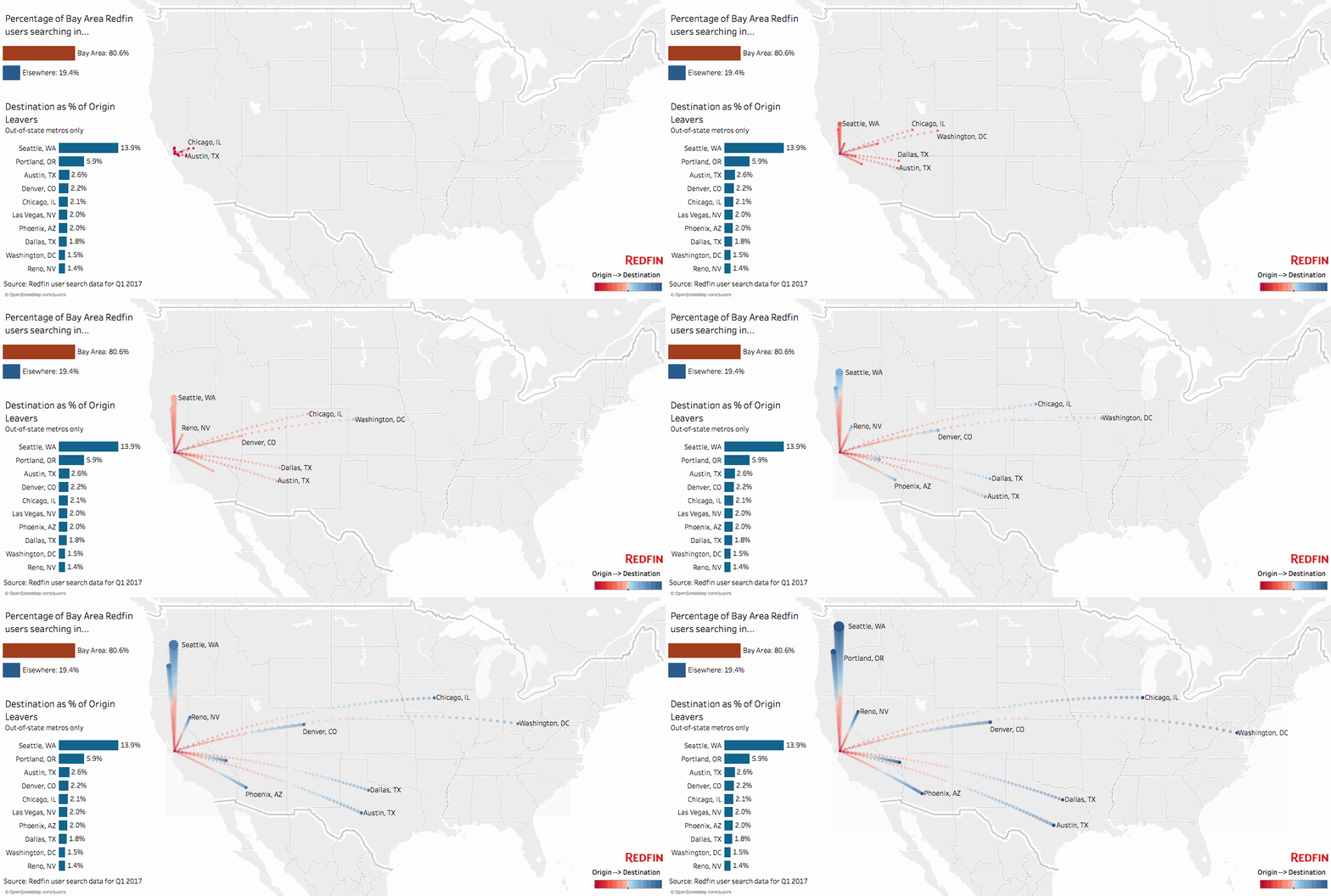
Redfin highlights migration patterns out of California. (Source)

For those who can't stomach a $2 million price or higher (and that includes us, by the way), buyers are looking elsewhere - to Seattle, Boulder, Austin, Portland, or even Washington DC, for alternatives. Seattle's home prices were up 16% in the last year alone, largely driven by migration out of California, which impacted the entire country. And while prices went up, more people were sent to the street - which has led to a spike in homeless deaths in the highest priced cities. (Source)

As I mentioned yesterday, the majority of children in school districts near Facebook headquarters are homeless. This is a new and growing crisis. Low to middle wage earners who can't afford to buy homes here are living in their cars and RVs. I see many of them when I walk the dog at night and recognize familiar faces who are just trying to make it to the next day. Even as Sunnyvale and other cities nearby are raising our minimum wages to $15 an hour, that is not a sustainable wage that can cover high rents that continue to grow. And there is always resistance from NIMBY (Not In My Backyard) neighbors who enjoy the high home values, but want to avoid rising traffic, taller buildings and crowds that come with job demand. Add on to these issues competition from foreign money like China, where many area buyers come from, and you have a recipe for disaster.

Silicon Valley's successes have had incredible impact on the world and the region. Some people have gotten obscenely rich from company successes and acquisitions, and have the option to buy these multi-million dollar homes for cash, or dual income couples with big bank accounts can float enough to solicit high bank loans to get there. But traffic on area streets is consistently thick as people drive further to daily routines. Highways are jammed as badly as Los Angeles - and commutes are worse.

California is where you look to see the future, from our inventions, to our forward thinking governments and social acceptances. The Bay Area is where you look to see what is coming to metropolitan areas throughout the country, and perhaps, the world.

Our high prices today are yours tomorrow, and we're erecting a massive "No Vacancy" sign to those who aren't here yet. Good luck to us all.

January 01, 2018

Silicon Valley's Lost Year Blends Fake With Future


At the beginning of last year, as the Trump presidency sickeningly took hold, I worried his mere presence and daily volleys against what most of us thought to be good and proper, right and just, would dominate our every thought and conversation. His long shadow of darkness constantly loomed against any chance of progress and invention - taking the luster off usual excitement, demanding an unrelenting distraction, and regular dread.

I pushed pause on the blog because I felt like my comments on the day to day in Silicon Valley carried less weight in a world of crisis, as politics overwhelmed the usual storylines. But I realize silence is not the answer. Instead, we should ask more of ourselves when the wind is not at our back, but against us.

So what if we can make cars to drive themselves, only to find our streets hit by long-range missiles? So what if we could make it easier to connect people together on the Internet, all while seeing people turned away at the entrances to our countries, and see laws enacted that pitted people against each other in ways that we found abhorrently racist fifty years ago? So what if somebody could sprinkle some magical Internet dust on cryptocurrency and make a handful of desk jockeys rich (on paper), when trillions of real world dollars were being extracted out of the lower 90 percent of earners from an egregiously unequal tax bill jammed through congress, with chicken scratches in the margins?

It all seems pretty foolish sometimes, as we banter about over variations in cost per click on banner ads when retail supermarkets are going out of business and laying people off. It seems ridiculous that customers can debate the benefits of the latest food delivery startup when US senators openly debate eliminating food stamps for those who need them. And you can't get all that excited about meal replacements like Soylent and the highest tech juice squeezers in all the land when there are people just miles from the most valuable companies in the world who can't afford to both live and eat.

Remember "Everything's Amazing and Nobody's Happy?" Well, not only is the guy telling that story now tainted with his own awful reality, but not only is nobody truly happy, but there's a lot of crap that isn't amazing.

Nearly 60 percent of children in the city of East Palo Alto, buttressing Facebook headquarters in Menlo Park are homeless, victims of skyrocketing housing prices. Families have stuffed themselves into RVs, only to be told to move along, in Mountain View and Palo Alto, home to $3 million average home prices, bordering Google and Stanford. And yet, the big tech companies keep hiring, while Bay Area cities don't even come close to keeping up with the housing demand.

The Uncloaking of the Alt Right and the Me Too Phenomenon

As for those tech workers who have managed to find a way to live here? 2017 was a mess. Along with an emboldened racist and sexist wing in the Valley, with a new hero in the White House, and a self-promoting ex-Google engineer having penned a hateful screed that cast doubt to his colleagues' abilities solely due to their gender at birth, we also managed to get pummeled by regular news alerts to who the latest scumbags were who mistreated women and thought they could forever get away with it.

What a disaster to see people I considered friends in years past - like Robert Scoble and Dave McClure, to find some of their seedy behavior exposed to the world, and know that's just the tip of the iceberg, as others who have made sport of inappropriate behavior a practical part-time job are legion. While I am very glad to see that it seems, finally, women are being believed, and men are admitting they screwed up, it will take generations to see our workplaces truly be welcoming places for everyone - if it is ever to be.

(Time out: What a f---ing disaster Robert's non-apology post turned out to be. I was stunned at how bad it was, when the easiest thing to do would be to admit guilt, admit to being an ass and promise to work on making things right. I was horrified when I saw it...)

Bitcoin - A Bet or a Con?

So what did our best and brightest minds tend themselves to, instead of taking on hard work and pushing back on the vacuous fact deniers running the place? Many of them took to gambling their life savings on shiny internet tokens and watching prices rise like addicted penny stock chasers - making their own lingo, and debating the basis of specific coins, as if there were any real value in it - besides to get rich, and quick! Thanks for nothing, crypto nerds.

I'm old enough to remember the first dot com boom, with its own fake money games - Beenz and Flooz, that made up their own online currencies, only to go bankrupt at the first sign of weakness. At risk of being the last person on the crypto train, spare me the spam messages and emails and tweets, and please, get back to work. There are too many things you could have done with your time that helped the world, like we are supposed to do.

I apologize for my irregular notes here. When the Valley is really humming, and working on important tools and exciting ways to help us all learn, communicate and share, that's exciting. I see those flashes of brilliance, where I am, at Google, more than I tell you. But I worry many of the trends we've seen that reward bad behavior have become so entrenched, that the real value is being absorbed by the funders and the funded, more than the users. We have to share or the backlash will be stronger than we've already seen.

January 30, 2017

Your Steady Stream of Tech News Will Continue When Morale Improves

The Web always promised to bring people together. But just as simply, it can drive people apart, as geographical barriers or partial or full anonymity empowers people to say things or behave in ways they wouldn't in a direct setting.

Accelerated by the new reality of realtime streams where everyone has a megaphone and seemingly everyone is working to "go viral" and make the biggest noise leads to a constant cacophony of shouting on the issues of the day. And of late, as I outlined in my last post about Trump's looming $100 billion productivity crisis, just about every stream and news source is dominated by politics and the impact to people by political decisions.

For those opposed to the Trump team's way of thinking, the daily barrage of news and rumors can be fatiguing. Each morning can bring new horrors of gut-churning policy and more needing to escalate to fight back. This weekend's sparked crisis stemming from an ill thought out and very likely racist and illegal refugee travel ban saw rallies across the country and millions of dollars raised to flow into the coffers of charities aiming to help, like the ACLU. (I too donated, and my company has promised to set aside millions to help.)


As colleague Yonatan Zunger warns (and you absolutely must read his post), we will likely hit a wall of outrage fatigue. If there is a steady stream of controversial news that impacts us, or people we know, or people we are tangentially fond of, we will run into capacity limits to be angry and to be heard, as the calamities run into each other. But even if that occurs, that doesn't mean we can act as if nothing is happening at all.

I've already seen people yearn for the good old days when we could debate data portability, site aggregation, text editors, or even which mobile OS is the best. But at a time when people's lives are at risk, and foundations we expected to be stable are proving themselves unstable, having a row about the latest geek gadget seems out of place.

It's not that we didn't see this coming. Back in 2006, an ancient eleven years ago, I knew we would see the web accelerate people's disagreements. People want to flock to their tribes, where others agree with them, and the opposite side can seem evil, foolish or subhuman. Most of the time, they're not - even as their words are alarming and frightful. We knew when people had an opportunity to polarize one another and their beliefs, they would. And every study shows this - including our unprecedented divisions in government, globally, nationally and locally.

We can use the Web to rally together and raise funds and awareness for our causes, and we will. But while I'm excited to see the deep pocketed among us excitedly match donations, a great chunk of society is living paycheck to paycheck, and the access to discretionary funds to hold back the government, an institution that is designed to help them, is simply going to run out.

Until we reach some level of stability and understanding with one another, and are out of a crisis mode, you can expect the 'all politics all the time' streams to continue. Mild apologies.

January 20, 2017

Trump's Looming $100B+ Distraction and Productivity Crisis

Each year, American businesses are confronted with estimates that upwards of $2 to $4 billion in worker productivity is lost thanks to employee office pools around March Madness, the month-long college basketball championship tournament. Conventional wisdom has it that the tens of millions of players may physically check in to the office, but mentally are somewhere else, working at half speed, sapping dollars from their employer.

That single digit billion dollar gap is trivial compared to what the country has likely already seen after a year-long torture test of a presidential campaign, followed up with the looming tenure led by a person whose unpredictability and lack of respect for historical precedent, combined with a filter-free ability to share his half-formed thoughts with the world has everyone guessing what headline will flare up next.

The fidgety and distracted half-attentive employees in corner cubicles who may have been pulling for upset picks to win their bracket are instead replaced by entire teams of workers who are on edge - possibly unsure whether their place in the world is safe, whether their rights are going to be protected as new leaders rewrite and repeal the laws, or simply numb and horrified from the scandal of the day. And, if the 2016 campaign and post-election news cycles have been any hint as to what's to come over the next few years, this feeling, resembling post-traumatic stress disorder, will be felt in some capacity for a large percentage of the population for some time.

"Sharon, you've been watching CNN for about 8 weeks now.
Don't you want to watch something else?" -- South Park

If it's at all possible to act as if politics were not part of this discussion, leaving aside my strong support for Hillary and revulsion to Trump... putting aside the real life-threatening possibility that he and his team will ignite wars, stir up hatred against people who don't match his criteria of perfection, and the domino effects of reducing health care for millions and denying environmental impacts that threaten the very world... the very spectacle of distraction alone will seep in its darkness, sapping morale and focus.

The volume of noise and conflict around Trump is unprecedented in a connected age, when everyone can consume and share information instantly. And while Twitter has had its challenges, it has become the epicenter for the latest volley of noise from the president elect. Buzzfeed recently said noise around Trump had crested 10 times higher than the previous first family of the network -- the Kardashians.

At this point, even logging in to a social network, be it Facebook, Twitter or any other, runs into the possibility someone is talking about who Trump might be or what he might do. The campaign even brought the debate of whether you could trust news sources to the fore. The entire Web is infested.


Conversations among friends, neighbors, and colleagues either tiptoe around the election or confront it head on, but it's always there, in the way the tragedy of 9/11 was on everyone's mind for the months and years following the attacks. It's a distraction not just for a few hoops jockeys or degenerates, but for tens to hundreds of millions of people, and won't just last a month, but, most likely, for years.

Maybe this administration isn't going to be as alarming and disruptive as we all predict. Possibly after we all look at this like passing a smoldering wreck on the freeway, we can continue forward, but the rhetoric and policies promised to hit us seemingly have us positioned for a half decade of PTSD, which will impact everyone. This madness won't end with a buzzer beater from Gonzaga.

Disclosures: I work at Google, a perceived partner and occasional competitor to Twitter, which I use constantly. I was also more than happy to donate to Hillary's 2016 campaign.